If you are a follower of this blog, especially if you are a fellow preacher, then I would invite you to follow and visit my new site: Thepulpiteer.org
My own sermons will continue to be posted here, but theological reflections and practical advice on the art of preaching will be posted over on the Pulpiteer. Please check it out and sign up to follow it!
A year ago a company called the Barna group released the results of a survey they performed among US protestant pastors. One of the questions that pastors were asked was this: Have you given real, serious consideration to quitting being in full-time ministry within the last year? Real, serious consideration to quitting the ministry. The answer: 42% said yes. 42%. Close to half. And what is remarkable is that that number had jumped up 13% from the last time the survey was conducted only a year before. What were the three main reasons these pastors gave for wanting to quit? The immense stress of the job, feeling lonely and isolated, and current political divisions.
Now I am not sharing this with you as any sort of plea for sympathy, because although this job is a lot more stressful than many people realize, there are plenty of people who have stressful jobs. And I am not trying to scare anyone into thinking that I am a part of the 42%, because I’m not (let’s be clear), but I do understand the temptation to quit and the frustration that pastors go through. I get the stress, and the isolation, and the exasperation at the maddening, ridiculous politicization and polarization of everything right now. I get it, but none of those things are new. Stress isn’t new; isolation isn’t new; and political division isn’t new. And the temptation to quit serving God isn’t new either, and the clergy aren’t the only ones who feel it.
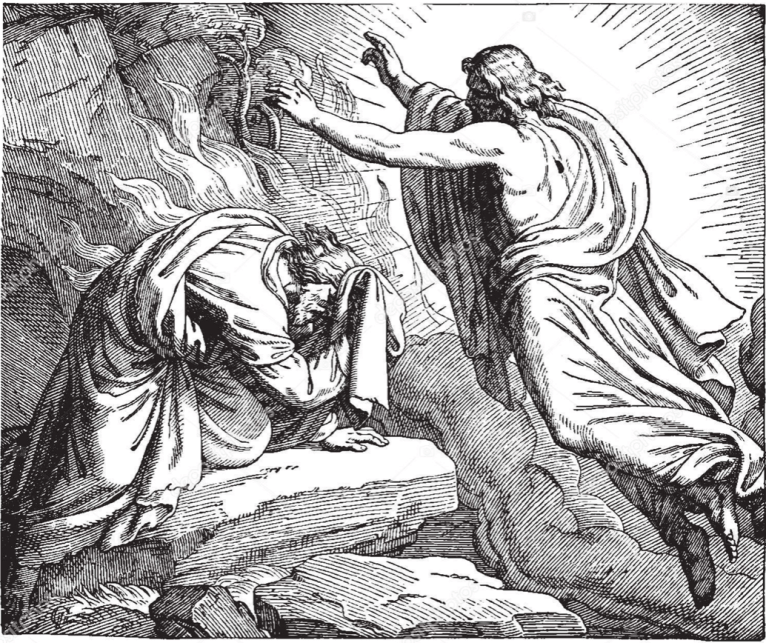
In our passage from first Kings this morning we find the prophet Elijah at a low point in his ministry. The evil Queen Jezebel wants to kill him. He is running for his life. Despite all his efforts, people are still turning away from the one true God and worshipping false idols. Elijah has not been able to change or fix a thing. Society is still a mess. He wants to quit. He is so despondent he doesn’t want to eat, but God forces him to eat. He heads out into the wilderness, completely alone, a dejected failure. God asks him: “what are you doing here Elijah?” Elijah tells his sob story. God says “go outside” and before Elijah can even make it out into that terrifying world he hears a great wind, and then an earthquake and then a fire, but he can tell that God isn’t speaking in those great, cataclysmic things, but finally in the silence he can hear God’s voice. Elijah knows that God is present, and he covers his head and face out of respect. And God asks again: “what are you doing here Elijah?” And again, Elijah tells his sob story. This job is hard, I’m the only one, and everyone is against you and your prophets, oh and did I mention they are trying to kill me? And God offers Elijah the kind of pastoral advice that only God can give: Get back to work!
Go! Get back to work. Here is what you are going to do. You are going to minister to this political faction; and then you are going to minister to that political faction. You shouldn’t be doing this alone, so go and get Elisha to help you, but trust me to do the final sorting out. I know who has worshipped an idol and who hasn’t, and there will be faithful people in the land. There is going to be war and division. God says that plainly to Elijah. Fixing the world is NOT a burden that God has put on Elijah’s shoulders. Elijah has work to do, but that work requires him to have more faith in God and what God is doing than he does in his own abilities. Elijah had imagined that success in ministry would look like popularity and huge numbers of converts, and billions served like the hamburgers on a McDonalds’s sign. But what he learned is that true success is just being faithful to what God has called you to do.
There is a pressure on religious leaders and religious communities right now to try and do everything, and be everything, and fix everything. In a world that is so broken, simple faithfulness is no longer praised or prized as much as innovation. We want entrepreneurs. We want social justice warriors with a superhuman zeal to go out and right every wrong. We want visionary leaders who will go out and change the world putting an end to disease, war, poverty, racism, ignorance, inequality and the list goes on. We want pastors who can walk on the water in the midst of stormy seas. And this pressure to go out and do everything and be everything, it comes from our leaders as much as it does our congregations. Maybe for some, it even comes from some place deep within. We want to save the world and somewhere along the way many of us discover that we can’t even save ourselves, so we want to quit. When we discover that we actually can’t walk on water, or transform the world into some utopian dream 42% of us want to quit.
And if this is true for pastors, I imagine that some of this is true for people in the pews as well. If you think that the point of having faith is fixing the world, if that is what you think religion is about: a program for social transformation, then you are likely to get a little frustrated when you look around and see the world on fire in every direction. Perhaps you wonder: what’s the point? Stress, loneliness, political division, these things don’t just affect pastors, they affect all of us. All of us can be tempted to give up: give up on God, give up on ourselves, because we have created an unrealistic expectation of what success looks like. But what if true success is really just a matter of simple faithfulness to the call we have received? Not ingenuity, not creativity…just simple, stubborn faithfulness. How much good has been done in this world by the people who just showed up? Faithful people, not trying to fix the whole world, but just trying to follow Jesus as best they can.
It was Jesus’s command to come that gave Peter the ability to walk on water, not his own power. As soon as Peter took his eyes off Jesus he sunk and realized very quickly that he still needed a savior. The same is true for us. The moment we take our eyes off of Jesus and what he is actually calling us to do; the moment we become more concerned about fulfilling our own agendas than faithfully following him, we sink. And we will drown if we don’t learn to grab onto him again. Jesus can give us the power to do amazing, impossible things, but it is his power, never ours. Elijah was called to minister to people on both side of a political divide, but that was God’s idea, not Elijah’s. The ministry is God’s; it isn’t ours. He is the one who calls, he is the one who sends, and ultimately he will decide what success and failure look like. Our job, whether we stand in the pulpit or sit in the pew, is to be faithful to the one who calls us.
When that same survey that the Barna group sent out asked the pastors that had NOT considered quitting, what it was that made them want to keep working, what made them stay, they said two things overwhelmingly: that they believed in the value of their ministry, and that they felt that they had a duty to fulfill their calling into this ministry. Not self-confidence, not renewed vision, not growing churches. Belief in the value of your ministry and a sense of duty and calling. That is what keeps pastors showing up, and I think it is probably what keeps Christians showing up as well. A belief in the value of what you are doing, no matter how small it is, even if it is just showing up to pray. And a belief in, a faith in and a sense of duty to, the one who call us all: Jesus. Those two things can be summed up in one word: faithfulness. Faithfulness is something we should spend a little more time celebrating.

 Inwardly Digest