
Sermon for Christmas Eve 2023
Readings:
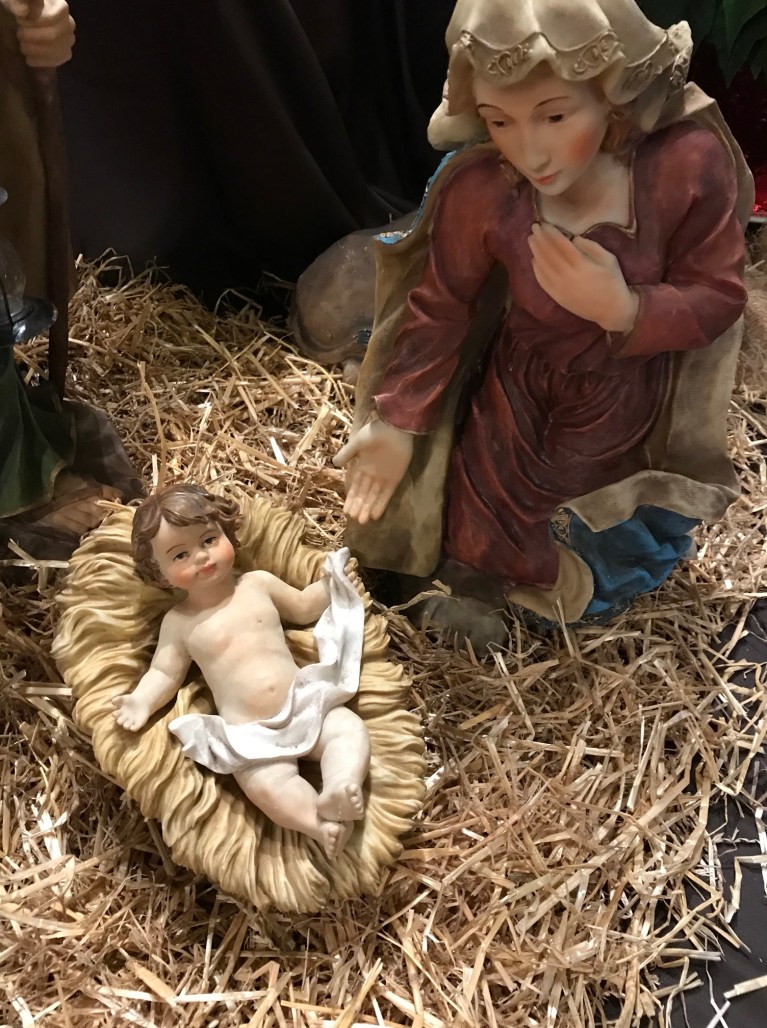
Every year at this time we set up our creche, our nativity scene, right underneath this pulpit. It was the most convenient and the most prominent place we could put it, and it is fitting really since the good news, the gospel, which is what the pulpit should be all about, that begins here. This is the story of the birth of Jesus Christ, who Christians believe to be the Messiah, the Son of God. At least, that is the story that these statues are pointing us to. On the one hand, they are really just plastic. Molded plastic with some paint. And they are imperfect and fragile. This angel’s wing is chipped. Part of Mary’s robe is cracked. One of the wisemen is a little damaged. It’s a beautiful set, but that is what happens over time with material things, including our own bodies; they get a little worn and banged about, and these statues are just material things. But on the other hand, I think most of us would recognize that they are much more than that.
When you pass by this scene later, you won’t look here and see molded pieces of plastic and paint. You will see Joseph, and Mary, and Jesus. They are symbols. They are material things, we can see them and touch them, but they point us to and remind us of something that we can’t see or touch. Despite whatever jokes I may sometimes make, none of us was actually at the birth of Jesus. No one here saw him in the flesh, with our own eyes; no one in here held Jesus in our arms. But tonight, these very fragile, imperfect, material things can direct us to, and help us to see, something that our eyes don’t have the power to behold.
That may sound very philosophical, but the truth is, that’s what happens every time you look at a photograph or a picture of a loved one that is no longer with you. Material things have power and meaning. Whether they are a piece of photographic paper or molded statues of plastic and paint, material things can point us to things that are harder to see and impossible to hold onto or contain. Material things are NOT meaningless. If you don’t believe me, then go and look in the face of any child tomorrow morning.
There are quite a few presents under my Christmas tree tonight. Most of them aren’t for me, which is as it should be, but I will still find joy in them. Presents, which are of course material things, can bring you joy. I’m here to say it. They can be a source of joy whether you are getting them OR giving them. They can be a gift of joy to you either way. Material things can give you some measure of joy. Joy is one of those things that is hard to nail down. It is an experience that isn’t always easy to define and it is impossible to fully control. Joy can come in odd and unexpected moments in life. Joy isn’t a material thing, it is an experience or an encounter that is more than a simple emotion, but a whole bunch of emotions and thoughts rolled together. Joy is spiritual. I think that joy is an encounter with the love of God. Material things are not the same thing as joy, just like this statue is not the same thing as Jesus, but they can help us to encounter it.
Now you might be expecting me to stand up here tonight, and like Charlie Brown, rail against the materialism of our society and the commercialism and consumerism of Christmas. You might be expecting me to chastise you for all of the shopping and the partying and over-eating. You might be expecting me to drone on about all the suffering in the world. But I’m not going to do any of that. Stealing joy never alleviated anyone’s suffering. Besides, I don’t want to be too much of a hypocrite, because I can be something of a materialist myself.
I appreciate material things. Whether it is a good piece of cake or roast beef, nice china on a beautifully set dining room table, a comfy sweater, a good book, a sharp kitchen knife, or watching my son play with his stuffed giraffe; material things can bring me joy and I won’t deny it.
You see, there are two types of materialism though. There is the materialism that finds joy in material things, and there is the materialism that thinks that material things are all that there is. The first can be a real problem when it leads to greed and avarice and ignoring the material needs of others. It can lead you astray. It can lead you to thinking that joy can be marketed or found in the wrong things, it’s not completely benign, but the second type of materialism is far more devastating because it destroys joy all together. It destroys all emotions, including love. If the material world is all that exists, then things like joy are just an illusion: chemicals crossing neural pathways with no deeper meaning or significance. Well I might be guilty of being the first type of materialist, but not the second.
While I love science, and have benefitted greatly from some of its advances, it is only really good at describing things that can be seen and touched and even that it does very imperfectly. But there are things in this world that can’t be seen, touched or measured. I think that there is more to this thing called life than just one long chemical reaction. There is meaning and there is mystery. There is love and there is joy. In a universe that could simply be chaos, there is actually order. We live in a world where pieces of plastic are actually much more than just pieces of plastic. Isn’t that amazing?
The story that is told by these statues, the story we tell here tonight, is that in the fullness of time, in the middle of the story of our existence, the ultimate spiritual thing, the God of all the universe, became one with the ultimate material thing, a human life. God was born among us. Heaven and Earth meet in Jesus Christ. It is an improbable and magical story that defies easy explanations, but it is a story that I believe to be true. It is a much better story, and I think a more believable story, than the meaningless, joyless story that is told by the world in so many ways. It is a story in which material things, including flesh and blood, have meaning and value to God.Material things are not God, that is idolatry, but they can help us to encounter God. They can point us to God and to spiritual truths and realities and stories that don’t get old. They can connect us to future generations and past generations. They can bring us joy and in the process remind us of the source of our ultimate joy. Christmas is a complicated time of the year filled with so many emotions: love, grief, anxiety, frustration, fear, stress. My prayer for all of you, is that whether you are celebrating alone or with family, whether there are many presents under your tree or none, my prayer is that you will find in at least one of the material things you encounter, a symbol of God’s love and that you will realize in that moment that God has come to meet you and that there is a world of reality beyond those things which we can see and touch. Material things have the power to do that. They aren’t meaningless you know.

 Inwardly Digest