
Sermon for July 14, 2024
Readings:
Amos 7:7-15
Psalm 85:8-13
Ephesians 1:3-14
Mark 6:14-29
Sometimes the problem we face isn’t all that new. Sometimes the solution isn’t all that new either.
In the town of Guedelon, France, which is somewhere South of Paris, there has been an interesting project going on for about the past 25 years or so. A bunch of archeologists and laborers have been building, from the ground up, an entire castle using only the tools and techniques available during the 12th and 13thcenturies. I first learned about this through watching a British documentary television show, which focuses on a group of people trying to understand and recreate the lives of people living in different periods. I am fascinated by these shows.
Anyways, one of the things that is fascinating about this castle program is that many of the tools and techniques that builders were using in the 13th century were thousands of years old even then. So you had very sophisticated buildings being built with very simple and ancient tools; tools that had remained effective and useful across thousands of years, some of which are still in use to this day. You know the modern world often likes to sneer at our ancestors and their beliefs and methods, but I hasten to point out that the reason these archeologists in France can build this castle using ancient methods is that there are still many, many buildings, cathedrals and castles from the 11th, 12th, and 13th centuries still standing. Meanwhile, we are rebuilding and renovating our front steps that are a mere 7 years old. We might make things faster now, but we don’t necessarily make them better. The old ways aren’t always wrong. Our ancestors still have a lot to teach us.
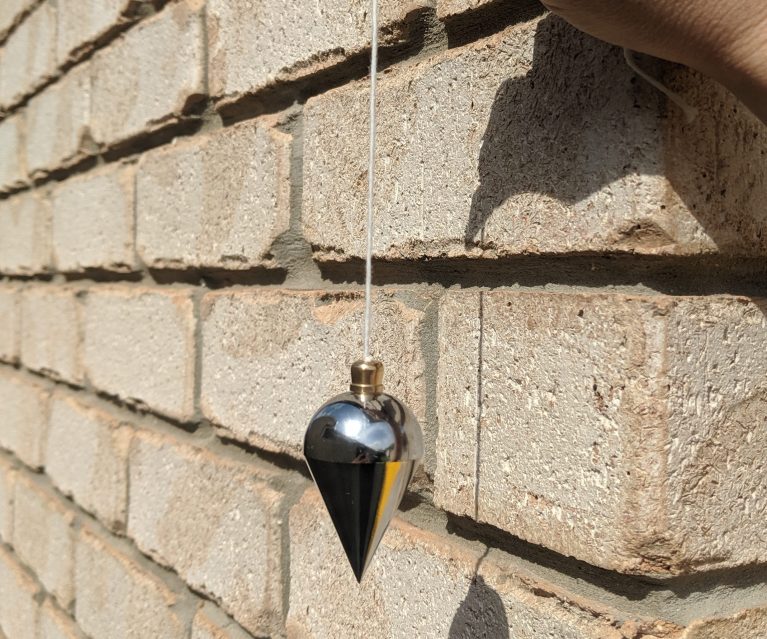
Well, one of the tools that they demonstrate using in this documentary about the castle in Guedelon, is a plumb line. A plumb line is an incredibly simple tool. It is just a weight on a string that is held against the stones of a wall to determine if they are “plumb” or rising purely vertically. It’s the simplest thing, but it is brilliantly effective. As long as the weight hangs exactly the same distance from the wall, the wall is rising vertically. If there is any variation, then it means that the wall is starting to tilt one way or another. It is a critical measurement and has to be done constantly during building, because when you are building a tower, the tiniest variation at the bottom can become a huge variation at the top resulting in the building collapsing. The slightest tilt matters, not necessarily for the stone that was just laid, but for the many, many stones that will rest upon it. A builder needs a constant reference point for what is straight up and down, and that is what a plumb line does.
Our Old Testament passage from the prophet Amos this morning is clear evidence that plumb lines were in use LONG before the 13th century. Amos was writing some 500 or more years before Jesus was born, and plumb lines were old technology even then. Amos has a vision. God shows him a plumb line, and God says “see, I am setting a plumb line in the midst of my people.” I am holding up a gauge to see what is crooked and what is straight. And what does Amos see? He sees the whole thing tumbling down. Not just God’s house; not just the walls of Jerusalem, but God’s holy people are not upright anymore. The whole society is crooked. And those at the top, the priests and the politicians and the leaders of society, they are the most crooked of all. They are so far from plumb, so far from true, that they are about to pull the whole building down with them. But it’s not just their fault. As master masons know, little problems at the bottom of the wall lead to big problems at the top. That’s what the plumb line is for. Amos is looking at a whole society that is not straight; not upright. He warns people, but naturally they don’t want to hear it. The priest Amaziah, the king Jeroboam, they don’t want to hear how far they have strayed from God’s standard. They tell Amos to go and preach somewhere else. And Amos basically says “hey look, I’m just the messenger. I’m no one special. I am just doing what God told me to do. He sent me to his people to remind them of the true standards that he gave them.”
That is what the plumb line is. It is the standard. The line by which things are judged to be straight or crooked. For God’s people that standard was the law. God’s law. The commandments about what should be worshipped and how. The rules and standards of behavior in how we should live our lives and treat each other. Basic ideas of right and wrong. It is amazing how many non-believers and atheists will appeal to ethical standards and ideas of right and wrong, without really appreciating why such standards should even exist. This is a part of C.S. Lewis’s argument in Mere Christianity: there seems to be an external moral standard by which we judge things. Where does this standard come from? Well, the faithful answer is that it comes from God.
It is God who sets the plumb line in the midst of his people.
Now you may think that the prophet Amos was writing to a certain group of people at a certain place and a certain time, and that’s true, but when I look around I don’t see a world all that different from the one Amos was living in. Human beings haven’t changed all that much. Sometimes our technology may change, but our nature doesn’t. We still don’t live up to the standards of right and wrong that God has given us. Next to the plumb line that God is holding we are all a little crooked. Now you may think to yourself: I’m not so bad. I haven’t killed anyone. I make sure my parents are cared for. I haven’t had any affairs with my neighbor’s wife. Compared to some people, I’m doing pretty good commandments-wise. I’m not THAT far off the mark.
But you see, as I have learned, the reason that builders use a plumb line is because they understood that little mistakes grow into big ones. If this stone is a little off, the next stone is going to be ever so slightly further off, and the next further off still and on and on until the wall falls down. What happened yesterday is, I think, a clear example of what happens when we ignore little things (little faults or sins or inaccuracies). We may have witnessed the heinous act of one individual, but we can’t say that it came out of nowhere. Is there anyone in here that can honestly say they have never said something about a politician or a political party that wasn’t completely fair or true? I don’t think there are many people in here who have never had a laugh at the expense of a politician we didn’t like. Most of us have probably launched into hyperbole from time to time; exaggerated our opponent’s faults; blamed them for things that we knew weren’t their fault. These aren’t big sins. We all do them. But the problem is sins grow. You might be content to just make nasty comments online, but someone else might want to take it further. Your nasty comment leads to someone else’s nasty comment. The anger and fear and resentment grows, until someone, or even a bunch of people, decide to turn their anger into actions. That is how we have gotten to where we are in this country. Obviously, there is much that we still don’t know about what happened in Pennsylvania yesterday. We don’t know much about the shooter’s motives or even mental state, and yes, the man who pulled that trigger was responsible for his own actions, but we all need to recognize how sin and hatred and fear and anger grow. We all have some responsibility for the temperature of political discourse in this country, the problem isn’t just with the stones at the top of the wall. We all need to recognize that next to God’s plumb line, there ain’t none of us that are standing perfectly straight.
And that is why grace and forgiveness is such a critically important thing to understand. God has given us standards of behavior that even the best of us don’t meet. God has given us a standard, but God has also given us grace and forgiveness. We are told that in Jesus Christ, God is still gathering up all these crooked stones, and loving them as his adopted children. We are told that God’s love for us is not contingent upon us being perfect, or perfectly fulfilling the law. Christ loves us even when we are so crooked that we topple over. But the law is still there. We still need the standards, even when we don’t meet them. They are a perpetual reminder to us of how much we all need grace and forgiveness in our own lives, both in receiving it and in showing it. And that is what we need in this world and in our country, now more than ever. The problem of sin and hatred isn’t a new problem, and neither is the solution. We need to show each other a little more grace and forgiveness; we need to trust that while God may be holding the plumb line in one hand, he is busy picking us up and holding us with the other.
I don’t have easy answers for the times we are living in, and I certainly wouldn’t trust anyone that does. My faith is in God, not in countries or elections, or political parties or leaders, and my faith is certainly not in violence or attempted murder as a solution to anything. My faith is in God. As people who have faith in God, the best thing that we can do right now, in addition to praying for our country and our leaders, including the former president and those who have been injured or killed, is to show people what it looks like when you put more faith in God’s righteousness than you do your own. It always amazes me in this parish how people of just about every political stripe can come together, day by day, week by week. We live life as a community and most of the time we get along. What makes this place work is the conviction that I think most of us have, that we all stand in need of perpetual grace and forgiveness. We can live together because we recognize that God is holding the plumb line, and not us. God is the master builder, not us. That is good news that we can share with the world. Grace and forgiveness and personal restraint may not be new tools, but they still work. Despite all of the talking heads and headlines, the problem we face in our world and in our country right now may not be all that new, and the solution may not be all that new either.
 Inwardly Digest