
Sermon for Palm Sunday 2026
Readings:
The Liturgy of the Palms
The Liturgy of the Word
Then Pilate said to him, “Do you not hear how many accusations they make against you?” But he gave him no answer, not even to a single charge, so that the governor was greatly amazed.
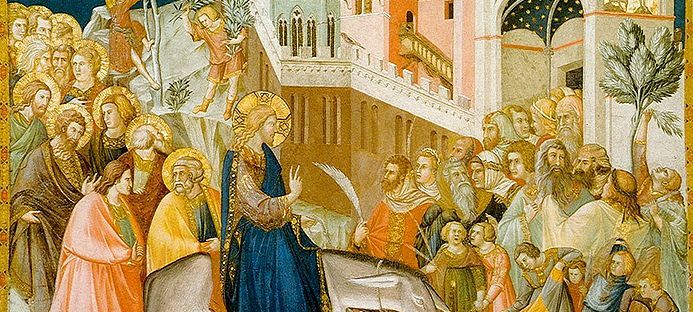
We often think of the gospel readings that we hear during mass to be mostly the words and the teachings of Jesus. But in today’s quite long gospel account of the passion of our Lord, the actual words of Jesus are relatively few. Today’s gospel is not a sermon, it is not a parable or a story, it is not a moralistic teaching. Today’s gospel is not as much about words as it is about actions. And actions speak louder than words. Words, even when they are shouted may be shallow and meaningless. Today we recall that when Jesus entered Jerusalem on that Palm Sunday, the crowds shouted “Hosanna to the Son of David! Blessed is the one who comes in the name of the Lord!” Their praise of Jesus was shouted from the rooftops and in the streets, but what did all that shouting mean? Those loud shouts of praise would turn to loud shouts of condemnation in less than a week. Most of the people who shouted “Hosanna” would later shout “crucify.” What the crowd said, was not nearly as significant as what they did. They projected onto Jesus their hopes and dreams, but also their failures and their sins. They expected Jesus to only affirm and not to challenge, and when he did challenge them they eliminated him as quickly as possible.
Friends, let me pause here for a moment and emphasize that when I say “them” what I really mean is “us.” Jesus’s death was God’s response to human sinfulness. Human sinfulness. That’s all of us. Don’t try to get off the hook by blaming this on the Jews or the Romans, or the Clergy, or Politicians. One thing that the gospel makes pretty clear today is that just about everyone has a hand in his death. From the mighty Pilate to the servant-girl in the street, there is plenty of blame and guilt to go around. Humans are a fickle lot, so what we say in the gospel is not nearly as important as what we do. Remember that Pilate said “I am innocent of this man’s blood” just as he is handing him over to be crucified. Words can be pretty meaningless sometimes.
And standing in stark contrast to all of this human hypocrisy and lies and shifting public opinion is Jesus, who is often silent in today’s gospel. Perhaps more silent than we would like. As he enters Jerusalem, riding on the back of a ridiculous donkey, Jesus says very little. When he clears the temple of the money changers, he says little to defend himself, only quoting a line from the prophet Jeremiah. He performs miracles with no explanation. He is challenged by the chief priests and scribes and responds with a simple line of scripture. His words become fewer and fewer and Jesus nears the end of his life. And finally, as he is on trial before Pilate and being condemned for a lie, Jesus stands silent. He offers no words in his own defense. The Messiah, the Son of God, is silent and still. Sometimes God speaks, and sometimes God is silent.
This week I have been thinking about Jesus standing silent before Pilate as the crowd called for crucifixion for him and freedom for Barabbas, and my mind kept being drawn to one of my favorite Psalms, Psalm 50. It comes around once a month if you say morning prayer daily, and it is one of those Psalms that always jumps out at me. If you want to, grab the prayer book in front of you and turn to page 654. Psalm 50. Jump ahead to verse 16.
| 16 | But to the wicked God says: * Why do you recite my statutes, and take my covenant upon your lips; |
| 17 | Since you refuse discipline, * and toss my words behind your back? |
| 18 | When you see a thief, you make him your friend, * and you cast in your lot with adulterers. |
| 19 | You have loosed your lips for evil, * and harnessed your tongue to a lie. |
| 20 | You are always speaking evil of your brother * and slandering your own mother’s son. |
| 21 | These things you have done, and I kept still, * and you thought that I am like you.” |
| 22 | “I have made my accusation; * I have put my case in order before your eyes. |
| 23 | Consider this well, you who forget God, * lest I rend you and there be none to deliver you. |
| 24 | Whoever offers me the sacrifice of thanksgiving honors me; * but to those who keep in my way will I show the salvation of God.” |
These things you have done, and I kept still, and you thought that I am like you. That is such a powerful line. Sometimes God speaks, and sometimes God is silent. But do not equate God’s silence with approval. God can see past our loud shouts and protestations. God knows just how humans are. God knows just how much words mean to us. So honoring God with sacrifices and thanksgivings is one thing, but it is those who actually keep his ways, who understand the importance of action, that will see the salvation of God.
God’s salvation can be seen in action, more than in words. That is the lesson of the Passion Gospel. That is the lesson of Holy Week. That is the lesson of Easter. Pay attention to what Jesus does. He cleanses the temple, and he cleanses his disciples’ feet. He offers his body in the bread of the last supper and on the cross of Good Friday. He is betrayed and he forgives. He dies by the power of humans. He rises again by the power of God. He is confronted with human sinfulness at its worst and unlike us, he doesn’t defend himself or justify himself with shouts or empty phrases. He is fully human, but in many ways he is NOT like us. He remains still and silent before his accusers, but his actions are a revelation of the faithfulness of God. From the shouts of Hosanna, to the shouts of crucify, God remains faithful to us, even when we have been faithless to him. That is the love of God. It has been revealed to us in Jesus’s words. But this week, perhaps more than any other, it is revealed to us most clearly in his actions.
 Inwardly Digest