Ground Zero

Standard

Sermon for January 26th, 2020

Readings


It’s hard to imagine, but a couple thousand years from now people may read news stories or letters from the distant past and wonder: “what is this place Ground Zero which these people keep referring to?”


When we hear that name though, we know exactly what it is. And I say “what it is,” rather than “where it is,” because when we hear that name we think of more than just a geographical location, for us it is so much more than a dot on a map.


When we hear Ground Zero we don’t just think of the World Trade Center or a city block in lower Manhattan. We hear the name and are instantly reminded of something that happened there. We are reminded of death and destruction and horror. The images come flooding back, even some of the sensations. That horrible smell that filled the air; the missing person signs that papered the city; that sense of fear, of wondering “what’s next?” All of that comes rushing back to me when I hear the name “Ground Zero.”


There are some places in our world that see such horror that just saying their name conjures up painful emotions and images, even if we didn’t witness the horror personally. If I say the name “Auschwitz” or “Treblinka” or “Daccau” you don’t just think of places in Europe…dots on the map. You think of all of the horrors that we know happened there. Death, defeat, captivity, starvation, cruelty. There are other places whose names conjure up similar emotions: Pearl Harbor, Dunkirk, Verdun. Sadly, that list of names grows longer everyday:


Columbine, Newtown, The Pulse Nightclub.


So many place names become synonymous with the horrors witnessed in those places, that to say them out loud is a risky thing because you are evoking powerful, terrible emotions and memories in people. These names mean so much to us and evoke so much within us, that it is hard to imagine a day when someone might hear them and have no concept of what those places represent. But sadly, that day often comes. Our memory of history fades, and the horrors that our history contains fade away with it, until place names, just become place names again. If I went up to the average person on the street and mentioned Andersonville or Culloden or Carthage, how many would have any idea what I was talking about?


When you heard the first reading just a few moments ago, and heard Isaiah talk about the land of Zubulun and the land of Naphtali…did it stir up anything within you? Did you feel a surge of emotion when you heard Matthew repeat Isaiah’s words in the gospel reading?


No?


Well neither did I at first. They are just funny place names in the bible. I don’t have any emotional connection to them at all. So when I hear that Jesus is going to start his ministry in the territory of Zebulun and Naphtali my first thought is: ok, whatever, who cares? Just one of those meaningless, tedious details that the Bible is full of right?


But then again, there is always the chance that I am missing something, so I dug a little deeper.


Who were Zebulun and Naphtali?


Well if you think way back to the book of Genesis, or if you try and remember the songs to the musical Joseph and the Amazing Technicolor Dreamcoat, you may recall that there was Abraham, then Isaac and then Jacob (Jacob and Sons!), there was Jacob who had twelve sons.


Reuben, Simeon, Levi, Judah, Dan, Naphtali, Gad, Asher, Issachar, Zebulun, Joseph and Benjamin.


Naphtali and Zebulun were two of Jacob’s sons and with their brothers they were founders of the twelve tribes of Israel. Well when the Children of Israel (or the descendants of Jacob) returned to the Promised Land after their exile in Egypt, each of these tribes settled in their own little territories, sort of like our counties. The Zebulun and Naphtali tribes settled in the North by the Sea of Galilee. Thus was established the Land of Zebulun and the Land of Naphtali.


Ancient history so why would Matthew care that Jesus started his ministry there?


Because in around 740 BC during the time of the prophet Isaiah, the Assyrian army, living to the North of the Kingdom of Israel invaded. There was war and destruction and death. The tribes that lived there, if they weren’t killed in battle, they were hauled off into captivity and lost. They disappeared. The Babylonian Captivity or Exile of the Jews is still pretty well know and talked about, but that was of the Southern Kingdom of Judah. The Assyrian Captivity of the Northern Kingdom has largely been forgotten, because no one came back. The people had just disappeared.


And Ground Zero for the Assyrian Captivity was the Land of Zebulun and the Land of Naphtali. That is where the Assyrian army invaded first. Those were the people whose lives were first destroyed by this terrible event. And those are the people that Isaiah is talking about when he talks about people walking in deep darkness. These were current events for Isaiah. And yet he had the faith and vision to say that those people walking in darkness, who are living under the rod of the oppressor, someday they are gonna see a light. And there will be no gloom for them anymore. This land that has been destroyed, someday it will be made glorious. That is what God is going to do for his people.


That is why Matthew thinks it’s significant that Jesus is starting his ministry there. This is the region and shadow of death. This is where death and destruction first reared its ugly head for the Kingdom of David, so this is the first place that this son of David is going to go to establish his new kingdom. Jesus isn’t going to Galilee because it’s a nice place to go fishing; Jesus is going to Galilee because the Land of Zebulun and the Land of Naphtali had been a hell on earth. The names Zebulun and Naphtali had become infamous symbols of suffering and death. When you said Zebulun and Naphtali, people thought of more than just a place on the map.


That is where God sends his son to teach, heal and proclaim the good news that God’s kingdom is a lot closer to them than they imagined.


It was in this land, a symbol in itself of how broken human kingdoms and human society can be, it was in this land whose name was a reminder of just how cruel and inhumane we humans can be to one another, it was in this land of pain, anguish and darkness, it was in this land that the light of the world walks up to a couple fishermen trying to mend their broken nets and says:


Hey, aren’t you tired of this yet? Aren’t you tired of living in a land of fear and death and darkness? Aren’t you tired of trying to mend a world that won’t seem to stay mended for long?


Wouldn’t you like to follow me and live differently and invite others to live as a part of this new Kingdom that God is building?

Maybe the fact that Jesus goes to the Land of Zebulun and the Land of Naphtali isn’t such an insignificant detail after all, because if I lived in the Land of Zebulun and Naphtali next to those fishermen Peter and Andrew and James and John, and someone made that offer to me, well…I almost might be persuaded to follow him.


Hear the Angels Sing

Standard

Sermon for Christmas Eve 2019

Readings


Before I being my sermon in earnest, first a little Sunday School lesson, or catechism:


Angels are a special order of God’s creation. They are spiritual beings that have no physical bodies, and that most of the time, are invisible to us.


They are not your deceased relatives. That is a popular misconception, but it’s not biblical or traditional.


Now your dead aunt Ethel may have been a wonderful person, she might have even been a saint, she may even have a front row seat before the throne of God, but that doesn’t make her an angel. We humans can become saints, and our souls may enter into heaven, but we don’t become angels. Angels were created differently than we humans were.

Angels are spiritual creatures that were created to serve God in heaven and on earth. They do this primarily in two ways: they either protect us or they deliver important messages to us.


I’m telling you this so that if and when you ever encounter an angel in your life, you will know what it is and what it’s up to. Because we do encounter them.

Thus endeth the lesson.


Tonight’s story, the entire Christmas story really, is filled with humans encountering angels.


In Luke’s gospel, before Jesus was born, the old priest Zechariah saw an angel in the temple of the Lord, that told him that his wife, who was barren, would give birth to a son that would be the prophet John the Baptist, the forerunner of the messiah.


And then a little later that same angel, Gabriel, was sent to a young girl in the city of Nazareth named Mary, and that angel told her that even though she had never been with a man, that she would bear a son by the Holy Spirit, and his name would be Jesus.


That girl’s intended husband, Joseph, understandably found her story hard to believe, he was going to quietly break off the wedding. Quietly, because he didn’t want Mary to be shamed or killed. But an angel came to Joseph in a dream and confirmed that Mary’s story was true.


And then, on the night that Mary’s child was born, an angel appeared to shepherd’s in the fields to announce this glorious birth and to point them to where it was happening: a simple stable. A cave right outside of town that was being used to shelter animals.


And then that angel was joined by other angels, the whole host of heaven, and they began singing this glorious song of praise: Glory be to God on high, and on earth peace, goodwill towards men. Gloria in excelsis deo.


You know those words. You have probably sung them countless times over these past few weeks. Those words are found in so many of our Christmas Hymns.  Angels we have heard on high, while shepherds watched their flocks by night, O come all ye faithful, so many of our Christmas Hymns allude to that angel song: Gloria in excelsis deo. Glory be to God on High.


You know those words that the angels are singing. Outside of the penitential church seasons of Lent and Advent, just about every mass begins with that song: Gloria in excelsis deo. When we come together for mass, to celebrate the life of Christ and all that that means, we usually begin with the angels’ song that announced his birth: Glory be to God on high. The joy of Christmas meets us all over again whenever we gather at this altar. Week in and week out we are reminded of an encounter some poor humans had with angels, and of the glorious news that they were given. God, your God, the messiah, the son of David, the king you have been waiting for, has been born among you.


The God of all creation has done the most miraculous thing: he has been born among you. He is here to save you from slavery to sin and death.


The angels’ song was about rejoicing in what God has done. The angels were fulfilling their role as God’s messengers. They were leading us to find God in our midst and teaching us how to rejoice in the amazing thing that God has done. The good news of Christmas is a message of hope about what God has done and is doing. It is not about what humans can do.


The angels weren’t singing about the glories of mankind. The message of Christmas was not: hey y’all just be nice to one another. And the angels definitely weren’t saying “if you just be good, God will give you a present.” The angels weren’t telling us how to save ourselves, they were singing a song about how God has saved us from ourselves.


Can you hear them singing?

Can you hear their message about the glorious thing our God has done?


It isn’t always easy.


One of our hymns later in this service is “It Came Upon the Midnight Clear.” It is an old and familiar hymn, but the problem with familiar hymns sometimes is that you may sing them without paying much attention to the words you are singing. Pay attention to it tonight. Pay attention to the image that hymn paints of the angels singing their song. Pay attention to the middle verses…the ones you may not hear on the radio, the ones you may not know so well.


Still through the cloven skies they come with peaceful wings unfurled,

And still their heavenly music floats o’er all the weary world;

Above its sad and lowly plains they bend on hovering wing,

And ever o’er its Babel-sounds the blessed angels sing.


Still through the cloven skies.

Still their heavenly music floats.

Ever O’er its Babel-sounds.

The blessed angels sing.


The angels that sang to those shepherds that night…they are still singing. They might have passed out of our sight, but their music still fills the air. The bible never says they stopped singing. They are still singing about the glorious thing God has done. They are still astonished at this miraculous birth.


Can you hear them singing?

Many people can’t.


Yet with the woes of sin and strife the world has suffered long;

Beneath the heavenly strain have rolled two thousand years of wrong;

And man at war with man hears not the tidings which they bring;

O hush the noise ye men of strife and hear the angels sing.


The angels are still singing. We’ve just stopped listening. We care more about our petty grievances and concerns than we do with the glorious thing that God has done. This isn’t something new. We have been ignoring the angels for two thousand years.


No sooner had the baby Jesus been born, then an angel had to warn Joseph that King Herod wanted him killed. Hatred and sin are not news in this world. But the glorious thing that God has done in the birth of this child, well that is news. Good news. It is something worth singing about. God is still sending his angels to bring you that news.


If you want to hear the angels, you must first learn to be silent. You must learn to hush the noise both on the inside and on the outside so that you may hear and receive the message that these heavenly creatures are proclaiming. Hear the message first; receive it. And then, maybe you will learn to sing along with them. We don’t become angels, but we can learn to sing with them.


For lo! The days are hastening on, by prophets seen of old,

When with the ever-circling years shall come the time foretold,

When peace shall over all the earth its ancient splendors fling,

And all the world give back the song which now the angels sing.


The angels are still singing.

Can you hear them singing?

Can you join your voices with theirs?


The Little Miracles

Standard

Sermon for Sunday, December 15th, 2019

Readings


Some of John the Baptist’s disciples came to Jesus and asked him:


Who are you?

Are you the one?

Are you the messiah that we have been waiting for?


It wasn’t the first time Jesus had been asked this question. It wouldn’t be the last either. As a matter of fact, this is the question that Jesus is always being asked.


Who are you?

Are you the messiah?


In some form or another people throughout the gospels are asking Jesus this question. Everyone from Peter to Pilate. Everyone wants to know who this man really is. It is the most important question they ask Jesus in the scriptures. It is the most important question any of us ask Jesus. In fact, it is probably the most important question any of us will ever ask in our lives:


Who is this man?

Who are you Jesus?

Are you the messiah?


Jesus answers this question in many different ways in the scriptures. This time, Jesus tells John’s disciples to go and tell John what they see.


Tell him that the blind, see.

Tell him that the lame, walk.

Tell him that lepers are cleansed.

Tell him that the deaf hear, that the dead are raised.

And tell him that the poor, have hope.


Tell John what you hear and see. Jesus is telling these people that the evidence for who I am is right in front of your eyes. Elsewhere in scripture Jesus says: “If you don’t believe me, then believe my works. My works testify to who I am.” The miracles are right there, only, for some reason people can’t see them, can’t believe them. Some people can’t take them in. Why can’t they take them in? All these little miracles are pointing to the big miracle right in front of their faces. When John’s disciples ask Jesus who he is, he points to the little miracles. Maybe Jesus suspects or knows, that if people can’t accept little miracles, they’ll never accept the big one. If they can’t accept people being healed, they won’t accept the promise of eternal life either.


You know I typically don’t like either/or categories and I don’t like separating people into being either this or that, but this is one occasion where I feel compelled to. It seems to me that there are people that believe in miracles and people that don’t. Either you believe that God has sovereign power and is active and alive in the world, or you believe that the universe is essentially a machine, with every mysterious phenomenon possessing a logical explanation. If you believe in miracles, then even the tiniest, most insignificant thing can be proof to you of the presence and the love of God. If you don’t, well then even a dead body coming back to life isn’t likely to impress you. You will find a way to dismiss it. If you can’t accept the little miracles, you aren’t likely to accept the big one. It should come as no surprise then, that the people that like to dismiss the little miracles Jesus performs, are also typically the ones that end up denying Jesus’s resurrection. If you can’t accept the little miracles, you aren’t likely to accept the big one either.


But when they asked Jesus who he was, he pointed them first to the little miracles. Pay attention to the little miracles, and then you will begin to see the big one. Sometimes I wonder if that’s how God’s grace works. Maybe God uses little miracles to crack that crusty exterior of ours so that his big miracle and get through. The little drops of grace, the little miracles are the most important ones to absorb, because they are what prepare us for the big miracle.


As I was reading the passage from Isaiah this week about the desert blossoming and water being upon the dry land and the highway in the desert, I was reminded of our pilgrimage to the Holy Land a few years ago. Not our most recent pilgrimage, but the one a few years before that.


As tourists are wont to do, one day while we were there we took a drive (took a highway through the desert actually) to visit the Dead Sea and to see a mountain fortress that King Herod build called Masada. If you ever get the chance to visit Masada, it is really spectacular. It sits on top of a giant rock next to the Dead Sea. And you can either hike up a trail to the top or you can take a cable car. Well just as our group got off the cable car on top of that mountain, something spectacular happened: it started to rain. It started to rain hard actually. It wasn’t the slow, misty, drizzly rain like we have had here all week. It was a driving rain. Well we had to scramble to find some protection from the elements while we waited for the next cable car back down the mountain. Unfortunately, that year that group didn’t get to see much of Masada, because it’s just not safe to visit it in the rain. So, we loaded ourselves back onto the bus and got back on the highway headed back to Jerusalem.


Our tour guide commented as we got back on the bus, that it usually only rains one day a year in that part of the desert. One day a year and as luck would have it that was the day we tried to visit. Now you might think that the parched and dry land of the desert would suck up and moisture like a sponge, but that’s not what happens. It’s funny, but dirt that isn’t used to water, doesn’t know what to do with it. Water is so foreign to the dry land of the desert, rain is so uncommon, that when it does rain, when there is water, the land has no idea what to do with it. The desert soil doesn’t absorb the water; the water runs right off it.


If you have ever had a houseplant that you have let almost die from neglect and not watering it, and then decided to try and save it by pouring water onto it, then you may know what I am talking about. Once the soil has turned dry and hard, if you just pour water on it, most of the water is just going to pour straight through the pot or overflow onto your counter. Dry soil doesn’t know what to do with water, so the water just runs off.


Well on the one day a year when it rains in the desert, the water doesn’t soak into the soil; not much at least. It mostly runs off and creates rivers and streams and waterfalls and flash floods. That highway in the desert that we were traveling on, headed back to Jerusalem, was quickly flooding and becoming almost impassable in places. We made it back obviously, but it was a little slow-going at times.


Dry land is so unused to water that when it comes, it kind of shrugs it off, as if to say, “what is this stuff?” “I don’t recognize this stuff. Better dismiss it.” The ground becomes so hardened that it can’t absorb what it needs the most even when it is right there. Little drops of daily rain water the ground much better than an annual flash flood. Maybe it is the same way with us and God’s miracles and little graces. If we aren’t used to seeing little graces, little miracles in our daily lives, then we aren’t likely to recognize big ones. Our souls become dry and hardened by not seeing God alive and at work on a daily basis, so when the big miracles come along, the grace just runs off us; it doesn’t seep in because we haven’t learned to let it in. Just like the desert soil doesn’t know what to do with water when it comes.


If you want to know who Jesus is, and as I said, there is no more important question, then maybe start with the little miracles, not just those he performs in the scriptures, but start trying to see the little daily miracles in your life. Don’t write them off; don’t dismiss them or try to explain them away, but choose to believe that God is active and alive in the world, even in small and almost imperceptible ways. Believe that God has power to do little things, and then maybe your crust will start to crack, your eyes and ears will be opened and then maybe you will be able to receive the big miracles when they come along.


The One Thing We Have in Common

Standard

Sermon for December 8th, 2019

Readings


The prophet Isaiah declared that “a shoot shall come out from the stump of Jesse, and a branch shall grow out of his roots.” 

Paul also quotes Isaiah when he says “the root of Jesse shall come, the one who rises to rule the gentiles; in him the gentiles shall hope.”

Well you will be forgiven if you are sitting here listening to the readings and wondering: who was Jesse and what does he have to do with a tree stump?

Jesse isn’t necessarily a biblical character that I would expect you to know much about. There isn’t a lot written about him. 

You know it must say something about the power of association, but when I hear the name Jesse, I think of Uncle Jesse from the Dukes of Hazzard. I grew up watching that show, and in that show the old, wise and loveable patriarch of the family is named uncle Jesse. So when I hear Jesse, my mind thinks old, wise patriarch, Uncle Jesse. Well, you know that isn’t too far off from what people in biblical times would have thought of when they heard the name Jesse. He was a sort of patriarchal figure. 

Jesse was the father of King David. He is the grandson of Ruth, from the Book of Ruth and he is the father of David. His role in scripture is extremely minor. His grandmother gets a whole book, Jesse gets just a few lines. But because Jesse’s son would go on to become Israel’s greatest king, his name would be forever associated with the monarchy. Just like Abraham would be the father of the Hebrews, Jesse would be the father of the monarchy. So when people in biblical times heard the name Jesse they would have thought old, wise patriarch. They would have thought founder of our monarchy. They would have thought of King David. He was the one that the Kings all traced their lineage to.

So the name Jesse meant something to the people in Jerusalem that Isaiah was addressing. And Isaiah had just got done telling the people that there are bad times just around the corner. Isaiah said to his people: look, you have fallen so far away from the ways of God, that there is a reckoning coming. Isaiah said to Ahaz, the then king of Judah, he said you, who think you are high and mighty, you are going to be cut down. The Assyrians and going to invade your kingdom, just like they invaded the northern kingdom and they are going to burn it all down to the ground. And then the Babylonians are going to attach the Assyrians and there will be war and destruction and exile. This is what happens when we put our trust in faithless rulers. This is what happens when we let corruption go unchecked. This is what happens when we turn away from God and pay no attention to his commandments. We have not put our faith and our hope in God, Isaiah says, and the result of that is the painful times that are ahead. Our glorious kingdom will be brought low and our mighty king, the descendant of the great king David, he will be brought low with it. He will be cut down. Felled like a mighty tree. 

But…

But, Isaiah says, that is not the end of the story. Because God, well God is going to bring new life out of that tree stump. The mighty tree may be cut down, but there is a new shoot that is going to come out of that root. That root of Jesse, the monarchy that has been cut down, well Isaiah says that there is a new king coming, and this new king is going to lead us back to God. 

Our kings have led us astray. Our kings have divided us. After David’s son Solomon died, the kingdom split in two. Corruption and division and division and corruption. Our kings have not united us; have not protected us, and have not led us to righteousness. Our kings have led us away from God. Even mighty and glorious king David, was a sinful man. Our kings have led us astray, but Isaiah says, there is a new king coming. 

This King will be like new life coming out of that dead stump. He will be a descendant of Jesse, from the line of King David, but this King won’t look like the kings we have had recently, Isaiah says. No, this king will have a spirit of wisdom and understanding. This king will delight in being obedient to God. This king will not judge by appearances or what is on the surface. This king will judge with righteousness. This king will be faithful and righteous. 

And this king will bring enemies together. The wolf shall live with the lamb, the leopard with the kid, the calf and the lion, the cow and the bear, a nursing child and a poisonous snake. In this king’s kingdom, enemies will come together. This king will be a symbol that will bring people together. 

Isaiah says that there are hard times coming, because we have faithless leaders, and we have turned away from God, but he says, we have hope because there is also a new king coming. There is a king coming that will unite us, that will judge us righteously, and that will lead us back to God. There is a new shoot that is going to grow out of that dead stump of Jesse. 

There is a new king coming. There is a new anointed one (one of the symbols of kingship is being anointed. King David was anointed by the prophet Samuel). There is a new anointed one coming. In Hebrew anointed one is translated as meshiach, messiah. In Greek that word is Christos, Christ.

In the days of John the Baptist, people were still looking for that coming King, the messiah that would unite them and lead them back to faithfully following God. As he stood in the Jordan river, telling people to repent and return to following God, John noticed both Pharisees and Sadducees coming out together to be baptized. Well Pharisees and Sadducees might both be groups of Jews they might have common ancestry, but they don’t get along. They don’t like each other. And yet, something is drawing them together. It isn’t their past that is drawing them together. It is their future. It is the coming king. It is the approaching messiah that is bringing them together despite their differences. 

Like Isaiah, John is preaching and warning of a coming judgement, but he is also offering the hope of a coming king that will judge with righteousness. That isn’t condemnation, that is hope. This new king will do what other kings couldn’t. He will unite people and bring enemies together. The new king will bring together people that have no other reason to get along, that otherwise would never like each other or associate with each other. And here in the middle of the Jordan river John is watching enemies come together to prepare for their new king. Maybe they don’t agree on much, but they do agree that they want to be a part of his kingdom. That’s something. And that desire to be a part of his kingdom is more powerful than you might imagine.

I want you to take a minute and look around this church. Look at the people that are gathered here. Think about all the members of this church. Some of these people are your friends. But some of them are not. Admit it, there are people in this church that you don’t like. There are people in this church that if we didn’t come together once a week for worship, you probably would never cross paths with. There’s no shame in admitting that, because some of us have nothing in common. We don’t all share a common ancestry or history. We don’t all share the same likes and dislikes. Think about the makeup of this church for a minute. There are some people that were raised Episcopalian, but even more that were raised something else. There are people here whose ancestors were slaves; there are people here whose ancestors were slave owners. There are people here that were born in the Unites States; there are people here that were born in other countries. There are married people. There are single people. There are straight people. There are gay people. There are people with children. There are people without children. White, black, Democrats and Republicans, conservatives and liberals, there are people that I know live very comfortably and there are people that I know are really struggling to make ends meet. Now if this church didn’t exist, there are some of us that might still be friends and hang out on the weekends, but there are some of us that would never cross paths with each other. And yet, each and every week here we are, gathered together, because there is one thing we do agree upon. There is one thing we have in common.

Him.

We want to be a part of his kingdom. We want this new branch from the root of Jesse to be our king, our leader. If we are going to be judged, we want to be judged by him. If we are going to be led, we want to be led by him. We may not agree on anything else, but we agree that Jesus is the way. We agree that he is the future. And that means more than anything else that may divide us.

You know, people like to make a big deal about the divisions that exist within the church. People like to point out all the splits and schisms in the church in history and they like to point out that even within our own denominations, sometimes within our own parishes it doesn’t seem like people like each other that much. If you read the scriptures you will see that there has been division among Jesus’s followers from the very beginning. But if you are focusing on the squabbles and divisions among Jesus’s followers then you might be missing the miracle that is right in front of your face. These fractious, squabbling, disagreeable people are all following the same man. That is the power of Jesus, is that he is bringing together people that otherwise would have nothing to do with each other.

The church didn’t invent disagreement and division. That is a part of humanity. That is the world. The miracle of the church is that all these people that never had any reason to agree, to like each other, or to even inhabit the same space, now have something vital in common: Jesus. They may not share a common ancestry, but they have a common future. That is a miracle and it is a miracle that happens here every single week and we may never notice it. There are people here that you would have never met or encountered were it not for one thing. Him. Jesus. He draws together this rag-tag group of followers, people that outside those doors would be natural enemies, would have nothing to do with one another, and yet in here we are side by side, under the same roof, learning to get alone, and I dare say along the way, learning to actually love each other. The fact that Jesus’s followers are disagreeable and don’t always get along, well that is a testimony to his power.

When you look at all of the different people that look to Jesus as their messiah; that see him as the way to God; all the divided people that are somehow united by the water of baptism; all those people that seek to follow him side by side with people they have nothing in common with, no matter how imperfectly they do it, then you realize that maybe John was right. Maybe God could even turn stones into children of Abraham.


Misusing the word

Standard

Sermon for Sunday, November 24th, 2019

Readings:

Jeremiah 23:1-6
Psalm 46
Colossians 1:11-20
Luke 23:33-43


There is a great line from the movie The Princess Bride, where the character Inigo Montoya, played by Mandy Patinkin, responds to another character’s constant misuse of the word “inconceivable” by saying: “You keep using that word; I do not think it means what you think it means.”


It is such a great line and Patinkin’s character is so memorable, that whenever I hear someone overusing or misusing a word or phrase, Inigo Montoya jumps into my head saying: “you keep using that word; I do not think it means what you think it means.”


Words can mean different things to different people. The power of language is that it can transfer meanings and idea and thoughts from one person to another, but we must recognize that the weakness of language is that there is always some translation and interpretation going on. If you have studied another language, or if you speak another language, then you probably know that there are some words that simply do not easily translate from one language to another; there just is not an equivalent word, so you have to use several English words to try to convey the same idea. For instance, the French words terroir or milieu, both somewhat complex ideas that don’t have an equivalent English word.


But even within the same language, sometimes we have a hard time communicating because what a word means to me, may not be the same thing as it means to you. And I’m not just talking about regional dialect differences here. I’m willing to bet that most of you know that the word “Yankee” has very different connotations if you grow up South of the Mason-Dixon Line, than if you grow up in the Northeast. But there are other words that have different meanings and connotations for each of us based upon our own lives and our own history and our own baggage. There are two such words in our gospel today.


The first of these words is the first word our Lord utters from the cross. The first thing that Jesus says after his hands of been nailed to the cross is a powerful word that has powerful meanings for each one of us: “Father.” “Father, forgive them for they know not what they are doing.” That is the first thing that Jesus says from the cross. Father. It is such a powerful, meaningful word. If you are looking at someone’s genealogy or family tree, then you know that father means “male biological parent.” But you know and I know that the word means so much more than that.


Those of us who have had the good fortune to have good and loving fathers will probably find the word comforting and reassuring. For us, father, means someone that is nurturing, loving, protecting. But we live in a world of broken human beings, and not everyone has had that kind of a father. Some people may hear the word father and think abuse. Some may think absence. What you think of when you hear the word father, may not be what I think of. What you think it means, may not be what I think it means.


So when Jesus consistently uses the word father, to talk about God, as he does throughout the gospels in his teachings, as he did when he taught us to pray saying “Our Father,” and as he does today, pleading from the cross, we need to pay attention to the kind of father he is talking about. What does this word “father” mean to Jesus when he says it? We need to look over our own baggage for a minute; put aside whatever your own relationship with your father is, if indeed you even have one and pay attention to the relationship that Jesus has with the one he calls father. What does that word mean to Jesus?


The other word that we get in the gospel today is a word that was written in three different languages on a sign nailed over Jesus’s head. King. It was meant as a cruel joke. Kings are supposed to have power and glory and strength. A great king was a symbol of a great kingdom. To shame and bring down a king was to shame and bring down his people. And that’s what Pilate wanted to do. Pilate wanted to humiliate the Jews by putting a sign over a beaten, dying man that said: “this is their king.”


Kings should be strong. Kings should be able to save themselves and their people. What could this man do? That is why the people kept taunting him. “Save yourself if you are the Messiah” the leaders of the temple jeered. “Save yourself if you are the King” the soldiers yelled between their perverse fits of laughter. Even one of the thieves crucified next to him drew a painful, dying breath to add his voice to those mocking Jesus: “Are you not the messiah? Save yourself and us!”


This was no king like the kings of the earth. The only crown he ever wore was the crown of thorns. There was no precious ermine collared cloak. No diamonds, no gold. No vast estate, no treasure chests, no earthly glory at all. The world would never use the word “king” to describe this man. That’s why it was a joke. Only maybe the joke was on us.


Maybe we were the ones who got the meaning of the word wrong. Maybe the things that we associate with kings: power and glory, riches and excess, maybe these things have very little to do with what it really means to be a king. Just like it may be possible for us to misunderstand the word “Father,” so too maybe we are likely to misunderstand the word “king.” Maybe the word doesn’t mean what we think it means.


One person recognized that on Calvary’s hill on that first Good Friday. The thief that was able to admit that he had done wrong, was also the one who was able to recognize that he had been wrong. He was the first to see that the word king might mean something different to God than it does to humans. That word “king” that was hanging over Jesus’s head, well it wasn’t a joke to this man. The thief saw a blameless man that was willing to suffer for others, willing to forgive, willing to love the most unlovable people and he had a moment of conversion, he thought: “yes, that is what a king really is.” I want to know this father that this man keeps calling out to; I want to see the world the way he sees it. This is what a king really is and if that is true then I really want to be a part of his kingdom. The thief is the only one there that actually believes that Jesus has a kingdom, and he is the one that Jesus promises will join him there.


Those that mocked Jesus got no reply. But the one that humbly asked to be a part of his kingdom, well to that one paradise was promised.


Today is the Feast of Christ the King. We celebrate and proclaim Christ as our Lord and King above all others today. It is good that we should do so. Being a part of his kingdom should mean more to us than being a citizen of any earthly kingdom or nation. We should celebrate it. But in doing so let us be mindful that this kingdom doesn’t look like the kingdoms of this world and this king doesn’t look or act like most kings on earth. The word king means something different to him than it does to us.

Some people would like for us to stop using these tricky words like “Father” and “King” because they want to avoid misunderstanding who and what God is. I disagree. In the first place, they are words that Jesus uses, and I have to think that he probably used them for a reason. In the second, well maybe the fact that these words have such baggage and various meanings, means that I am always having to readjust my own understanding of them; I am always having to remind myself that the way Jesus sees the world is not necessarily the way that I see it.


I think it might be better to let Jesus define what a father is and what a king is, and then adjust my understanding accordingly. Maybe I am the one misusing the word.


Oriented Towards Giving

Standard

Sermon for November 17th, 2019

Readings:

Malachi 4:1-2a
Psalm 98
2 Thessalonians 3:6-13
Luke 21:5-19

So I brought a little friend with me this morning. I don’t often preach with props, but today I just couldn’t resist.


This is the Apostle Paul. I had this doll special made for some classes that I am teaching for the Diocese. I had to have him custom made, because, and you may find this hard to believe, there isn’t a huge demand for Apostle Paul dolls. For some reason, when people think of cuddly Christian figures, the Apostle Paul is not someone that quickly comes to mind. I just don’t get it.


Maybe it is because this man said things like: anyone unwilling to work should not eat. Maybe it is because he said things like: we command you beloved, in the name of our Lord Jesus Christ, to keep away from believers who are living in idleness and not according to the tradition they received from us. Maybe it is lines like “some of you are living in idleness, mere busybodies, not doing any work.

Actually I totally get it. Paul can be hard for some people to take. He isn’t always burdened by a sensitivity to people’s feelings. I have a deep love for the Apostle Paul now, but it is a love that was hard won. Paul says some difficult things sometimes. He can be blunt, he can be gruff. He is kind of an equal opportunity offender. At some point, in one of his letters he is likely to say something to offend you. Stick with him though, because Paul very often will say things that we need to hear. Sometimes we need someone to call us out and remind us of things we have forgotten.

It is important to remember that Paul was a convert. Now all of the disciples were converts of a sort, but Paul came late to the game. Paul was a persecutor of the church before he was a member of it, so as a convert; he has a unique perspective and a missionary zeal that people that were raised in the church or people that have been longtime followers of Jesus don’t always share. When you have been working in the church for a long time, it is very easy to lose the enthusiasm you may have once had. Frustrations and setbacks and personalities, they can all wear you down, and you can forget what a treasure you have been given. It is easy to become weary in doing what is right. Sometimes you need someone to remind you of what this thing called church is all about, and converts, adult converts are usually the best ones to do that, because they haven’t learned to take anything for granted yet. For them Christianity isn’t just an old habit, for them it is an active choice.

That is one of the things that makes Paul so great; he is a convert to the church. And when he wrote letters to churches, he was usually writing to remind them of something vital they seemed to have forgotten. I have learned to love this man, because despite his flaws and his personality, so often when I read him, he reminds me of things that I am liable to forget. And sometimes, he can be very blunt about it.

In his epistle today Paul says: anyone unwilling to work should not eat. When I hear Paul say that there is part of me that rejoices and part of me that cringes. The part that rejoices is the part of me that is a workaholic. It is the part of me that appreciates how much we rely as a church on the labors of a core of dedicated people that are committed to this place and that this church could not survive without.

The part that cringes is the part of me that wants to be welcoming and gracious and understanding. Paul just sounds insensitive here. I wouldn’t stand up and say something like that at the potluck supper. Its tempting, but I wouldn’t do it. But even though Paul’s words might make us squirm a little, I think we need to hear them, because believe it or not, he isn’t just talking about some idle people in one parish centuries ago; he is addressing something that is an important part of who we are as Christians now.

Paul’s underlying point is this: Christians must be people that are oriented toward giving. Giving must be a fundamental part of who we are. If we don’t understand that in the small things; we won’t understand it in the big things. That is why Paul warns the church to stay away from people that are just looking for what they can get. Beware, he says, of people that only want to take from the community and don’t want to give back. Because that is not the example we have been given. Not by Paul, and not by Jesus.

We give, because of what we have been given. Salvation has been given to us; forgiveness has been given to us; communion with God and eternal life these things have been given to us, and we are here to share them with others. Giving must be a fundamental part of who we are as Christians. So giving is a spiritual act.

And it is important to remember that we aren’t giving just to keep the lights on or the altar richly adorned. Temples, all temples, serve a purpose. They are places where we gather, where we share, where we learn, and where we grow, but they are always a means to an end. They are tools to be used to proclaim the gospel, but they aren’t idols to be worshipped. There will come a day when temples will be no more. There will come a day when we will stand before the Lord and all that will matter will be our relationship with him.

We don’t need to be worried about that day or live in fear of it. It will come when it will come. But in the meantime, we have work to do. We have people that need to be encouraged and comforted. We have a world that needs to hear about forgiveness and grace. We have people living without hope, and we have people that have placed all their hope on the wrong things. Our faith reminds us about how much we have been given by God, and our work is to share that faith with others. It’s ok if we convert a few adults like Paul along the way. Sometimes we need the zeal and the insight of a convert to give us a good kick in the pants and to remind us of the importance of the work we are doing.

The Passing Bells

Standard

Sermon for Sunday, November 10th, 2019.

Remembrance Sunday

Readings:

Job 19:23-27a
Psalm 17:1-9
2 Thessalonians 2:1-5, 13-17
Luke 20:27-38


There was a miniseries produced by the BBC a few years ago called “The Passing Bells.” The title was based on a line from a Wilfred Owen Poem called ‘Anthem for Doomed Youth.’ “What passing-bells for these who die as cattle?” The miniseries followed the lives of British and German soldiers during the First World War. It was a pretty good series, but whoever made the last five minutes, well God bless them. You don’t even have to watch the whole show, but if you watch the last five minutes you will see a vision that will break your heart wide open. Let me try and paint the scene for you:


It early November 1918, they last days of the First World War, the most horrific battle the world had ever seen. Millions are dead; millions of lives destroyed and families ruined. It’s the last day of the war. In a distant city, the distinguished leaders are trying to hammer out the terms of the armistice, working out the details to make it all end neatly on the eleventh hour of the eleventh day of the eleventh month. Meanwhile in the trenches, men are still fighting and dying. On one side is a young British soldier that we have been following throughout the war; on the other side, his young German counterpart. They both get drawn into a one-on-one battle in no-man’s land. They are wrestling back and forth while their friends on either side watch in the distance. Just then a wire comes through that the war is over. Hostilities have ended. Only word can’t get to our two young men fighting it out between the trenches. They are each fighting for so many things: for their loved ones, for their countries and for their own lives. They are both determined and brave and strong, and in the last moments of the struggle one grabs a knife and the other his gun, and just as the knife hits its target, a trigger is pulled, and both soldiers lie dead on the ground, and the war is over.


Two bodies lay side by side in the bloody mud. But then, the camera focuses on two little red poppies growing up in front of the two dead bodies. The bodies become a blur all you can see are the poppies. And then, there is movement in the background. Our two soldiers get up and embrace each other. And then one by one you see all these other soldiers getting up, the British and the Germans and they are all standing up, the entire field, as if the director had just yelled cut and the actors were all heading home. They get up and they laugh and smile and they begin to walk off in the distance arm in arm. And the field is full of little red poppies. And then the scene changes and the poppies turn into a field of little white crosses, a war cemetery, a field of graves of young soldiers who still lie in wait for that glorious day.


I must admit, that scene turns me into a weeping mess. But it isn’t just sadness or despair that I feel; it is also hope, and joy. It’s like I feel everything at once, because whether they knew it our not, whoever made that scene created a powerful vision of my faith. When I see that field of crosses it is like I am standing in the valley of dry bones, and I can hear the words of God to the prophet Ezekiel asking “Can these bones live?” God shows Ezekiel the answer: yes. These bones can, and will, live again.


There is this crazy belief that shows up again and again in ancient scriptures; it is the belief that there will be a future day, when the dead will rise again. Not in some creepy, spooky way as ghosts or zombies, but as bodies that are given new, restored flesh; the image of all that God created them to be. No more pain or suffering. Called from their graves and called to stand before their creator. Ignorance and hatred and animosity, all gone. Nothing left but truth. People can finally see each other for what they really are.


Now you could say that this was just a nice way for the filmmakers to put a happy ending on a terrible story. You could say that the dead are just dead and that there is little or no meaning to the tragedy and struggle of human life. You could say that, plenty of people do. Plenty of people think that the only thing that matters is what happens right here and right now. But I’m not so sure.


In the Book of Job, probably one of the oldest books in the Bible, Job, who is a good and righteous man, suffers in body, mind and spirit, yet as he is suffering he has the power to say:


For I know that my Redeemer lives,
and that at the last he will stand upon the earth;

and after my skin has been thus destroyed,
then in my flesh I shall see God,


You have probably heard those words from the Book of Job before, only they might sound more familiar to you in the old translation:


I know that my Redeemer liveth, and that he shall stand at the latter day upon the earth; and though this body be destroyed, yet shall I see God; whom I shall see for myself and mine eyes shall behold, and not as a stranger.


Those words of Job are some of the first words we say as a part of our funeral service. Our funerals begin with the words of Jesus where he says: “I am the Resurrection and the life; he that believeth in me, though he were dead, yet shall he live; and whosoever liveth and believeth in me shall never die.”


Then we jump right back to those words of Job, words that no doubt Jesus knew very well:

“I know that my Redeemer liveth, and that he shall stand at the latter day upon the earth; and though this body be destroyed, yet shall I see God; whom I shall see for myself and mine eyes shall behold, and not as a stranger.”


There it is: this crazy belief. Dead bodies in some distant, blessed future day, coming back to life. What a hard thing to believe. To be able to look at a field of grave markers and see young men and women getting up; pulling themselves up out of the mud, holding on to each other again and standing in the sun. Is this just some director’s idea of how to end a tragic historical drama? Is this just an ancient myth, or is there more here?


The Christian answer, is that there is more here. In our creed, we say we believe in the resurrection of the body and the life everlasting. The resurrection of the body. I become a puddle when I watch those soldiers getting up in the field, because for me that is a vision of my faith. When I stand in the midst of a field of crosses I want to see bodies that are about to get up and stand in the sun again. Maybe that seems hard to believe; sometimes death is more real to us than resurrection. Maybe you are afraid to believe it; because people will think you are crazy, or make fun of you for believing something so impossible as dead bodies coming back to life. Sadly, there will always be those people that are all too prepared to mock you for this crazy belief. Even people that are otherwise faithful and good will think you are crazy for thinking that the dead will rise again.


In Jesus’s day, there was a whole sect called the Sadducees, that worshipped God, but didn’t believe in the Resurrection. They made fun of Jesus for believing in everlasting life. In our gospel reading today, they are making fun of Jesus, not asking a serious question about marriage. They are making fun of his belief by asking that if a woman has been married seven times, and then dies and then rises again, who will she belong to? Jesus’s answer is priceless. He says: she will belong to God. She will belong to God. Those who are raised up on that day, will belong to God. And God will do all the sorting. God will know who belongs to him.


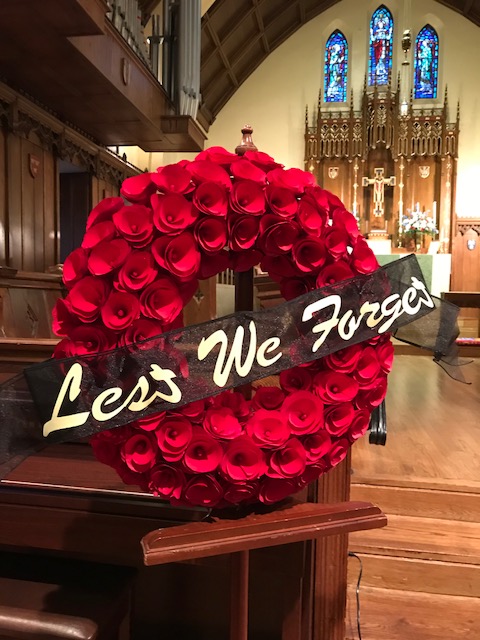
Today is Remembrance Sunday, and as is our custom here, we take this time to remember the men and women that have given their lives fighting for what they thought was right. We remember people who sacrificed everything for liberties that we so often take for granted. We remember them, and we should remember and give thanks for them, but we don’t do this just as citizens, we are Christians, and this is Sunday and this is Church. We need to remember them, but we need to remember them as people that gather to witness and proclaim the resurrection of the dead every week. God has not just told us, God has shown us what he is going to do with the dead in the Resurrection of Jesus Christ. And Christ has promised us, that he will never lose anything that belongs to him. We say it in our creed, we proclaim it at our funerals; the vision of that future day when the dead will be raised is not just the extra ending tacked onto the story, it is the story.


I am not here today, we are not here today, to just remember past tragedies and lives lost. We are not here to whitewash the pain and destruction of war and human sinfulness. We are here to give thanks to God, that human history is not going to end with soldiers lying dead in a field. Human history is going to end with God’s children standing in the sun once more and forever.


How are you responding to God’s grace?

Standard

Sermon for Sunday, October 27th, 2019

Readings

Sirach 35:12-17
Psalm 84:1-6
2 Timothy 4:6-8,16-18
Luke 18:9-14


“Give to the Most High as he has given to you, and as generously as you can afford.”


I’m willing to bet that this is not the sermon that anyone wants to hear the week after our parish fair and biggest fundraiser. We just spent months collecting donations, moving furniture, advertising, cooking and setting up displays. We spent two days of long hours with some people working in the heat while others worked in the cold. We saw old friends and welcomed new people. We spent money. We raised money. We did pretty well actually, and thanks be to God for it, because we need it. You know it takes a lot to make worship happen here on a weekly basis. It takes a lot to keep the lights and the heat on. Over $5,600 a week. That’s a lot, and I assure you we try and run a pretty slim organization. We are blessed to have a lot of dedicated and talented people that give of their time generously. We are and have been blessed.


But here, the week after the fair, after all that we have done and raised, I am going to stand here and tell you that it’s not enough. It’s not enough y’all. I warned you that this wasn’t going to be a sermon anyone wanted to hear. That’s why I made sure this morning that I was wearing shoes I could run in. But before you start sharpening your pitchforks, hear me out. I know that we’re good Episcopalians, we don’t like to talk about money. Money seems common and profane, and we don’t want to risk worshipping it, so we just avoid talking about it altogether. Money brings up issues with people. It can cause embarrassment and shame if you don’t have it. It can lead to pride and vanity if you do have it. What priest in his right mind wants to talk to his people about money? Best to avoid it and not offend people. Well lucky for you your priest isn’t in his right mind.


Your priest recognizes that there are two big problems with trying to avoid talking about money: the first is Jesus. Jesus actually talks about money quite a lot. It’s all over the gospels. Unless you want to take a pair of scissors to the words of Jesus (something which I don’t advise) then at some point you will have to confront what he has to say about money and our relationship to it.


The other big problem is worship. Now you may think that the worship of God is something that happens within your heart, and Lord knows I hope that is true. I hope that you are worshipping God in your heart in ways that are inexpressible and free, but the outward worship of God is costly. It always has been. Maybe it is supposed to be.


From the beginning of our scriptures worship has been tied to sacrifice. This isn’t just a Judeo-Christian thing though; this cuts across religions. Worshipping God and giving up something of value have always walked hand in hand. We cannot escape that. From the beginning of time worship has meant sacrifice. We give up something we value, because we value God more. We give, because we recognize how much we have been given. That is sacrifice.


Now maybe you are thinking: Great, why don’t we sacrifice this priest? After all he is one of our biggest expenses. That’s true. But the ordained clergy are kind of a necessary evil if you want to have mass and not just a community meeting. The expense of priests has always been a factor in the worship of God, it has been since Old Testament times, that’s not new.


The worship of God has always been costly. It costs money, it costs time. And for many people, it has cost their lives. Many of the saints of the church were martyrs…people who gave their lives to God….and we worry about talking about money?


So here is our dose of truth this morning: we raised about $40,000 at this year’s Friendship Fair and that is terrific and it is a testament to the dedication of this parish, but it is enough to keep this place running for less than 2 months.


The truth is the church does not, and cannot survive, much less thrive on fundraising. No church can. Churches that are thriving and growing, churches that have robust membership and ministries, and they are out there those churches, they aren’t balancing the budget by having bake sales every week. Churches that are thriving and growing are churches where the core membership understands that worship means sacrifice. They are churches where people are committed to giving to God. They are churches where people have such gratitude for what God has given them, that they are willing to joyfully and generously give back. Not to get something from God, not as some sort of bribe, but because of what they have already been given. That takes faith. And people when they visit churches like that can feel and experience that faith, even if they never look at the church budget.


When people come through those doors they can tell if this is a community that is committed to gratefully and thankfully giving back to God. They know. That is what attracts people. Nobody wants to join a church that when you walk in the door people just see a dollar sign or someone to serve on a committee. Nobody wants to be asked to pay for someone else’s faith. That’s not attractive. But you know what is attractive? When you walk into a place and you can tell that the people there have something precious that they are committed to and that they care for and they look at you and say welcome, would you like some too?


Friends we have such a treasure here. We are a blessed church. Our building is beautiful, and we have talented people, but most importantly we have the grace of God. We have our Lord’s presence in his body and blood. We have the story of God’s healing power of forgiveness and we have the hope of eternal life with those we love. Now that is treasure. And I think that when most people walk through those doors, they know that that is a treasure we are committed to caring for and sharing.


Yes, it is true that the fair helps us do that, but I remain convinced that the primary benefit of the fair is not the money it makes (no matter how much we may need it). The primary benefit of the fair is the connections it makes. We get to interact with the community and with each other. Visitors witness our commitment to this place and the worship here, and that speaks volumes. Now next year is not a fair year, for which many of us may be breathing a sigh of relief; however, stay tuned because I am going to be proposing soon a smaller one-day much simpler event for off-fair years. Why? Would a little extra money in off-fair years help with the never ending maintenance issues around here? You bet. But that’s not the primary reason to do it. The best reason is that it gives us another chance, as a community, to show others what this place is all about.


Fundraisers are great. They are necessary. But money from fundraising should never be more than the gravy on any church budget. The meat and potatoes, the substance of the meal comes from us. It comes from understanding that worship means sacrifice. It comes from looking at all that God has given you, and choosing to give back. I mentioned how much it takes to run this place, because you should know it, but it is important to remember that stewardship, sacrifice and tithing is not about paying the bills here. It really isn’t. It is about you recognizing how much God has given you and making the commitment to give back to the best of your ability. That is why the tithe in the bible is a percentage and not a specific amount. It is the benchmark for a level of giving that we are called to honestly strive toward, recognizing that the one who really knows how much we have been given, God, is the one that will ultimately be the judge. And you may wonder why 10%, what is so special about that number? It’s the biblical and traditional standard, but why? Well maybe it is because that is when it starts to hurt. That is when a sacrifice starts to be significant. Don’t believe me? When was the last time you went shopping at a 1% off sale? When have you ever seen a rack at the department store labeled “Big Sale! 2% off!”? Stores know that discounts start to get meaningful at 10%. That is when we recognize that it really means something to us and to them. If they offered us less, we wouldn’t take them seriously, because it wouldn’t be much of a sacrifice to them. 10% is where is starts to hurt. It is a serious commitment, but it should always come from the place of gratitude in our hearts, not pride.


Jesus tells a parable this morning about a Pharisee that was ranking himself in comparison to another man in the temple. And one of the things that he was proud of was how much he gave. He was giving the biblical standard, 10%, but that wasn’t the problem. The problem was his pride. Maybe he thought he was giving more than the tax collector. Maybe he thought that the tax collector was a lesser person because he gave less. Truth is we have no idea how much the tax collector gave, Jesus doesn’t say. But which one of them was really the most grateful for God’s grace? You see it’s not whether we are doing better or worse than the person in the next pew; it’s not whether you toss in a twenty folded just right so the usher can see it, or whether you have to let the plate pass you by because you gave online, or even because maybe you aren’t sure where your next meal is coming from. The question is not “are you doing better than this person or that person, or any other person?” The question is simply, “how are you responding to God’s grace?” How am I responding to God’s grace? That’s it. Maybe you really can’t afford to tithe, God knows that, but is your heart so disposed that you really do want to give God everything you’ve got? God knows that too. That is what stewardship is all about.


Today is NOT stewardship Sunday. I am not asking anyone today to make any financial commitments to the parish for the coming year. What I am asking you today is to think about that tax collector in the temple, the one that is so humbled before God he can’t even look up. What if, on his way home someone stopped him and said “Good news! God heard your prayer. He has forgiven you. He wants you to come home.” What in this world, would mean more to him than that little bit of good news? How might he respond to that news? How might you respond?


What will he find?

Standard

Sermon for Sunday, October 20th, 2019

Readings:

Genesis 32:22-31
Psalm 121
2 Timothy 3:14-4:5
Luke 18:1-8


Our faith is full of stories that can be a bit odd. Our sacred writings, our scriptures tell tales that are at times bizarre, perplexing. Even for people that devote their lives to scripture, who study its languages and its history, even for professionals, these writings can be a challenge. The great saints of our faith, many of them the most brilliant minds of their time, even they had to struggle with some of these stories.


So when you come across a story like the one we get in Genesis this morning, and you scratch your head wondering what is going on here, you are not alone. Do not be discouraged.


Jacob, is one of the patriarchs of the faith. He is the son of Isaac; the grandson of Abraham. Jacob has been moving around the middle East. Why has he been moving? Family problems.


Now you may think you have family issues, and you might, but Jacob has serious family issues. He is at war with his brother Esau over an inheritance. He has been fighting with his father in law. He has been fighting with his brothers in law. He has two wives, two maids and eleven children. This is not an uncomplicated family. And Jacob is not a paragon of virtue.


This same Jacob, as he is wandering with his dysfunctional family, ends up spending a night alone beside a stream in the desert. And while he is there alone under the stars he encounters this mysterious man, this stranger, and right out of the gate there is a fight. Jacob has to wrestle with this man. Jacob is holding his own, but the man won’t quit, until finally the stranger strikes Jacob right in his hip socket, down to the bone.


Sometime during that struggle though Jacob must have realized that this wasn’t just some man he was wrestling with, because as dawn was breaking Jacob says to the mysterious man: “I will not let go of you until you bless me.” We don’t know why Jacob started wrestling with this character; we don’t know how the fight started, but we know now that the reason Jacob won’t let go; the reason Jacob persists, is because he believes that this man has the power to bless him.


And what blessing does Jacob receive? He gets a new name; a new identity. No longer will he be called Jacob. Now he will be called Israel. And his children will be called the Children of Israel. And his name means one who has striven with God.


Striven. Struggled. Persisted. Fought. Wrestled.


Jacobs identity now is as someone who has struggled with God. And the struggle has changed him. He didn’t instantly become a better person. His family struggles didn’t go away. But he never walked the same way again. Before he had swagger…now he has a limp, and the difference between a swagger and a limp is pride and humility. Jacob, now Israel, has been humbled by struggling with a force far greater than himself.


But more than that, it isn’t just Jacob’s name that has changed. The way that Jacob sees the world has changed. He calls the sight of this mysterious fight Peniel, a name meaning the face of God. Jacob now recognizes that God is not just some generic higher power, but is a force active and alive in the world that he has dealt with face to face, and it happened here. A place becomes sacred because someone saw, and struggled with God there.


Jacob’s blessing, wasn’t instant virtue, easy money, it wasn’t artificial happiness or peace; Jacob’s blessing was a new identity (a new way of looking at himself) and a new way of looking at the world.


Such a short little passage of scripture. Just a few verses that don’t make a whole lot of sense if you take them out of context. It would be so easy just to pass over it, or to look at it for a moment and think “well this doesn’t make sense,” and then just go back to thinking about something else. You wouldn’t be alone. The problem with scripture is that sometimes its wisdom is obvious and its blessings come easy, but sometimes, many times, you really have to struggle with it.


But it is precisely because of that struggle that scripture is so valuable. It is useful for teaching, for reproof, for correction, and for training in righteousness because it causes you to struggle with God. The scriptures are an occasion for you to wrestle with your faith and your experiences and with the experiences of others. The scriptures will make you question yourself and your own righteousness; your own abilities. You’ll think you have things figured out; you may think you have found some answers and then some scripture story will come along and say nope, not so easy. You might be wrong there.


And then, after a long night of struggle, you get a glimpse of the face of God, and it was all worth it.


Faith is a struggle. It is supposed to be. If being a Christian comes easy to you, you are probably doing it wrong. If the Christian faith always makes complete sense to you, I hate to tell you, but there is a good chance that you don’t really understand it. Faith is a struggle. Sound doctrine doesn’t always go down easy like a piece of cake and neither does the truth. That’s why people don’t want to hear it. They want you to tell them what they want to hear; make them feel good. But what if, we are not supposed to live on a diet of cake all the time?


You know, a lot of times in life, things that are effortless are also very often worthless. You invest nothing and you get nothing back. We know that is how it works with diet and exercise, so then why do we expect faith to be different? We will persist and strive and struggle with the forces of this world, often all our lives and with minimal benefit, so why is it that when it comes to God, it is so easy to give up?


It is so easy to give up on God and the church. We say a prayer and it isn’t answered the way we wanted or hoped for, so we give up. We join a church and we encounter sinful, difficult people and we quit. We try to read the Bible and find a story that doesn’t make complete sense and we stop reading. We do this in other areas of our life to, but for some reason it is particularly easy when it comes to God.


We are more willing to strive with the forces of this world than we are with God. We will stand in line, we will wait, we will sit, we will listen, we will pay, we will have patience, we will keep trying, we will do all that for material things of minimal benefit to us, we will do it with the unjust forces of this world, but when it comes to God or church, if our desires aren’t met right away…we move on.


When the Son of Man comes, when the Lord returns either in glorious day or under cover of night, will he find faith on earth? Will he find Jacobs that are willing to hold on to him and wrestle with him? Will he find a Moses that is willing to follow and lead? Will he find prophets that can warn and rebuke? Will he find a Sarah or a Mary that can both question and believe at the same time? Will he find people willing to persist and strive with him? Will he find people willing to look past their own imperfections and the mess of their lives? Will God find people that he can rename and reshape and strike to the bone? Will God find people that can then look at the world and see his face in it?


If we find ourselves alone like Jacob under the starry sky and God comes to meet us, what will he find?


The Word in Chains

Standard

Sermon for October 13th, 2019

Readings:

2 Kings 5:1-3, 7-15c
Psalm 111
2 Timothy 2:8-15
Luke 17:11-19

One of the most amazing things about the Bible for me, is that even if you read it every day, even if you know some of its stories very well, it still reveals new things to you. You reread a story, that you think you know, that you have read many times before, and yet somehow, this time, you notice something that you didn’t notice before.


You know when Paul says that I have been chained but the Word of God is not chained, he’s not kidding. You may think that your imitation leather, red-letter bible can’t mess with you if its just sitting on the shelf on your bookcase, but you’d be wrong. Because the conviction of the church has been the same God that inspired these writers is the same God that created and runs the universe that you’re still living in, so the truth that is speaking in this book is alive in the world, you can’t shut it up just by keeping it on the shelf…so you might as well read it.


You won’t always understand everything, but that’s ok. I don’t understand everything that is happening in the world, but that doesn’t stop me from living in it.


You would think that after thousands of years, we would have figured out this book by now, but we haven’t. It reveals new things to us all the time.


Take the story of Naaman for example. Now it is buried down in the second book of Kings in the Old Testament, but it is a popular story, and I have heard it many times.


Naaman is a powerful leader of a foreign army. He works for the King of Aram, which was a kingdom to the North of Israel, around where Syria is today. Naaman was a powerful leader, but he had a weakness. He had leprosy, a terrible skin disease. His wife tells him that there is a prophetic healer in Israel that might be able to help him. So he asks his king for permission to go and seek help and his king sends him with a letter to the King of Israel. The king of Israel reads the letter from the King of Aram that basically says “This is my general, please heal him of his leprosy” and he is indignant. No one can heal but God. This King of Aram must be trying to pick a fight with me…this is a trap. But Elisha the prophet tells Naaman to bathe seven times in the Jordan river, he reluctantly does so, is healed, and is finally convinced that the God of Israel is THE God. God heals this foreign general and proves his power. God (the God of Israel) has the power to heal. End of story.


Only there is more to this story. There are parts of this story you might have missed, because I did the first several times I read it. Yes, it is the power of God that heals Naaman in the end, but how did Naaman hear about this God? Let’s go back to the story:


Now the Arameans, on one of their raids, had taken a young girl captive from the land of Israel, and she served Naaman’s wife. A young girl captive who is now a servant. You know, we have a word in English for a captive servant…they’re called slaves. This is an enslaved little girl that had been taken from her homeland and her family and now she is forced to work for the leader of her captors and she is the one who says to Naaman’s wife: I know who can heal your husband.


Let that sink in a minute. Why on earth would this little girl want to do anything to help her captors? You would expect her to be asking God to give Naaman a skin disease, not take one away, but here she is telling the man that enslaved her where he can go to be healed. It’s remarkable. Yes, it is God the heals Naaman, but it was this little girl that first led him to God.


So I went back to the story again and I started to pay attention to all of the servants. You know sometimes we get frustrated by the names in the Bible, names we struggle to pronounce, but you know, sometimes it is the characters without any names at all that are the most important. Most of the servants in this story don’t have names.


The nameless slave girl tells Naaman’s wife where God’s prophet lives.

Elisha the prophet, who is a servant both of God and the King, sends a nameless messenger to the King asking him to send Naaman to him.

When Naaman arrives, Elisha sends another nameless messenger out to meet him and to instruct him to wash in the Jordan.


But Naaman doesn’t want to be greeted by some lowly messenger. Naaman’s salvation and healing should come from on high: the mighty prophet of the mighty God should give him a mighty task to perform. But this guy expects him to listen to some lowly servant, and bath in some dirty little stream.


He storms off, but then who stops him and talks sense into him? His servants.


It is the lowly servants in this story that direct and redirect Naaman to the healing power of God. The two Kings and the mighty general, they look weak and powerless in this story. They look ridiculous.


It is the servants that know where true power lies. The lowly, the humble, the powerless…they are the ones that ultimately lead Naaman to God. They showed mercy and forgiveness and lead a man that for all intents and purposes was their enemy, to God. Naaman needed these nameless servants and messengers more than they needed him. In God’s eyes a dirty little stream can be more important than a mighty river.


When you discover in this Word the wisdom and power of the humble and often nameless voices; when you realize that it is the Samaritains and the servants and the slaves that truly know where God is to be found when he is revealed in this word, then you may be more prepared to listen to those voices when you encounter them alive in the world today. The word of God is alive and powerful, it is not chained, but sometimes its messengers are. The word of God is mighty and powerful, but it constantly reminds us that it is very often the humble and powerless that actually have the faith and the strength to share it.