
Invite them

Standard

Note: This sermon was preached on Thursday, September 29th, 2016, being the Feast of Saint Michael and All Angels, and on the occasion of the blessing and dedication of our new front entrance.

In the Name of the Father, and of the Son, and of the Holy Spirit. Amen.

The Church of The Ascension in Rockville Centre has, I think at least, a well-deserved reputation for being a welcoming church. Plenty of individuals have made this observation to me, and it is certainly something I have experienced myself. To welcome outsiders into our community is very important, but if we are going to minister to the community in which we live and if we are going to evangelize the next generation of Christians, then being welcoming will simply not be enough. We need to be an inviting church.


You see, in the recent past going to church was taken for granted. It is just what you did. When people moved into a new community they went church shopping and very often the church they selected was the one that was the most welcoming, or the one that most suited their needs or their tastes. People were looking for church and your task was to get them to choose yours. Alas, that is not the world we live in anymore.


Most people in our society are not looking for a church anymore. Sure, you may encounter a few here and there, but they are fewer and farther between. People still have spiritual needs and they still long for answers to life’s tough questions, but they are less convinced that church is the place to have those needs met. That makes our job, as Christians that are called to spread the good news, a bit harder. We can no longer depend upon people coming to us, so we must go to them. We cannot just welcome people into this worshipping community, we must invite them.


The world we find ourselves in is less like the 1950s and 60s of our parents and grandparents, and more like the 50s and 60s AD of Paul and the Apostles: We live in a largely secular world that is mostly unfamiliar and unconcerned with the teachings of Jesus. But, that is the same world that Christ sent his disciples out into; he sent them, he didn’t tell them to wait until the world came looking for them; he sent them out and told them to go out into the world making disciples of all nations. That is the world in which we live: we are not just reminding people of the good news; for many people we are helping them encounter it for the first time.


Now you may be wondering: what on earth does this have to do with new church doors and windows? It’s this: people no longer assume that church has much to offer their lives. They aren’t going to fight to overcome obstacles to get in. We have to invite them to take a look inside. We need to show them that this isn’t just a door into a community meeting space, but a gateway into a different kingdom. Our new entrance isn’t just designed to be pretty; it is designed to be inviting. It is designed to remove barriers. It is designed to entice people to go deeper; to encourage them to look within and maybe, just maybe, respond to the God that is calling out to them.


It is fitting that standing guard over this new entrance are four archangels. Tonight is the Feast of Saint Michael and All Angels; it is a day when the Church celebrates God’s angels and the work they do for his kingdom. Now I feel that I should point out here that there are many misconceptions about angels in popular culture. The biggest misconception is that angels are what we become when we die. No. That is not what the church teaches. Angels and humans are entirely different types of beings created by God. We might join the ranks of the faithful departed when we die, we might even be called saints, but we do not become angels. What we do share with angels though is a common mission: angels were created to be the special messengers of God, to work for God’s kingdom here on earth, and we as Christians are called to do very much the same. The angels that grace our doors direct our thoughts not only to the things we ought to pray for as we enter this building, they remind us of the work we need to do as we leave this building.
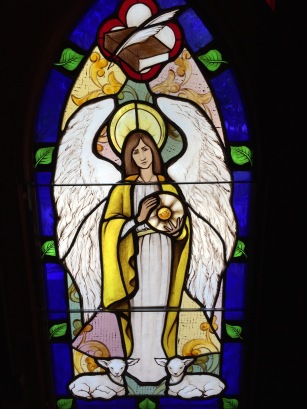
IMG_0175

Saint Uriel, the giver of divine light and patron of poets and artists. Saint Uriel’s task is to inspire. To make people wonder at the greatness of God and all his works. We pray to Saint Uriel to fill our thoughts with the beautiful ideas that come from God and we pray that like Saint Uriel, we too can inspire others in our own way.
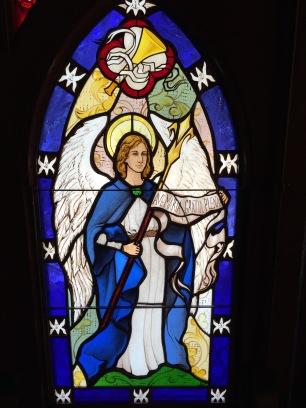
img_0174

Saint Gabriel, the announcing angel who visited a young virgin to tell her that she was with child and that that child was the son of God. Saint Gabriel’s task is to proclaim. To announce to the world the coming of Jesus Christ and to proclaim the truth that this child is unlike any other. We pray to Saint Gabriel that he may continually make Christ known to us and we pray that we can be so bold as to proclaim that same child to an unknowing and unbelieving world.

IMG_0169

Saint Michael, the prince of all the angels, the angel who casts Satan down and protects us from every attack of evil. Saint Michael’s task is to defend. To use his strength to defend those that are weaker in the name of justice. Saint Michael is the patron saint of police officers, soldiers and all law enforcement and that window is given as a tribute to all those who have answered the call to serve and protect. We pray to Saint Michael that he will protect us from the evil in this world, and especially protect those who put their lives in harms way on a daily basis, and we pray that we too will have the courage to stand up to evil in the world whenever we encounter it.
img_0168

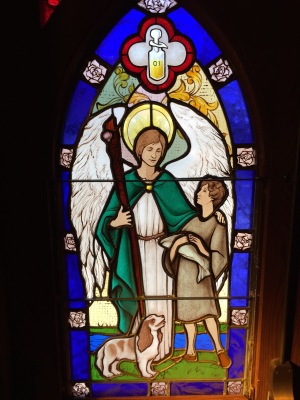
Saint Raphael, the medicine of God and the patron of pilgrims. Saint Raphael’s task is to heal. To embrace those who are suffering in body, mind or soul and give comfort and consolation. We pray to Saint Raphael that he may heal our infirmities, including our sins, and we pray that we too can be the instruments of God’s healing in the world.


Saint Uriel, Saint Gabriel, Saint Michael and Saint Raphael. As we enter this building, they remind us of the things for which we need to pray; as we exit they remind us of the work that we too are called to do in the world. We too are messengers of God, and we are called to Inspire, to Proclaim, to Defend, and to Heal. When we go out into the world doing that work, we invite people into relationship with God. The new entrance stands as a witness, not just to welcome those that are already coming in, but to invite those that are walking past. Our lives should do the same.


There are, of course, two more windows, which I haven’t referred to yet, and they are the most important. The windows at the heart of our front entrance, the two center doors, are mostly clear, and standing outside as you peer through them you first see the baptismal font, and then beyond that in the distance, the high altar and the tabernacle containing the body and blood of Christ. This is the feast that the angels are inviting us to. This is communion, becoming one with Christ and one with God. We go out into the world. Like the angels we serve as God’s messengers: we inspire, proclaim, defend and heal, but this is what we are inviting people to: to become the body of Christ in this world and ultimately to become citizens of the heavenly kingdom.

img_0717

Those aren’t just new doors and steps out there that lead into an old building. It is the gateway into a different kingdom and a different way of life. We have reason tonight to celebrate. We celebrate Alice Mary Roggenkamp who began pushing for a ramp for people with mobility problems to get into the church. We celebrate all those who contributed to the 125th campaign to help fund this project and especially the committee and those who worked long hours over the past couple of years to make this a reality. We celebrate the courageous lives of our soldiers and police officers who we will remember every time we see the light shining through Saint Michael’s face. We celebrate the lives of Mildred Savrda and Russell Dee Cooper, William and Dorothy Challice, Alfred and Ruth Frauenberger and Judith Berglund, for whom the other angel windows are given. Finally we celebrate the life of one man that wasn’t a member of this congregation; wasn’t even an Episcopalian, but nonetheless Fred Quenzer found in this church a place of spiritual refreshment and of grace. The front doors, the two center windows, the floor under your feet and even this vestment set that we are wearing were all made possible by the generous bequest from a man who only came here because someone invited him. If you have found God in this place, if you have experienced God through his angels, if you have been convinced of the truth we proclaim, if you want to fight for God’s kingdom and if you want to heal a broken world, then don’t just wait to welcome the souls that make it inside: go out and invite them.

What has straw in common with wheat?

Standard

Sermon for the Thirteenth Sunday after Pentecost

August 14, 2016

Readings:

Jeremiah 23:23-29

Hebrews 11:29-12:2

Luke 12:49-56

“What has straw in common with wheat?”


Or so asks the Lord through the prophet Jeremiah this morning. What has straw in common with wheat? Jeremiah is railing against false prophets in this passage. He is drawing a comparison between those prophets who truly have the word of the Lord, and those that are just promoting their own agenda. In the middle of this comparison he asks this interesting question: what has straw in common with wheat?


It is an interesting question, because the truth is, straw actually has a lot in common with wheat. Straw and wheat are the same plant. It’s a type of grass. When it grows and becomes ripe it is harvested. The seed, or the grain, is separated from the stalk and the leaves. The seed is wheat, the stalk is straw. So really, between one part of the plant and another there is quite a lot in common: it grows in a common field, it has a common look and smell, a common life really. There is so much in common between wheat and straw, and yet only the wheat has life within it. It is only the wheat, the grain, that can be planted again and create new life, and it is only the wheat, that can be crushed, transformed into flour and worked into bread; bread that can nourish us and sustain our lives. Humans can’t live on straw; horses can, their bodies our built to digest it, but ours aren’t. If we could manage to chew it, it might fill us up, but it can’t nourish us. We need wheat.


So this is how Jeremiah wants us to look at these two types of prophets and two types of prophecies: they may look alike and smell alike, they may in fact have a lot in common, but at the end of the day only one has the power to give life. Only one can nourish us.


So what are these two different types of prophecies or prophets that Jeremiah is talking about? Well the prophets of the true God, and there are many more than just Jeremiah, as he points out, the true prophets challenge God’s people. They preach a word that convicts them, calls them to change, calls them to put aside the false Gods that they have made by their own hands, to put aside idolatry and to return to the one, true, living God, who alone has the power to give life. Those are the true prophets; they may not be a barrel of laughs or much fun at a party, but they are the ones that help us to grow.


The other prophets? Jeremiah points out that God is well aware of them. He hears what they preach and yet can’t remember saying it himself. They are preaching from their own imaginations and dreams. They aren’t challenging the false Gods of the people; the people aren’t being asked to change their ways. Since the people are not being continually redirected to the true and living God, they are gradually turning away from him; moving further and further away, until eventually they even forget his name. Now let’s not kid ourselves here: we like these prophets; we like them because they make us feel good about ourselves, they don’t challenge us to change anything in our lives, we don’t have to examine our motives; they tell us that it is ok to stay just as we are: no need to grow, no need to change, no need to repent. Perfect for a party, but perhaps not so good for growing closer to the true God. Their words are straw: filling perhaps, maybe even comforting, but there is no life in them.


There is so much straw in the church today. Not just our church, not just the Episcopal Church, but in all churches there is straw; different types of straw maybe, but straw nonetheless. We have a lot of false Gods out there that we keep running after. We have made a lot of false Jesus’s, or perhaps not false, but at least incomplete. We cut out the words of scripture that challenge us. We dispense with any image of God that isn’t warm and fuzzy and we create (to quote the old Depeche Mode song) our own personal Jesus. We have liberal Jesus, the guy who only cares about the poor and the environment and convincing the world to take a big group hug. We have conservative Jesus, the Jesus of family values, who lets you keep your money, but makes you feel compelled to spend it on statues of him playing sports with your kids.


The problem with both of these Jesus’ is that they are straw men. They are one-sided caricatures of Jesus that don’t challenge us. They are easy and comforting and they ask very little of us. They aren’t the real Jesus. If you spend enough time reading scripture, and reading all of it, not just the happy parts, not just the warm and fuzzy parts, if you read all of it, at some point you are going to encounter a tough word from God. At some point Jesus is going to say something that you won’t like, and you can choose to either wrestle with it, or you can skip over it, walk away and ignore it and chase after the Jesus that makes you feel righteous without actually having to be better than you are.


This morning we get one of those tough words from Jesus. If you think that Jesus is all about peace, love and happiness: you are in for a surprise. If you think that Jesus is all about family values: you are also in for a surprise. This morning, Our Lord Jesus Christ, the prince of peace, says to us:


Do you think I have come to bring peace to the word? No, I tell you, but rather division.


And it’s not just going to be about one nation against another: it is a division that can separate our very families: the most intimate bonds. That is a tough word to swallow. It isn’t comforting, but if you have lived long enough in this world you will recognize that it is truth. Sometimes following God can mean making choices that you don’t want to make. This is the wheat of our faith. This is wheat because passages that challenge us and make us question our assumptions about ourselves and about God, those passages are the ones that put real life in our faith; those passages are the ones that make us grow. Whenever we read something that makes us question our own righteousness, that is when we are growing in our walk with God. Yes, sometimes we need God to embrace us, to pick us up and to love us in all our brokenness. We believe he does that, and thank you God for doing that, but sometimes we also need a kick in the pants; sometimes we need God to challenge us to do better, to be better. Sometimes we need to be redirected away from the idols of our own making and back to the God who actually saves us. Sometimes we need to be reminded that maybe God doesn’t always make the same choices we do, and just maybe, God doesn’t always vote the way we do. Last time I checked, Jesus was neither a Democrat nor a Republican, but we love to pick and choose his words to make him always agree with us. It is so easy to try to avoid being challenged by God, and it has gotten even easier in a world of Facebook, wherein you can just turn off the voices that say things you disagree with. I’m guilty of that too, I admit it.


The lesson from this morning’s gospel, and from the prophet Jeremiah, is that if you are looking to God for a pat on the back only, you may be sorely disappointed. God loves us, yes, but he is calling us to be better than we are. He is calling us to be more. Recognizing that is to lay hold onto the wheat of our faith; there is new life to be had in that truth.


As Christians we are continually surrounded by a great cloud of witnesses to the faith. Saints, prophets, patriarchs and matriarchs and martyrs, so many individual stories of people who found in God and in Christ a call to follow; a call to grow and to change; a call to forsake sin and to seek the redeeming love of Jesus. That is what our faith is about: not platitudes and sentimentality, but a God that is willing to suffer death in order to save us from ourselves. This isn’t cheap grace. We can’t turn away from the tough words of Jesus, we must embrace them, because there is truth there that we probably need to hear. That cloud of witnesses isn’t filled with people that had it all figured out; it isn’t filled with people that understood every utterance of God, and it isn’t filled with people that made all the right decisions. It is filled with people that knew that they couldn’t get through this life on their own and that turned to God for help whenever the storm clouds formed on the horizon.


We don’t come here to worship a straw man, or a caricature of Jesus: we come here to worship the living God, who sometimes comforts us and sometimes convicts us. Sometimes his words go down like honey, sometimes it is a bitter pill. There always have been and always will be false prophets. There will be ministers and churches that will focus on one aspect of Jesus and not the whole Jesus. There will be ministers that try to explain away miracles and there will be ministers that try to perform fake ones. There will be ministers who choose to skip over any Bible passages where God gets angry, and there will be ministers that revel in God’s anger and direct it at everyone else but themselves. Episcopal, Baptist, Catholic, it doesn’t matter, we all have our share of false prophets who promise you peace, even though Jesus promises us quite the opposite. Beware of them, beware of anyone who tries to over-simplfy God, or cheat you of the life-giving wheat of our faith, because what they are selling you is, to put it bluntly, horse manure, and as someone that has been knee deep in it, both figuratively and literally, I can attest that it is mostly straw.


The blood of the martyrs…A requiem for Orlando

Standard

Sermon delivered at the Requiem Mass for the victims of the Orlando Massacre

Sunday, June 19th, 2016

The early Christian author and apologist Tertullian once wrote that the Blood of the Martyrs is the seed of the church. He was making an argument to the Roman authorities that it was futile to keep persecuting the Christians because it only caused them to grow and become stronger.

The valor, the strength and the witness showed by those who were being put to death only served to strengthen the resolve of the living. Furthermore those that were unconverted, witnessed how these Christians would willingly accept death, rather than deny the Christ they knew, and they marveled at it. This must be some God these Christians are worshipping if they are so convinced of his love for them, that they are content to die rather than betray their God.

What these Christians knew, and what made them so resilient, was that their Lord had conquered death. They had the hope and the promise that because they were united to Christ in his life and death, so too would they be united to him in his resurrection. They knew that those Romans could kill their bodies, but that they could never kill their souls. It was by holding on to Jesus, it was by holding on to a God which they knew to be a God of love and forgiveness that those early martyrs claimed the victory. They had victory over death.

So I have been thinking this week about what it means to be a martyr. Christian martyrs are those who have died or been put to death specifically because of their faith in Jesus Christ, but there are other types of martyrs that deserve to be honored as well. I know very little about the faiths of most of the individuals that were killed last week in Orlando. I know that one young man was a gospel singer in his church, only when they found out through this tragedy that he was gay, declined to do his funeral. I know of another young man, a friend of a friend of mine actually, who was there at the club with his fiancé, both of whom were killed and now their love is being celebrated at a funeral service instead of a wedding. I know of a young man who was there with his girlfriend who was killed trying to save her. I know of a woman who was there with her son who died saving him. I don’t know much about what kind of faith each of those people had, or what their beliefs were, but I do know something about what brought them together that night.

You see I grew up gay in Central Florida, not very far from Orlando. Despite what people think about Disney World being there, Central Florida is a very conservative area. I can honestly tell you that I did not know one person who was openly gay, until I went off to college. There weren’t really any support groups or community organizations back then, at least not around where I lived. People still very much lived their lives in secret. Showing affection in public was very dangerous, you could never know how someone was going to react. I know what it feels like to grow up threatened with violence on a daily basis, just because I was different.

When you live in an environment like that you look for places that are safe. You look for places where you can be yourself, perhaps find love, and hopefully be able to express that love for a few moments before going back out into a world, that despite all of the advances that have been made in recent years, can still be very hostile. Now you might think that a nightclub is just a place for drinking and dancing and debauchery, but when you grow up gay in a conservative area, a nightclub can be one of the few places where you feel safe to express your love. I have been to the Pulse nightclub in Orlando with my friends and we went there to relax, enjoy our lives, enjoy each others company, and maybe, just maybe meet someone special. I have no doubt that that it is the same reason that all of those clubgoers were gathered together last Sunday: to celebrate love, to enjoy love or maybe even find love. It was love that motivated those people to gather at Pulse last Sunday, and it was love that motivated many of their actions to the very end.


To all of those who were killed in last week’s attack, and I believe you can hear me, you have the victory in all of this. You have the victory, not some evil man with a gun. You have the victory, because it was love that motivated you that night not hate. Our Lord was put to death because of the hatred and intolerance of others, he was put to death because he loved when others hated. To the souls of those killed last week, you were put to death because you loved when someone else hated. And it doesn’t really matter in whose name he hated in. I honestly don’t care about what that one man believed, because I know what I believe.


I believe that like the old gospel song says: “Jesus loved me ere I knew him and all my love is due him.” I believe that Jesus loves us before we know him. I believe that love and the act of loving draws us closer to the heart of Christ and of our God. I believe that Christ has won the victory over sin and death and that he offers those of us who unite ourselves to him in love that same victory.


We are here tonight to commend the souls of these 49 individuals to God. An evil man might have taken their bodies from us, but their souls belong to God. Death has no more dominion over them. Those of us who are still on our journey must keep on loving and showing love to others, not just to honor those that were killed for love, but for our sake too. So to build on what the Apostle Paul said, we must be steadfast in love, unmoveable in love, always abounding in the work of the Lord, which is love, foreasmuch as we know that our labour of love is not in vain in the Lord.


So I say this to the forces of evil out there that think that killing us or spilling blood is going to give them some kind of victory: if you think that hatred is ever going to win over love, let me tell you a story about a man I know named Jesus.

So that the world may know…

Standard

Sermon for May 8th, 2016

Readings:

Acts 16:16-34
Revelation 22:12-14,16-17,20-21
John 17:20-26


The first time I ever attended Mass in an Anglican Church, and the first time I ever received communion, was in Saint Paul’s Cathedral in London. It was one of those life changing moments that you never forget. I can remember clearly the beginning of the priest’s sermon as well. He got into the pulpit and began by saying:

God can change all things, but history….historians, however, can and perhaps that is the only reason why he tolerates them.


Now mind you, I was a history major in college at the time, so his point hit home. Sometimes it does seem like historians are changing history, with their at times wildly different interpretations of what actually happened. Now we know, of course, that historians can’t actually change history. Facts are facts. You can interpret or misinterpret them, you can like or dislike events that happened, there may be large gaps between what you know and what you don’t know, but you cannot change what actually happened.


I was reminded of that priest’s opening line this week, when I was reviewing this morning’s readings. I can’t change the Bible, but obviously the committee that devised our lectionary feels that they can. Our second reading this morning, the one from the Book of Revelation has been shortened…twice. Now by now, I am sure that y’all know how I feel about the cutting and pasting that sometimes happens in our readings. It is one thing if it is just a list of names that is being cut out to make the passage shorter, but that isn’t what is happening this morning. This morning there are verses that are cut out because someone either didn’t understand them, or they made them uncomfortable. Let’s take a look:

At verse 14 in Revelation chapter 22 we read:

Blessed are those who wash their robes, so that they will have the right to the tree of life and may enter the city by the gates.

That is all well and good. It is a nice image of heaven with people washed clean of sin, welcomed into the city and given access to the Tree of Life. But then it goes on. Here is the first verse that our reading skips this morning:

Outside are the dogs and sorcerers and fornicators and murderers and idolaters, and everyone who loves and practices falsehood.

We don’t want to talk about people getting left out of heaven (and no, for the record I do not think the author literally means that dogs are left out…at least I hope not). It seems so much nicer just to talk about all those blessed people and not to think about the idolaters…so this verse gets skipped over.

We continue on with:

“It is I, Jesus, who sent my angel to you with this testimony for the churches. I am the root and the descendant of David, the bright morning star.”The Spirit and the bride say, “come.” And let everyone who hears say, “Come.” And let everyone who is thirsty come. Let anyone who wishes take the water of life as a gift.

That is the sort of passage we like: very welcoming and encouraging. We get that verse, but then it goes on and this is the next verse that is skipped:

I warn everyone who hears the words of the prophecy of this book: if anyone adds to them, God will add to that person the plagues described in this book; if anyone takes away from the words of the book of this prophecy, God will take away that person’s share in the tree of life and in the holy city, which are described in this book.

Now I hope you appreciate the irony here: Here we have a verse giving a very clear and explicit command NOT to add to or take away from what is written in the book, on pain of losing eternal life, and it gets cut out! Whoever made that decision has a lot more self-confidence than I do.


Here is my point in all this: The Bible is a huge book, written by many different individuals, in different times and places and for different reasons. We believe that each one of these individuals was inspired in some way by God and that the writings they left us are worthy of respect and are to be taken seriously. But sometimes the things that are written there don’t make complete sense to us. Or maybe they do make sense and we disagree with something that is said. Maybe the authors don’t see things exactly the way we do, but I believe that it is exactly for that reason that we need to hear what they say. The Bible is meant to challenge us. Our faith is meant to stretch us and make us grow. If we are only exposed to things that make sense, or that we immediately agree with, how are we supposed to ever be better than we currently are? You don’t have to like everything you read in the Bible; you don’t have to agree with everything; you don’t have to accept every interpretation either, but maybe, just maybe you do need to hear it. Maybe a vital part of growing in the faith is to be challenged by it. How are we ever gonna be challenged if we simply cut out, skip over and ignore, the passages we don’t like or don’t understand?


Now everything that I have just said about how we treat the scriptures in the church could also be said about how we treat the people in the church. The scriptures are really just people on paper. There are some people in the church, and I don’t mean this parish, I mean the whole church of Christ, there are some people in the church that it is just hard to understand, there are some people that you may not agree with, and there are some people that you may not like. That’s ok, you don’t have to. But it just might be important to hear them. If scriptures are really just people on paper then there is the temptation to treat God’s people the way we treat his words: ignoring those that we don’t understand, don’t agree with or don’t like. But we need those voices.


Our own Anglican Communion has been squabbling with itself for some time now over one issue or another. In that sense it is just like every other Christian church. Whenever confronted with someone that we don’t understand, don’t agree with or don’t like, there is always going to be the temptation to silence them, ignore them or exclude them like a Bible verse you don’t want to read. People on both sides do it, liberal and conservative, but we do it at our own peril. We loose a significant part of our own faith formation when we do that, but we aren’t the only ones that loose though.


Our Lord’s great prayer before he was crucified and died was that all of his followers should be one. He didn’t say that we all had to understand each other, or agree with each other or like each other. He said that he wanted us to be one, just as he and the Father are one. Not just one within our parish or our denomination, but one across every single division we have set up out of our own stubbornness. One across race and language, one whether we are high or low church, one whether we are catholic or protestant. Jesus’s prayer is that we should be one. Belonging to Jesus Christ should be more important in our eyes than anything else. And it’s not just for our own sake…it is so that the world may know and believe. If we expect the world to take us seriously when we claim that Jesus Christ is Lord, and that salvation can be found by calling upon his name, then we need to show the world that no other name by which we may be called is more important to us than the name Christian. Ever since that first communion in Saint Paul’s Cathedral years ago I have been devoted to the Anglican tradition and I am loyal to the Episcopal Church through which I practice that tradition on a daily basis, but I also remember that it is through being a Christian that I am one with Christ and the Father in heaven, and one with everyone else who follows him and calls themselves by his name, and that is far more important to me, than any other division here on earth.

We are all outsiders

Standard

Sermon preached at The Church of the Resurrection, New York

for The Feast of the Epiphany 2016


In the year 614AD, a Persian army invaded Palestine and in the course of its pillaging and plundering took possession of the two most important churches in all of Christendom: The Church of the Holy Sepulchre in Jerusalem and the Church of the Nativity in Bethlehem.


The Church of the Holy Sepulchre, the site of Our Lord’s death and Resurrection, was quickly set fire to, but when the commander of the Persian army entered the church of the Nativity, so the story goes, he saw depicted there in mosaics that told the story of the Birth of Our Lord, three interesting figures: they were Magi (or wise men) that had come to honor this special child and what was most remarkable, they were dressed as Persians.


The commander of the Persian army realized then and there that whatever had happened on this spot, whatever had caused these people to build a shrine on this site, involved his people too. Here were his own people bringing gifts to this Jewish child. Whatever all of this was about, he might not have known, but what he did know was that he, as a Persian, had a place in this story.


So he ordered the building to be spared. And there it still stands today.


I love that story. It is hard, of course, to know just how much of the story is historical and how much is legendary, but that doesn’t really matter, because the truth in this story is about more than just one moment in time. The truth is this: that building survived because someone from the outside realized that the birth of Jesus Christ had significance for him too. He was an outsider, and yet, he was a part of the story.


I must admit I have always loved and been fascinated by those three wise men. The scriptures don’t give us very many details. Tradition may give us their names: Gaspar, Melchior and Balthazar, but not much else. So we are left to wonder: where might they be from? How might they have traveled? Would they have trekked on camelback down the king’s highway through exotic places like Petra? Could one have even travelled from even farther away India or Africa (perhaps riding an elephant as your nativity scene so beautifully depicts), or even China maybe? In the movies and in artistic depictions, the wise men are always in the most exotic and foreign dress and they are almost always depicted as being from different races. They are foreigners, they are outsiders, they have nothing to do with the race, religion or culture that Jesus is born into, and yet there they are right there at the heart of the story; there they are in almost every depiction of his birth.


The manifestation of Christ to the gentiles, or the Epiphany, which we celebrate this night is about more than commemorating one moment or episode in the life of Christ. It is about celebrating the truly miraculous fact that we, who are outsiders, are invited to participate in the life of Christ and the worship of God through him. It doesn’t matter what culture we are born into, what class we are born into, what race, what country…no matter how foreign we think we are, no matter how much of an outsider we may feel, there is still within Christ’s story, room for us.


The fact is: we are all of us outsiders here, or at least at some point we were. Nobody is ever born a Christian.


While it is true that many of you may not remember a time before you knew the church and its teachings, and that is a blessed thing I am sure, but you were not born into this religion. Nobody has a birthright to the grace offered through this holy child.


You can be born a Jew, you can be born a Muslim, but you cannot be born a Christian. To be a Christian you must convert. You must look at the story of the birth of Christ, and no matter how foreign or different you may feel, you must find yourself within it. You must realize that his birth, no matter how distant and far away it seems, has implications for your life.


Now your conversion may have taken place at a very early age. It is likely that many of you do not remember your baptisms, but that is of no importance. What is important is that at some point your parents or your Godparents wanted you to be a part of Christ’s story. Well done.


Still, no matter how faithful your parents were and no matter how much they wanted you to live a Christian life and to know the blessings of our Lord, you were the one who had to be converted. You were the one who had to be made part of the body of Christ through the waters of baptism. And whether you came to those waters early in your life or late, you must never forget that everyone begins their journey of faith as an outsider. The miracle that we celebrate here tonight, is that no one need remain an outsider.


This church was the first place that I ever encountered the tradition of blessing chalk on the Epiphany for the purpose of marking our doorposts with the year and initials of the three wise men. I am happy to say that in the past 10 years I have seen this practice increasing among churches and among the faithful, perhaps with a little help from social media. It is an excellent way for us to be reminded of our faith during our daily comings and goings and it is an invitation for our lord to bless our homes during the coming year, but I would put to you that this little symbol can be more than just a sign of blessing made in some mysterious code.


I would put to you that the symbol we mark on the outside of our doors with this chalk can be a reminder to us, that we, like those wise men, all began our journey on the outside, as foreigners to the household of God; as people, who through some miracle given by God and not through any merit of their own, have been given an invitation to enter and who have found themselves to be a part of this story.


Let that symbol remind us of all those who seek God and as yet have not found him. Let it remind us of all of the outsiders in our midst: the foreigners, the outcast, the unloved and the lonely. Let it remind us that just as we have found a place for ourselves within this story, that there is still room here for yet more. Indeed part of our charge as Christians is to help others cross that threshold; to find here a home for themselves as well; to find in Christ’s story a part of their own story.


In our world of countless distractions, it is a miracle that people still seek God at all. In the Magi, we have the model of the religious pilgrim: the journeyer, the seeker, the person who risks much, and leaves much behind in order to search for God. Perhaps the greatest gift that the Magi had to offer Jesus was their attention and devotion: the very fact that they sought him to begin with was undoubtedly worth more to Christ than the Gold, frankincense and myrrh. I imagine it is still so today: Christ honors those who seek him. We must honor those who seek him as well.


Our faith survives because people on the outside still realize that the birth of Christ has significance for them too. There is no reason in this world why the birth of a Jewish child in Palestine should be of any concern to wise men from Persia or anywhere else, and yet miraculously it was of concern. Great Concern. There is equally no reason why it should be of concern to us living some 2000 years later, and yet miraculously here we are, taking the time to end our celebration of his birth, by celebrating the moment that those on the outside realized just how significant it was, and were welcomed into the story.


This parish was founded 150 years ago as a mission to those who were on the outside. This neighborhood, was then outside the city limits, and its residents were at the time in no sense a part of New York City’s elite or genteel society. But the founders of this parish believed that the people that lived here were a part of Christ’s story as well, and thus the Church of the Holy Sepulchre (later the Church of the Resurrection) was begun. But despite the fact that this church has for quite some time now, been well within the city limits, it is still very much in the mission field. Outside of these doors are a vast multitude of souls that do not have the connection to Christ’s story that you have; that are disconnected from the traditions of his church and unaware of the spiritual witness of countless saints and sages, who were also born outside of Christ’s kingdom, and yet found a place for themselves within it. As we leave here tonight to hurry home and mark our doors with the symbol of the Magi, may we give thanks to God that we who were born outsiders have been reborn as a part of this story, may we give thanks for the witness of this parish, which exists to retell this story, and may we always remember those who are still on the outside, looking to get in.


Be Linus

Standard

Sermon for Christmas Eve 2015 at The Church of The Ascension, Rockville Centre

Readings:

Isaiah 9:2-7
Titus 2:11-14
Luke 2:1-14(15-20)

In the name of the Father and of the Son and of the Holy Ghost. Amen.


This year represents the 50th anniversary of a Christmas tradition that I am sure is near and dear to the hearts of many of us here. I, like many of you, grew up watching the Charlie Brown Christmas special, and although it is a part of secular Christmas, something of which I am usually very skeptical, there is a timeless quality to that short little cartoon that makes it stand apart from the countless other Christmas specials that those of us that grew up with television have been subjected to.

If you haven’t watched it in a while, let me just remind you of how it begins. Charlie Brown, your average boy in an average American town has a problem. He isn’t happy. It is almost Christmas and all of his friends seem to be in the Christmas spirit and Charlie just isn’t. What is more, to all of his friends, that Christmas spirit seems to be primarily concerned with a joyful expectation of what gifts they will get on Christmas morning. Everyone is busy filling out their letters to Santa, telling him all the things they want; although to be fair, Lucy does admit that she never gets what she really wants: real estate.

Think about this for a minute. Think about how much in our world and in our lives has changed in the last 50 years, or for that matter, in the last 30, or 20, or 10. So much has changed in the last 50 years, and yet even then, Charlie Brown’s biggest complaint is how commercial Christmas had become. No computers, no internet, no cell phones, only 3 television channels, and even then there was an underlying disillusionment with the celebration of Christmas, so much so that we would create a children’s cartoon television special to talk about it.

Were the makers of the Charlie Brown Christmas special simply being prescient in their portrayal of Charlie Brown’s dilemma? Were they being prophetic about how commercial Christmas would become? Or, were they perhaps touching on something that has been a perennial problem for Christians throughout the ages: namely, how do we remain focused on the birth of Christ, when the world seems to be trying to draw our attention elsewhere? Maybe Charlie Brown’s observations about Christmas are not so much a reflection on what Christmas was like 50 years ago, but about what Christmas has always been like and maybe that’s why his Christmas special still seems timely and relevant, when so many others are dated.

So I decided to do a little research. I took a look back at portrayals of Christmas through the 20th century and before. Since I have always been a fan of old movies, it was not an onerous task. Think of some of your favorite Christmas films…the classic ones. Miracle on 34th street for instance. That film is about the conflict between the material secular world and its commercial Christmas, and the real Santa Claus, who is far more concerned with what is in a child’s heart, than in what is under their tree.

Or take one of my favorites: The Bishop’s Wife, about an Episcopal bishop who spends more time at Christmas worrying about building his cathedral, than he does tending to the emotional needs of his family. Or take a look at one of the darker films of the genre: It’s a Wonderful Life…about a man driven to the brink of suicide because the material pressures of the world have blinded him to the true importance he has had for the people around him. Film after film, story after story, at Christmas time we find people who’s interior life is in conflict with the world around them. Even in Charles Dickens’s beloved Christmas carol, we have Ebenezer Scrooge who cannot see the deeper meaning in Christmas festivities, but only frivolity and waste. It didn’t start with the Victorians either…the Puritans were so disgusted by the outward celebration of Christmas that they outlawed it, which was of course not the greatest of their religious errors, but a grievous one nonetheless.

What my very informal and unscientific research has shown me is that at Christmas time we become acutely aware of a conflict. It is a conflict that is always there, but we are usually able to ignore it. Throughout most of the year it is very easy to go about ignoring any tension between our physical wants, desires and inclinations and the interior spiritual longing which we all possess, but not so at Christmas. At Christmas people are on their worst behavior, while at the same time singing and proclaiming their greatest ideals. People will walk on top of each other…kill each other…in order to get a material gift, which they will then give in a supposed celebration of Our Lord’s birth. Of course Christmas unsettles us, because it is then that we have to confront the fact that we humans are incapable of living up to our own ideals. We have been singing “Peace on earth, good will towards men” for thousands of years now and it still hasn’t happened. No matter how hard we have tried, and I do think we have tried, we just have not been able to solve the problem of human nature. Our technology has changed, our clothes have changed, our hair styles have changed, but on the inside…people are still the same. Let’s not mince words and just call it what the church has always called it: sin. Who God calls us to be, and who we actually are, are in conflict. We do not live up to our ideals; we cling to the wrong things, we choose lesser goods and momentary gratification. It was ever this way, we just usually ignore it, but at Christmas it is harder to do that.

Now you may be beginning to feel a bit Charlie Brownish yourself. You may be feeling a bit depressed and want to run off to the nearest person dispensing psychiatric help like Lucy, and question why we cannot just be happy, and why we cannot just fix ourselves and our world while we are at it. Well psychiatric help is excellent, and I think many people would benefit from it, but Lucy doesn’t have the answer for Charlie Brown. She can’t help him fix his problem. Only Linus can.

Linus proclaims to know what Christmas is all about and what people are celebrating. So he steps out on stage, calls down the lights, and begins to tell a story. It is a story from the bible, and for those who may question whether children can relate to and understand traditional liturgy, I always hasten to point out that Linus recites from the Authorized or King James Version. Linus proclaims the birth of Christ to Charlie Brown, and he says this is what it’s all about. All of that conflict that you are feeling between your hopes and your dreams and your reality…this is the answer. The war between our ideals and our sins…this is how it is going to be won: not by any device or scheme of our own, but by something that God has done. Perhaps it is no accident that Christmas is such a trying time, for so many people, because it is in that struggle, it is in standing in that place between who we are and who we want to be that we realize just how much we need Christ. My sisters and brothers this is what the incarnation is all about: how God conquers the problem of sin and heals our broken world, and our broken souls.

Anyone can look out at the world and get exasperated at the sins of man, but it is the person of faith that knows that God has already done something about it, and in that knowledge rejoices. That is what we are celebrating at Christmas. Not what we give each other, but what God has given us.

I have watched that Christmas special so many times that I thought I knew it as well as Linus knew the Gospel of Luke, but last week someone pointed out a little detail to me that I had completely missed. I am going to venture to say that a lot of you probably missed it as well. You may want to go home and re-watch it, because it really is a lovely little detail.

We all know that Linus is forever attached to his blanket. It never leaves his hands. It is his security in a world that can be dark and scary. It is a material thing that gives him comfort that he clings to with all his might, but as Linus begins his recitation of Luke’s gospel and the proclamation of Jesus’s birth watch what happens: he drops his blanket. That material thing that Linus loved most, that represented his protection from the scary world and all of his fears, for a few moments it winds up as merely a rag on the floor, dropped by Linus as he is caught up in the awe and wonder of what God has done through the birth of Jesus and the real meaning of Christmas. With Christ he no longer needs to be afraid of this world, with Christ he no longer needs to cling to the material things of this world for comfort and protection; God has given him everything he could ever need or ask for.

It is a little detail, easy to overlook, but there it is: Christ separating a little child from his fears. Linus picks the blanket back up at the end of his speech, but watch what happens later: when he discovers that Charlie Brown’s Christmas tree needs it more than he does, he lets go of it again…uses it to wrap the tree in the love that it needs to shine. What was once a thing to cling to has become a tool to love and support something that needs it more.

If the knowledge of Christ’s birth and what God has done to fix our broken world and our broken souls can transform the lives of children in a cartoon Christmas special, what can it do for us? Can we let go of our fears? Can we find in the proclamation of the birth of Jesus the answer and the antidote to the anxiety and the stress and the unfettered materialism of this season? Can we let go of anything that we are clinging to more than we cling to Christ? Can we for a moment just stand in awe and appreciation, recognizing that God has done for us what we could never do for ourselves? And can we walk away changed…ready to use those possessions that we formerly coveted to help others who need them more?

Sisters and brothers that is our challenge tonight…but not just tonight. As Christians that is our challenge each and every day: to relate to the world differently; to be transformed by the knowledge of what God has done in Jesus Christ; to be subjects of the king that was born that night in the manger in Bethlehem, and to be the heralds of his kingdom.

In the end it doesn’t matter if it is the 1960s, the 1860s or the 1660s, people are still the same; human nature and human sin has not changed, but we can be changed. We can be transformed by knowing what Christmas is really all about. That has not changed. Not in 50 years, not in 200 years, not in 2000 years.

For a moment tonight, be Linus. Let go of whatever you are clinging to and simply hold on to Jesus. You will most certainly pick them up again on you way out, just as Linus did his blanket, but maybe, just maybe you will cling to them less tightly. Maybe you will learn like Charlie Brown, that this is the only part of all this Christmas stuff that actually needs to be taken seriously.

N.B. part of the inspiration for this sermon comes from an article that I shared earlier this week which can be found here