A balanced view of the Second Coming

Standard

Sermon for November 30, 2025

Readings:

The Reformation leader Martin Luther is reported to have once said that “the world is like a drunken peasant. If you lift him into the saddle on one side, he will fall off the other side.” 

That image of a man who just cannot stay upright in the saddle but is just inclined to fall off his horse on one side or another was an inspiration to C. S. Lewis who saw it as the perfect symbol of humanity out of balance. We make an error by going too far in one direction, but then we respond or react to that by going too far in the other direction. Sometimes we fall off the horse on the left, sometimes we fall off on the right, but regardless of which side of the horse you fall off, you are still a drunken fool laying on the ground. Balance is the key to staying on top. Balance is the ability to correct without over-correcting. It requires you to be aware of the forces that are pulling on you from both sides and not to give in to one or the other. 

This, Lewis says, is a problem not just with religion, but with everything. He said he distrusts reactions in everything and I have to say I am there with him. Humans don’t react to things, we overreact to them. We watch people make a mistake in one direction, and then we head off and make a mistake in the opposite direction. Lewis makes this observation in one of his essays about religion called “the World’s Last Night.” As an aside, if anything I say this morning interests or inspires you, then I would encourage you to read his essay yourself. I am stealing from him liberally and shamelessly this morning. Anyways, in this essay Lewis talks about the doctrine of the second coming of Christ, which is of course what Advent is really about, not just preparing for Christmas. “and he shall come again, with glory, to judge both the quick and the dead; whose kingdom shall have no end.” It is right there in our creed. It is in our scriptures. You heard it just now. Jesus says that he will come again. How are we supposed to react to those words? That is a question Christians have grappled with over the centuries.

The problem, Lewis says, is that we humans are inclined to make one of two mistakes or overreactions. We either take Jesus at his word, and then start trying to figure out the precise moment in time he will come, becoming utterly consumed by expectation that then leads to crushing disappointment. Or, we dismiss Jesus’s words, and the idea that he will come again altogether. We write them off as ancient superstition and go on living our lives as if we and the world we live in will go on forever. We pay no attention to him. But these are both mistakes. 

The first mistake of trying to figure out exactly when Jesus is coming has been done so many times at this point that it just boggles the mind that people keep doing it, but people keep doing it. We just can’t help ourselves. Some of you may remember a few years back that guy Harold Camping who had decided that it was going to be May 21st, 2011 when the world would end. When it didn’t happen, he said, ok, maybe October 21st. It is easy to make fun of him but Camping stands in a very long line of religious folks that have tried to figure out precisely the day and time of Christ’s return and failed. And they were destined to fail, because Jesus said they would fail. The same people who want to take seriously Jesus’s promise of his second coming, somehow fail to take seriously his admonition that no one can or will know when it will happen. If God says you’re not gonna know, you’re not gonna know, but for some reason people keep trying. 

And these failed predictions and the people who make them, actually lead people into making the second mistake. So many times, people have been told that the end is nigh and Jesus is coming, and so many times he hasn’t shown up. It is no wonder then that so many people, even many Christians dismiss all this talk about a Second Coming as being antiquated and embarrassing. To put it simply, they don’t believe it is going to happen. But this is, of course, to fall off the other side of the horse. 

The problem with both of those mistakes is that neither one of them takes all of Jesus’s words very seriously. They both want to conveniently omit something, and in doing so they miss the whole point of why Jesus told us that he would come again. Keep awake! Be ready! Jesus is talking in the present tense here, not the future. The Second Coming isn’t just about some future event. It is about the here and now. If we take Jesus’s words seriously, all of them, what I think we will find is a balanced view of the end of the world that has real power to affect the life we are living today. I think that is the point of all of this.

Jesus tells us that the world will someday certainly come to an end, AND then he tells us that we cannot and will not know when that time will be. It will be unexpected. Therefore, and this is the important part, THEREFORE we must always live our lives with a constant awareness that the future is in God’s hands, not our own. We never know how much time we have. We never know what the future holds. A wise and prudent person will make plans and provisions for the future, but a faithful person will remember in doing so that tomorrow is a gift, not a promise. Those big plans you have for the future, they might never happen. That thing that you are sitting here worrying about, it might never happen. This life that you have is a gift from God and at any moment you may be asked “what have you done with it?” That is what the Second Coming is about…not taking this life for granted. Being prepared for the end, not by living in fear of it, but by living with the knowledge that each day, each day is a gift from God. The end will come, someday, somehow, for each and every one of us. It may be a bus, it may be an embolism, or it may be our Lord descending from on high, but one way or another the end will come. To stay awake and to be prepared, is not to spend endless hours obsessing about the end itself and how and when it may come about. To stay awake and to be prepared is really about making sure that you are making the most of the time you have been given. It seems paradoxical, but the doctrine of the Second Coming really is more about what you are doing today, than it is about what God may be doing tomorrow. 

A Good Steward

Standard

Sermon for September 21, 2025

Readings:

Amos 8:4-7
Psalm 113
1 Timothy 2:1-7
Luke 16:1-13

Our family has been rewatching Downton Abbey lately in preparation for the new and final film which is about to come out. Not that we need to rewatch it; we’ve seen the series several times at this point, but it is a nice diversion and even little Lord Robert seems to be enjoying it. One of the central themes that comes up over and over again in that show is the idea of stewardship or being stewards. The Crawleys don’t see themselves so much as owners of the great estate, but as stewards of it. Episode after episode there is discussion after discussion about how they have a duty to hand something on to the next generation. They inherited the estate, but they had to do everything in their power to manage it wisely and carefully in order to pass it on. It was never just theirs. To be a steward of something, means that you are a caretake for a time, but not forever. It doesn’t really belong to you. 

I was reminded of that this week when I was signing for a permit to replace the roof over the parish hall. Incidentally we have to replace the roof over the parish hall to stop all those leaks you may have noticed. Anyways I had to sign the form under “owner.” Well I have had to do this many times before and it always feels odd. I am the rector, I am the executive of the organization and the legal representative with the power to sign for things, but I would never call myself the owner. I’m not the owner. None of us is. We are stewards that are entrusted with the responsibility of this place for a while, but not forever. 

We have less of that kind of talk now, of being stewards. Churches are one of the few places where we still talk about stewardship, but even when we do that, we are more often than not just talking about paying today’s bills. We aren’t usually thinking beyond next year’s budget. We live in a world of buying and selling and living in the moment. We aren’t trained to think long-term anymore. I think part of what makes Downton Abbey feel quaint is all that talk of duty and stewardship and responsibility and tradition. Everyone lives in a world of generations and eras. There is as much talk of history as there is the headlines in the papers. It’s quaint, but this understanding of stewardship, of being a generational care-taker, isn’t completely foreign to us. We know what it means. We just don’t think about it as much. We think that right now is all that really matters.

But to be a good steward, one has to be aware that one’s position is time-limited. The thing that you are the steward over will not always be yours. And what then? Will you leave something behind that is better and stronger than you found it? What future are you helping to create? And what of your time in power? Will you be remembered for using the power and influence you were afforded to help others, or will people think of you as self-centered and greedy? As a steward, the actions you take now will have future consequences, and will be judged by future generations, and you have to always be aware of that. 

This morning’s gospel reading is a difficult one, and I think it is made more difficult by our modern translation which calls the dishonest main character a “manager.” The King James Version uses the word “steward” which I think is more to the point and has a little less corporate baggage than the word “manager.” A rich man has a steward; someone who does not own the property outright, but nonetheless has the authority to run things and make decisions. Now we are told from the very beginning that the man is being fired for squandering the owner’s property. That is an important point to remember. The manager is already being fired for what he has done before his actions in the gospel story. We aren’t really given many details though. We are told that he was squandering property. Well judging by what happens next, we must assume that the steward or manager was not squandering property by lavishing gifts or preferment on his friends and acquaintances. He wasn’t storing money away in a secret retirement fund. He had to have been living purely for the moment. He must have been spending the money on momentary pleasures for himself, because this steward doesn’t start thinking about the future and about others UNITL he finds out he is about to be fired. The termination of his position seems to come as quite a shock to him. Like he wasn’t expecting it, or just thought his power and position would go on and on. It hits him like a ton of bricks when he finds out he is being let-go. Then all of his past decisions start coming out to haunt him. He has no money saved, and he doesn’t want to work and doesn’t want to beg. And it is clear from what happens next that he doesn’t have any friends either. This steward has been a terrible steward because he has been living only for himself and not thinking about the future. It comes as a shock to him when he realizes that his position is time-limited. To be a good steward one has to realize that one’s position is time-limited and he doesn’t. 

So he does something that is both shady, and forward thinking. It’s the first time this steward really starts to think about the future. He goes to everyone that owes the master money and he reduces their debt. He cooks the books, but probably for the first time he cooks the books not in his own favor but in someone else’s. He knows now that he needs other people. He knows that his future is in jeopardy because all this time he has been only thinking of himself, and taking, and using his position for his own pleasure and enjoyment. Now that he knows that power and wealth is fleeting, he realizes that it is relationships that really endure, so he goes around trying to repair those in his last few moments. It’s shady, its’s dishonest, but at least the steward has learned a valuable lesson. And the rich owner commends him. And that is a part of the gospel story that people really struggle with. Why does the rich man commend this dishonest steward for giving his money away?

Well we know that the master of the estate does not appreciate or condone dishonesty; that is why the steward is being fired in the first place. But finally the steward has learned what stewardship is really about: the future. The steward finally woke up to realize that living for the moment, and living for himself, was not enough. That is what the owner was commending. He had finally gotten enough wisdom to realize that it wasn’t all about him. He had been a slave to his own greed and self-interest and now at least, he was free of that. 

I have often said that inside of every pulpit should be inscribed the words “it’s not about you!” Perhaps those words should also be written on the vestry minutes or financial reports. Perhaps they should be written on the bulletins, in the prayer books, and on our website. Maybe we should paint them on the wall over the altar. Because all of us, on some level, are stewards of something. Whether it is the planet we live on, the country we live in, or the church we pray in, we have all been given responsibility, for a time to manage and make use of something that doesn’t really belong to us. What will we do with it? Will we be enslaved to our own interests and the needs of the moment? Or will we think about the generations to come? I will be interested to see how the Downton Abbey saga concludes, and please don’t anyone spoil it for me. But I would be willing to bet that the creators of the show will spend as much time thinking ahead to the family’s future as they do revisiting moments from the family’s past. I guess we shall see. 

Looking up, without looking down

Standard

Sermon for August 31, 2025

Readings:

Sirach 10:12-18
Psalm 112 
Hebrews 13:1-8, 15-16
Luke 14:1, 7-14

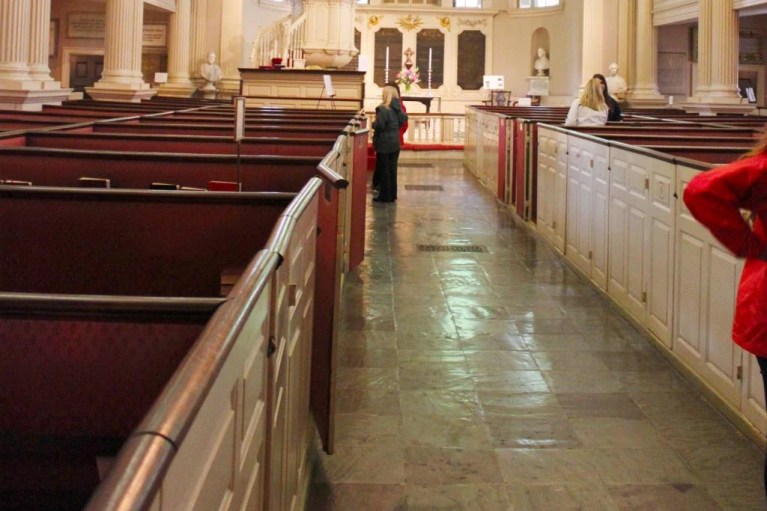
In 1885, when this church was founded, it was founded to be a free church. What that means, is that it was the intention of our founding families that this church would not charge pew rents, but instead would rely on the voluntary donations and pledges of the congregation. Many of you are aware that there was a period of time, especially during the 1700s and early 1800s, when churches had box pews with little doors that were rented. It’s how churches paid the bills. A lot of you have “your pew” that you always sit in now, but back then your pew really was your pew. You paid for it and nobody else could sit there. And of course, just like going to a Broadway show, the best seats cost you more. So if you wanted to sit down front where you could see and be seen, you would pay a premium for it. There were usually some free seats, but they were in the balcony or in the back. If you visit many historic colonial churches, you will find just this setup. 

It really was a disgraceful practice, especially in the light of the plain reading of the gospel, but for so many years it was so common that it really was unquestioned. You just assumed that the fancy, rich folks in church got to sit up front, and the poor folks would sit in back. One of the later reforms that came out of the Oxford Movement, which was a church reform movement in the early 19th century that was started by my hero, John Keble, was the movement away from this pew rental system. Our founders were influenced by that. I think that we may justifiably be proud of our parish, and our founders, for wanting to abandon this pew rent practice. It is a good thing to be proud of. The bible has lots of warnings about pride, but we need to remember that there is good pride and there is bad pride. There is a pride that is born out of love and gratitude, and there is a pride that is born out of self-righteousness and disdain. We can embrace one, hut we need to be very careful of the other.

It is good to be proud of our parish and our founders for wanting to abolish pew rents, but in being proud we need to remember that we weren’t the first parish to try that, not by a long shot. We weren’t the first; we weren’t the only ones; and there were times when we seriously considered implementing pew rents because finances were so tight. So, we can be proud of what our founders did accomplish while at the same time recognizing that they weren’t perfect. We can love our parish without having to feel that it is necessarily superior to every other parish that ever existed. That is healthy pride, good pride. That is pride that is born out of love. And I think that all humans need that sort of pride. It is a pride that makes you raise your head and look up. You raise your head and look up to people who might be a little better at this thing called life than you are. You raise your head and look up to elders, and heroes. You raise your head to recognize superior skill, superior values, and superior wisdom. You raise your head to recognize something superior to yourself. Healthy pride involves looking up, not looking down, and to look up you need to be able to recognize that there must always be someone or something above you. And if you can’t do that, then you can’t know God. That is when the other kind of pride gets in the way.

Negative pride, pride that is born out of self-righteousness and disdain, looks down. Negative pride is about feeling superior to others. This unhealthy type of pride is presumptuous, it takes the high seat at the table. It assumes that it must be the best, the greatest, the wisest, and therefore does not strive to be better than it is. That is why this type of pride is so deadly. It alienates you from God above and from everyone else below. You have no need for anything above you and you are too good for anything beneath you. Negative, unhealthy pride is isolating and it leads to destruction. That is the type of pride that the scriptures are talking about in the first reading this morning:

The beginning of human pride is to forsake the Lord;
the heart has withdrawn from its Maker. 

For the beginning of pride is sin,
and the one who clings to it pours out abominations. 

Therefore the Lord brings upon them unheard-of calamities,
and destroys them completely. 

The Lord overthrows the thrones of rulers,
and enthrones the lowly in their place.

Be very careful if you think the throne is yours or if you think the best seat in the house belongs to you. You may just find yourself turned out of your pew when the true owner of the house arrives. Take the lower seat our Lord advises. Assume that there are others that are better than you. Look up and show respect. Remember that you still have things to learn. We may think that charging rent for pews is a totally abhorrent idea that is contrary to the gospel, but 100 years from now there may be some practices that we simply ignore or take for granted that future generations may be scandalized by. We can be proud of our ancestors, we can look up to them, but we needn’t be self-righteous in doing so. We can look up, without looking down, if you know what I mean. 

The funny think about learning to always look up to those above you, is that in doing so you learn to hold your own head a little higher. Learning to respect others goes hand in hand with learning to respect yourself. So healthy pride, pride that is born out of love, pride that is born out of admiration for that which is good walks hand in hand with humility. We can be proud of ourselves and our accomplishments, we can be proud of our children and our families, we can be proud of our church, our country, our heroes, and we can be proud of our cultures. We can be proud of all these things and we can love them without thinking that they are superior to all others or completely faultless. Humility isn’t about looking down in shame; it is about looking up in admiration. When we learn to look up to others, our own status rises as well. Those who exalt themselves will be humbled, but those who humble themselves will be exalted. 

Mr. McBeevey

Standard

Sermon for August 10, 2025

Readings:

Genesis 15:1-6
Psalm 33:12-22 
Hebrews 11:1-3, 8-16
Luke 12:32-40

Many of you know that the Andy Griffith Show is one of my favorite shows of all time. I have preached about it several times. If you are a younger person and don’t know the show, go and watch it. You can stream it online. If you are an older person and grew up with it, it is worth watching again. The show is an intentional throwback to a different time and place, it is idealized and sanitized, but it is nonetheless a reminder of personal qualities and values that could use a revival. 

I think my favorite episode of the show is called Mr. McBeevey. Opie is out playing in the woods and he comes back to the sheriff’s office all full of stories to share with his dad, Andy, and deputy Barney Fife. He tells them that he met this man named Mr. McBeevey, who spends all day up in the trees, wears a fancy metal hat, jingles when he walks, and can make smoke come out of his ears. Andy and Barney naturally assume that Opie is telling a fantastic tale about a made-up friend as children sometimes do. And then Opie says, “and he gave me this quarter.” And as Opie holds up a real quarter, Andy’s demeanor changes. It is one thing to make up a make-believe story, but it is another thing to tell an outright lie, and Opie seems to be crossing the line. When Opie insists that he is telling the truth, Andy drives out to the woods with him to find this Mr. McBeevey, but of course there is no sign of him. Opie refuses to change his story though. Mr. McBeevey is real. Andy and Opie drive home and now Andy is getting very cross. Make-believe is one thing and that’s fine, but Opie needs to understand the difference between the truth and a lie. Andy is resolved that he is going to have to punish Opie. 

So Andy goes to Opie’s room for a father-son talk which is just one of the best scenes ever. He explains to him the difference between the truth and a lie and he tells him what the consequences will be if Opie persists with this Mr. McBeevey story. But Opie says (crying), but Mr. McBeevey is real, and if I said he wasn’t I would be telling a lie. Don’t you believe me pa? And you see this change come over Andy’s face. Before he had looked stern and disappointed, and now you could just see this sense of bewilderment and love. So Andy goes back downstairs. And Barney, who is always a little too eager to act in every situation, says to Andy: well, aren’t you going to punish him? And Andy says, no. Barney replies, you don’t mean to tell me that you actually believe in this Mr. McBeevey do you? And Andy says, no….but I do believe in Opie. No, but I do believe in Opie. 

I love that scene so much. Andy cannot comprehend the story that Opie is telling. It seems magical, nonsensical, unbelievable. Andy has serious doubts or questions about this Mr. McBeevey, what he doesn’t doubt though, is his son. Andy’s relationship with Opie and love for Opie his him the strength and the courage to say, I don’t understand this, I don’t know how this can be true, but I am going to trust you. My friends, that is faith right there. That is how faith works. Faith is not about certainty. Faith is not about seeing is believing. Faith is not about understanding. Faith is not as much an act of the mind as it is an act of the heart. Faith is a response to a relationship. It is an act of love. 

Our second reading this morning is the eleventh chapter of the Book of Hebrews. I remember once when I was in college I met a guy who had memorized the entire chapter and would perform it and I supposed if you are going to memorize a chapter of scripture this is an excellent choice, because it is all about faith. The passage talks about the faith of Abraham and Sarah, believing that God would do the impossible for them. There are a few verses missing there this morning that also talk about Abel and Enoch and Noah, and later we hear about Issac and Jacob. And we are told that “All of these died in faith, without having received the promises, but from a distance they saw and greeted them.” The great patriarchs and matriarchs of our faith, they had to trust in God and in their relationship with God, more than they trusted in themselves. Abraham and Sarah had doubts about where or not they would ever have a child, I assure you, but they trusted in God anyways. To be a person of faith means to be able to believe in things that you cannot yet see. To be a person of faith means to lean on love more than you lean on understanding or your own perceptions of things. 

You do not have to understand the meaning of everything Jesus ever said in order to love and follow him as the son of God. You don’t have to have a clear blueprint of heaven in order to believe in it. You don’t need to comprehend every single article of the creed in order to stand and say it will all of us every week. You don’t need to be able to explain why bad things happen to good people, or why good things happen to bad people. You ought to read the bible and pray, but you don’t need to be some great theologian to be a great person of faith. All you really need to be a person of faith is love. You need to love God and the more you are able to love God, the easier it will be for you to believe and trust in the promises that God makes to you. Love God, love Jesus, love whoever it was that first shared their faith with you. You don’t have to wait for a miracle or a sign to start loving God. You don’t have to see in order to believe, you have to love. When we stand every week and say the creed, we are not proclaiming things that we ourselves have seen: we weren’t there when God created the earth, we weren’t there when Jesus was born or when he suffered and died; we weren’t there when he rose from the grave; we may have encounters with the Holy Spirit, but we weren’t there when it spoke through the prophets, and so far none of us have seen Jesus come again to judge the quick and the dead, we have not experienced the resurrection of the body and the life of the world to come. Most of the things we proclaim in the creed have nothing to do with our own personal experience of God. It is the accumulated experiences and witness of countless generations of faithful people that have loved God, and experienced God’s love in return. The creed is a witness to the God we love and worship. We worship a God who creates. We worship a God who sacrifices and suffers. We worship a God who inspires and warns. We worship a God who judges, forgives and redeems. 

Living in relationship with this God means learning to use your heart as well as your mind. Sometimes love and relationship can open your heart to believe things that your mind cannot comprehend. At least, that is what happened to Andy when he decided that while he struggled to believe Opie’s story, he still believe in Opie. 

I guess I should add that at the end of that episode, Andy is wandering around in the woods trying to figure all this out, when he just utters the name “Mr. McBeevey.” Suddenly a voice from above says “Hello? Is someone calling me” Andy is completely startled and he looks up and down from the pole beside him climbs a telephone repairman with a metal helmet, and tools dangling from his belt that jingled when he walked. Andy was never happier to meet a telephone repair man in his whole life. Mr. McBeevey was real, and yes…he even had a trick to make smoke come out of his ears. 

On loving your enemies

Standard

Sermon for February 23, 2025

Readings:

I have to admit this morning that I kind of feel that preaching on this gospel passage is a little above my pay grade. Everything that Jesus has to say is important, but these words are extremely important. These words are the foundation stone of Christian morality and ethics. They are simultaneously the most often quoted words of Jesus, and the most often ignored. It is hard for me to preach on this passage, because I struggle with this too. Just this week I found out about something bad happening to someone that I would consider an enemy, someone I intensely dislike, and you know what it felt good. It felt really good for a minute, when I thought YES, this person is getting what he deserves. Karma! But then the gospel reminds me that God is kind to the ungrateful and the wicked. Jesus says to “be merciful, just as your father is merciful.” Jesus doesn’t offer us any exemptions on loving our enemies and praying for them. This morning’s gospel is familiar, but very, very hard. It tells us to do things that are unfair and that we don’t want to do. So I am turning to someone else for help this morning, one of my favorite authors, C. S. Lewis. What he has to say on this is better than anything that I could come up with. He writes:

Everyone says forgiveness is a lovely idea, until they have something to forgive, as we had during the war. And then, to mention the subject at all is to be greeted with howls of anger. It is not that people think this too high and difficult a virtue: it is that they think it hateful and contemptible. ‘That sort of talk makes us sick,’ they say.

But right in the middle of Christianity, I find ‘Forgive us our sins as we forgive those that sin against us.’ There is no slightest suggestion that we are offered forgiveness on any other terms. It is made perfectly clear that if we do not forgive we shall not be forgiven. There are no two ways about it. What are we to do? We might make it easier by trying to understand exactly what loving your neighbour as yourself means. I have to love him as I love myself. Well, how exactly do I love myself?

Now that I come to think of it, I don’t exactly have a feeling of fondness for myself. So apparently ‘Love your neighbour’ does not mean ‘feel fond of him’. I ought to have seen that before, because, of course, you cannot feel fond of a person by trying. Do I think well of myself, think myself a nice chap? Well, I am afraid I sometimes do (and those are, no doubt, my worst moments) but that is not why I love myself. In fact it is the other way round: my self-love makes me think myself nice, but thinking myself nice is not why I love myself. So loving my enemies does not apparently mean thinking them nice either. 

That is an enormous relief. For a good many people imagine that forgiving your enemies means making out that they are really not such bad fellows after all, when it is quite plain that they are. Go a step further. In my most clear-sighted moments not only do I not think myself a nice man, but I know that I am a very nasty one. I can look at some of the things I have done with horror and loathing. So apparently I am allowed to loathe and hate some of the things my enemies do. Now that I come to think of it, I remember Christian teachers telling me long ago that I must hate a bad person’s actions, but not hate the bad person: or, as they would say, hate the sin but not the sinner.

For a long time I used to think this a silly, straw-splitting distinction: how could you hate what a person did and not hate the person? But years later it occurred to me that there was one man to whom I had been doing this all my life—namely myself. However much I might dislike my own cowardice or conceit or greed, I went on loving myself. In fact the very reason why I hated the things was that I loved the person. Just because I loved myself, I was sorry to find that I was the sort of man who did those things. Consequently, Christianity does not want us to reduce by one atom the hatred we feel for cruelty and treachery. We ought to hate them. But it does want us to hate them in the same way in which we hate things in ourselves: being sorry that the person should have done such things, and hoping, if it is anyway possible, that somehow, sometime, somewhere they can be cured.

Lewis goes on here to point out that sometimes we are disappointed to find out that someone isn’t quite as bad as we had hoped. It isn’t just that we hate our enemies; it’s that we want to hate them. We find a perverse joy in hating them. So we are determined to cling to that hatred, even against evidence. Lewis also says that it is perfectly fine to punish your enemies, and to fight them even to death if necessary, so long as what is motivating you is the good of another and not simply this perverse desire to “get ones own back.” To love your enemies, does not require you to become a doormat. It doesn’t require you to turn evil into good. It requires you to look at your enemies the way you look at yourself. To wish them well, even if they aren’t. He concludes talking about the need for Christians to suppress hatred:

I do not mean that anyone can decide this moment that they will never feel it anymore. That is not how things happen. I mean that every time it bobs its head up, day after day, year after year, all our lives long, we must hit it on the head. It is hard work, but the attempt is not impossible. Even while we punish we must try to feel about the enemy as we feel about ourselves—to wish that he were not bad, to hope that he may, in this world or another, be cured: in fact, to wish his good. That is what is meant in the Bible by loving him: wishing his good, not feeling fond of him nor saying he is nice when he is not.

Looking at Christian love the way C. S. Lewis does makes it seem a bit less daunting to me. I don’t have to try and muster affection for people who have done harm to me. I don’t have to ignore any damage or pain caused. I simply need to wish his or her good. It isn’t affection. It isn’t the same thing as the natural love we feel toward our friends and families. It is a supernatural love that teaches us to love the way that God loves. It requires grace. It is about always desiring good, even in the face of evil, and not succumbing to the evil itself. 

A God who Keeps

Standard

Sermon for May 12, 2024

Readings:

On the night before Jesus died, he prayed. I know that it may seem odd now that we are well past Easter, and even past Our Lord’s Ascension into heaven, it may seem odd to jump back in our gospel readings to the night before Jesus was crucified, but that is where we go this morning.

 I guess in a way it is only natural, because after the disciples had witnessed Jesus’s Resurrection and then his Ascension into heaven, their minds certainly would have gone back to retrace all their steps over the past few months. They would have looked back with newly opened eyes to reexamine everything Jesus ever said or did, and the things that had happened most recently would naturally have stood out more prominently in their minds. So, this morning we go back to Maundy Thursday, we go back to the evening of the Last Supper, to after dinner was over, and we hear Jesus’s own post-communion prayer. 

“Holy Father, protect them,” he says. Jesus’s prayer is about his disciples. He is about to die, but his primary concern here is for his disciples and THEIRprotection. Their lives are his concern. “Protect them in your name that you have given me, so that they may be one, as we are one.” Protect them. Some other translations of this scripture, including the King James Version, use the word “keep” instead of the word “protect.” I think that is a better word actually because “keep” doesn’t just meant protect, but it also implies possession and belonging. If you keep something you hold on to it. Keep emphasizes the fact that these disciples BELONG to God. Their protection is directly linked to the fact that they are God’s treasured possession. Keep them, Jesus says, keep them. Keep them safe; keep them together; keep them in the truth and keep them united to us and to each other. Keep them.

There was a minister in England writing near the end of the 1600s named Matthew Henry who wrote an extensive commentary on the bible. And his comment on this passage is an extension of Jesus’s prayer and plays on this use of the word “keep.”

He writes:

Keep their lives till they have done their work; 

keep their comforts, and let them not be broken in upon by the hardships they meet. 

Keep their interest in the world, and let it not sink. 

Keep them in their integrity, keep them disciples, keep them close to their duty. 

Keep them for your name’s sake. Keep them in the knowledge and fear of your name; 

keep them in the profession and service of your name, whatever it costs them.

Keep them in the interest of your name, and let them ever be faithful to this. 

Keep them in your truths, in your ordinances, in the way of your commandments. 

Keep them by your own power, in your own hand; 

keep them yourself, undertake for them, let them be your own.

Keep them from evil. Keep them from Satan as a tempter that either he may not have leave to sift them and keep them from him as a destroyer that he may not drive them to despair. 

Keep them from the evil of the world and of their tribulation in it.

Keep them. Now those are Matthew Henry’s words; that is his expansion of Jesus’s prayer, but I think his use and repetition of the word “keep” meaning to hold, possess AND protect is really in keeping with (it is holding on to) Jesus’s original prayer and meaning. Keep them. Like a parent tucking their kids in at night, Jesus’s prayer before he leaves his disciples is that God will hold them tight. Now I lay me down to sleep, I pray the Lord my soul to…what? Keep! All at once it means to embrace, to own and to defend. That is what Jesus is asking God to do for these disciples. Keep them God.

And I think that it is important that we recognize and emphasize that the person who is being asked to do something in this prayer here is God. God is the one who is being asked to act. It is God who is being asked to keep, to hold, possess, and protect. It is easy to forget for a moment that Jesus is addressing God in the gospel today. He is so often talking to us. But this is his prayer to God that we are eavesdropping in on. It is so like us humans to always want to take center stage and make everything be about what we do or don’t do; and yeah, I think the things we do in this world matter and there are plenty of scriptures that talk about that, but I don’t think that this scripture is one of them. This scripture is about what God does. 

God keeps. God holds on to the people that belong to him. He gives them his word, his joy and his truth. Now God’s people don’t always hold on to God, but God is always willing to hold on to them. God keeps because that is who God is and what God does, but that is in contrast to what the world does. God keeps, but the world casts aside. The world throws away. In the eyes of God human life is precious; in the eyes of the world it is expendable. God keeps, but the world casts aside. God keeps his covenants; the world breaks them. God brings people together; the world drives them apart. God sanctifies truth; the world sanctifies lies. God raises up a human body to glorify it; the world raises up a human body to murder it. God’s ways, and the world’s ways are very different.

Now the Gospel of John is very clear about the fact that God created the world, but it is also clear, right here, that not everything in the world is OF God. There is a difference between God and the world. God keeps, but the world casts aside. But we are OF God. Jesus’s prayer reminds us that we are OF God. Jesus might not be telling us to do anything in this prayer, but his words should affect our actions nonetheless because they remind us of who we are and who we belong to. We belong to God, not the world. We are in the world. God wants us to be in the world. Jesus sends us into the world. There is work for us to do here and there are blessings for us to receive here, but we don’t belong to the world. We belong to God. We belong to a God who keeps.

Inviting all preachers…

Standard

Dear Fellow Preachers,

My companion website to Inwardly Digest, The Pulpiteer, will be beginning a special program next month called Preaching Companions. Preachers who wish to participate will be invited to send a video of a sermon that they have preached recently to the Pulpiteer. Sermon links or video files must be received by March 8th. The videos will then be compiled and sent out to all participants. The participants will then gather via zoom on March 19th to offer each other feed back. Please see below for further guidelines.

  • Participants will select one sermon that they have given from the previous month. After the first of the month they will send us a link to a video of this sermon. At the end of the first week of the month The Pulpiteer will compose an email that consists of links to all of the videos and send this out to the group. On the last week of the month we will have a scheduled zoom call and offer each person constructive feedback on their sermon.
  •  It is not necessary for each person to participate every month, however, out of consideration for everyone’s time if you submit a sermon for the group to watch, it is expected you will be present for the zoom call. If you can’t make the call at the end of the month, then please don’t submit a sermon that month.
  • Sermons may come from any context (Sunday morning, midweek, weddings, funerals, major feasts, etc.) but participants in the zoom call should submit a sermon of some sort and should indicate in some way what scripture readings were offered during the service. Ordinarily, everyone who is present to offer critique should also be receiving critique. This is meant to be a group for mutual support (and mutual vulnerability) and therefore everyone participating will need to be open to giving AND receiving feedback.
  • Participants should be committed to Christian orthodoxy, broadly speaking. While there is ample room for diversity and disagreement on biblical interpretations and styles of churchmanship, basic creedal Christianity is expected to be the norm. Participants are reminded that in their ordinations they affirmed their belief in the Old and New Testaments to be the Word of God and committed themselves to uphold the doctrine, discipline and worship of the Episcopal Church. Sermons should reflect these commitments even when trying to advocate for change or reform. Clergy from other Christian denominations are welcomed to participate; however the same commitment to a broad creedal orthodoxy is expected.
  • Feedback will be offered by participants both on content and style. For this reason, videos of sermons are preferred. Participants must be committed to offering critique that is constructive and to being respectful of their fellow preachers. All of us, at one time or another, have delivered a sermon that simply didn’t hit the mark. Humility and respect both in giving and receiving feedback is essential.
  • Arguments about pronouns and Divine gender are to be avoided. We respect that preachers will be preaching to different congregations in different contexts. Arguing about pronouns for God is rarely helpful and does not always take into account these local contexts. Plus, there are many ways that a preacher can broaden a congregation’s understanding of God rather than simply referring to God as “she.” Simply stated let’s not spend too much time here and respect a preacher’s choice to use what works for them in their context.

Finally, preachers are encouraged to submit “hits” as well as “misses.” In other words, don’t just submit your best sermons, but also submit sermons that just didn’t go quite the way you wanted or hoped. We are all here to grow and improve and not just to congratulate each other!

Our first zoom gathering will be on Tuesday, March 19 at 11:00am.

If you are thinking of something to do for your own spiritual and professional growth this Lent, why not consider joining us? For more information and to register, please visit thepulpiteer.org

Introducing “The Pulpiteer”

Standard

If you are a follower of this blog, especially if you are a fellow preacher, then I would invite you to follow and visit my new site: Thepulpiteer.org

My own sermons will continue to be posted here, but theological reflections and practical advice on the art of preaching will be posted over on the Pulpiteer. Please check it out and sign up to follow it!

The Gospel is weirder than you think.

Standard

Sermon for November 6th, 2022

Readings:

Job 19:23-27a
Psalm 17:1-9
2 Thessalonians 2:1-5, 13-17
Luke 20:27-38

The gospel is weirder than you think! And by “gospel” I am talking about the good news of Jesus Christ. That good news is written down in the four accounts of his life, the four gospels, but THE gospel, the message about who Jesus was and what Jesus did, that isn’t just a biography of a good teacher; it isn’t just a book, or four books; it isn’t just a philosophy of being nice; it isn’t a set of rules that we must follow; it isn’t a blueprint for fixing the world or establishing world peace. THE gospel isn’t about something we can do. THE gospel is a good news message about what GOD has done in the world and it is a message about what GOD is going to do in the world. We often think that the gospel is just a past-tense account or story of what Jesus said and did, but the real gospel isn’t just about the past, it is about the future too. And the real gospel, THE gospel, THE good news, isn’t just about Jesus. What makes THE gospel such good news, what makes it so compelling, is that fundamentally it is about us. Each and every one of us. The real good news is that Jesus’s resurrection is a foretaste, a glimpse of our resurrection, and that really is weirder than most people think. 

Christians have a long history of settling for less than the full good news of the gospel. We want to over-simplify it or sanitize it to make it more palatable to our skeptical friends. We want to strip it of the miraculous and make it mundane. We want to make it an instruction manual for this world, something else for us to do, and not the glorious vision of a transformed world to come that we have been offered, promised even, a place in. There is nothing mundane about a dead body coming back to life. Jesus wasn’t somebody that coded in the ER and was resuscitated. He crawled out of the grave. That is not something any of us have ever seen in our lives. You may have witnessed a miracle before, but you haven’t seen a miracle on that scale. The resurrection is a very weird thing. A glorious thing, but a weird thing. It is so weird that even people who wholeheartedly believe in Jesus’s resurrection still have a hard time believing that this is their destiny as well. It is so easy to make the gospel just about what God has done in Jesus, and not about what God is going to do in our lives, but that isn’t the full good news. 

You know, if you ask a lot of Christians what happens when we die, they are likely to say, “well, your soul goes to heaven (or maybe somewhere else).” But a spiritual, disembodied heaven has never been the full Christian hope. It isn’t the full gospel. Our real hope, our real destiny is resurrection. God taking the dust the remains from our earthly existence and transforming it into a new, living creation that is no longer subject to sin and death. That is our real hope and it is a hope that takes place in a future day at the end of all time. A new heaven and a new earth. Our blessed dead may exist now in a realm of paradise and rest in the presence of the Lord, but that is not the ultimate end. The ultimate end is the day of the Lord when the dead are rasied to a new life in a new body, in a new and very different, although recognizable and familiar world. That is our real hope, that is the real good news, the full gospel message: we have been invited to be children of God. Children of the resurrection. We have been offered the promise to some day walk out of the grave, just like Jesus did. Not metaphorically or spiritually, but flesh and bone. 

That is real good news, but it is real good news that people struggle with, in part because it is weird. None of us have seen a really dead body come back to life, so there’s that. But also, none of us have ever lived in a world that isn’t stained by death and sinfulness, so it is really hard for us to imagine what that might even be like. All of our relationships, even the most loving ones, still have the marks of this sinful, fallen world all over them. People struggle to imagine what a resurrected world and a resurrected life might look like, so the resurrection is a complicated and somewhat controversial idea for many people of faith, and that was true even more in Jesus’s day than it is in ours. There were some Jews who believed in the resurrection and hoped for it, and there were some who didn’t. The Sadducees were trying to make fun of Jesus’s belief in the resurrection in today’s gospel reading. They aren’t asking him a serious question; they are asking him a ridiculous question. A woman marries seven brothers, they all die. In the resurrection, whose wife will she be? In other words: who does she belong to? Belong to! That is what they are really asking. Think about that for a second…the Sadducees can’t even conceive of a world where a woman doesn’t belong to a man like a piece of property. Jesus’s response is basically: she will belong to God. Any world where we all stand equally before God as his children is bound to look a little different than the world we are living in right now. It isn’t that our loving relationships won’t exist in the next world, but they will be transformed, in ways that we probably can’t even imagine. That is good news too. 

The devil does not want you to believe this good news. The world, and even many in the church, will sell you a gospel that is less than good news, or at least less than the full good news. Don’t settle for it. Don’t settle for anything less than the resurrection of the dead and the life of the world to come. Don’t settle for a gospel that is just about what Jesus said, and not also about what he did, AND, AND what he is going to do. Don’t settle for a gospel that is just about the past, and not also about the future. Our future, as people who have been promised our own resurrection and a share in a new world that God is creating; a world that our sinful minds can’t even properly conceive of. Don’t settle for less than that. Don’t settle for a gospel that isn’t weird. Because good news, really good news, can seem pretty weird sometimes, and even hard to believe.

On the death of Her Majesty

Standard

Dear Ascension Family,

Today is a day that we always knew would come, and yet never wanted to see. 

While the news of the death of Her Majesty, Queen Elizabeth II, does not come as a great surprise given her advanced age and recent illnesses, it is nonetheless an occasion of great sadness, not just for the people of Great Britain, but for people throughout the world. We are not simply witnessing the death of a great and remarkable woman; we are witnessing the end of an era.

Although most of us are citizens of the United States of America, and we are members of the Episcopal Church, our shared tradition and history as Anglicans, means that we have a familial relationship with our brothers and sisters in the Church of England, of which Queen Elizabeth II was the Supreme Governor. It needs to be said that in addition to being an extremely influential head of state in world affairs, Her Majesty was a serious and committed Christian who lived her faith openly in front of the world. Her annual Christmas speech has consistently been a powerful witness to her faith in Jesus Christ. Her stability and sense of duty, in both civil and religious affairs, in good times and in bad times, have been an inspiration for so many. I can only pray that for those of us who may be wondering, “where do we go from here?” that her life may serve as an instructive example. 

The British system of democracy is different than the American system. Prime Ministers may come and go, but the Monarch remains a constant throughout his or her life. It is a system that values stability in the midst of change. I have always found that to be very comforting, because in a world that is constantly changing we all need stabilizing forces in our lives. Queen Elizabeth was certainly that. I also think that there is something to be said for having a head of state that is not a political figure, but one instead that seeks to be a symbol of national unity. Queen Elizabeth was that too. I suspect that although Her Majesty’s earthly service may have ended, her life will be teaching us lessons in leadership for many years to come.

Our prayers at this time are offered, first and foremost for the soul of Queen Elizabeth, that the Lord will welcome his servant into his heavenly kingdom; secondly, for her son Charles, who now ascends the throne as King; for the Queen’s family, during this time of great personal loss; for the people of Great Britain and of all the Commonwealth Nations; for Anglicans throughout the world; and finally, for all those who mourn the passing of a great woman who touched the lives of so many. 

A memorial service to mourn for and celebrate the life of Her Majesty will be scheduled at Ascension in the near future at a date and time to be announced. 

Our parish was founded during the reign of Queen Elizabeth’s great, great grandmother Queen Victoria. Her 63 year and seven month reign was the longest of any British monarch, until it was surpassed by Queen Elizabeth in 2015. Even the greatest kings and queens of this world come and go though, and now Elizabeth, who has lived a life of service to others may rest in peace and receive her reward. What gave Elizabeth strength in this life, was knowing that no matter what throne she sat on or what crown she wore, she always served a greater King. 

May that King, the King of Peace and the King of Glory, comfort us all now.

Sincerely,

Fr. Kevin Morris