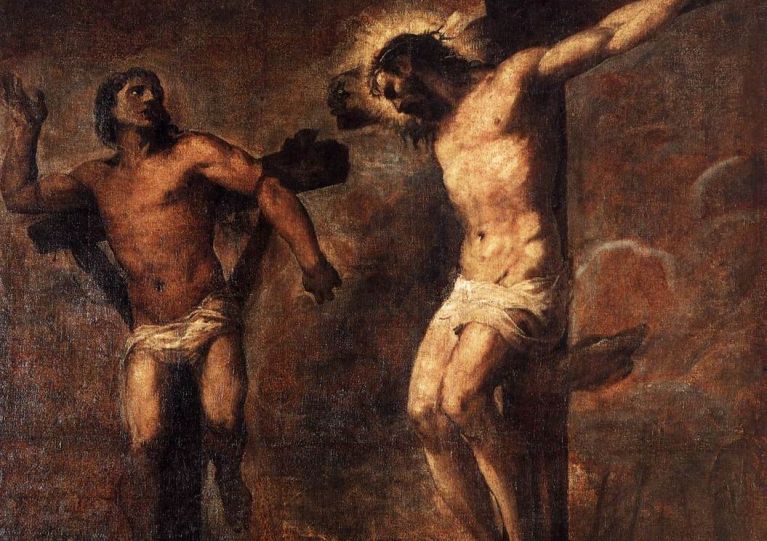
So that the world may know…

Standard

Sermon for May 8th, 2016

Readings:

Acts 16:16-34
Revelation 22:12-14,16-17,20-21
John 17:20-26


The first time I ever attended Mass in an Anglican Church, and the first time I ever received communion, was in Saint Paul’s Cathedral in London. It was one of those life changing moments that you never forget. I can remember clearly the beginning of the priest’s sermon as well. He got into the pulpit and began by saying:

God can change all things, but history….historians, however, can and perhaps that is the only reason why he tolerates them.


Now mind you, I was a history major in college at the time, so his point hit home. Sometimes it does seem like historians are changing history, with their at times wildly different interpretations of what actually happened. Now we know, of course, that historians can’t actually change history. Facts are facts. You can interpret or misinterpret them, you can like or dislike events that happened, there may be large gaps between what you know and what you don’t know, but you cannot change what actually happened.


I was reminded of that priest’s opening line this week, when I was reviewing this morning’s readings. I can’t change the Bible, but obviously the committee that devised our lectionary feels that they can. Our second reading this morning, the one from the Book of Revelation has been shortened…twice. Now by now, I am sure that y’all know how I feel about the cutting and pasting that sometimes happens in our readings. It is one thing if it is just a list of names that is being cut out to make the passage shorter, but that isn’t what is happening this morning. This morning there are verses that are cut out because someone either didn’t understand them, or they made them uncomfortable. Let’s take a look:

At verse 14 in Revelation chapter 22 we read:

Blessed are those who wash their robes, so that they will have the right to the tree of life and may enter the city by the gates.

That is all well and good. It is a nice image of heaven with people washed clean of sin, welcomed into the city and given access to the Tree of Life. But then it goes on. Here is the first verse that our reading skips this morning:

Outside are the dogs and sorcerers and fornicators and murderers and idolaters, and everyone who loves and practices falsehood.

We don’t want to talk about people getting left out of heaven (and no, for the record I do not think the author literally means that dogs are left out…at least I hope not). It seems so much nicer just to talk about all those blessed people and not to think about the idolaters…so this verse gets skipped over.

We continue on with:

“It is I, Jesus, who sent my angel to you with this testimony for the churches. I am the root and the descendant of David, the bright morning star.”The Spirit and the bride say, “come.” And let everyone who hears say, “Come.” And let everyone who is thirsty come. Let anyone who wishes take the water of life as a gift.

That is the sort of passage we like: very welcoming and encouraging. We get that verse, but then it goes on and this is the next verse that is skipped:

I warn everyone who hears the words of the prophecy of this book: if anyone adds to them, God will add to that person the plagues described in this book; if anyone takes away from the words of the book of this prophecy, God will take away that person’s share in the tree of life and in the holy city, which are described in this book.

Now I hope you appreciate the irony here: Here we have a verse giving a very clear and explicit command NOT to add to or take away from what is written in the book, on pain of losing eternal life, and it gets cut out! Whoever made that decision has a lot more self-confidence than I do.


Here is my point in all this: The Bible is a huge book, written by many different individuals, in different times and places and for different reasons. We believe that each one of these individuals was inspired in some way by God and that the writings they left us are worthy of respect and are to be taken seriously. But sometimes the things that are written there don’t make complete sense to us. Or maybe they do make sense and we disagree with something that is said. Maybe the authors don’t see things exactly the way we do, but I believe that it is exactly for that reason that we need to hear what they say. The Bible is meant to challenge us. Our faith is meant to stretch us and make us grow. If we are only exposed to things that make sense, or that we immediately agree with, how are we supposed to ever be better than we currently are? You don’t have to like everything you read in the Bible; you don’t have to agree with everything; you don’t have to accept every interpretation either, but maybe, just maybe you do need to hear it. Maybe a vital part of growing in the faith is to be challenged by it. How are we ever gonna be challenged if we simply cut out, skip over and ignore, the passages we don’t like or don’t understand?


Now everything that I have just said about how we treat the scriptures in the church could also be said about how we treat the people in the church. The scriptures are really just people on paper. There are some people in the church, and I don’t mean this parish, I mean the whole church of Christ, there are some people in the church that it is just hard to understand, there are some people that you may not agree with, and there are some people that you may not like. That’s ok, you don’t have to. But it just might be important to hear them. If scriptures are really just people on paper then there is the temptation to treat God’s people the way we treat his words: ignoring those that we don’t understand, don’t agree with or don’t like. But we need those voices.


Our own Anglican Communion has been squabbling with itself for some time now over one issue or another. In that sense it is just like every other Christian church. Whenever confronted with someone that we don’t understand, don’t agree with or don’t like, there is always going to be the temptation to silence them, ignore them or exclude them like a Bible verse you don’t want to read. People on both sides do it, liberal and conservative, but we do it at our own peril. We loose a significant part of our own faith formation when we do that, but we aren’t the only ones that loose though.


Our Lord’s great prayer before he was crucified and died was that all of his followers should be one. He didn’t say that we all had to understand each other, or agree with each other or like each other. He said that he wanted us to be one, just as he and the Father are one. Not just one within our parish or our denomination, but one across every single division we have set up out of our own stubbornness. One across race and language, one whether we are high or low church, one whether we are catholic or protestant. Jesus’s prayer is that we should be one. Belonging to Jesus Christ should be more important in our eyes than anything else. And it’s not just for our own sake…it is so that the world may know and believe. If we expect the world to take us seriously when we claim that Jesus Christ is Lord, and that salvation can be found by calling upon his name, then we need to show the world that no other name by which we may be called is more important to us than the name Christian. Ever since that first communion in Saint Paul’s Cathedral years ago I have been devoted to the Anglican tradition and I am loyal to the Episcopal Church through which I practice that tradition on a daily basis, but I also remember that it is through being a Christian that I am one with Christ and the Father in heaven, and one with everyone else who follows him and calls themselves by his name, and that is far more important to me, than any other division here on earth.

We are not left behind

Standard

Sermon for the Feast of the Ascension 2016

In the 1920s a man by the name of Albert Brumley was picking cotton one day on his family’s farm in Oklahoma. As he was struggling through the heat, and his sweat, and the prickly cotton bushes, he started to sing a song to himself. It was a popular song of the day called the Prisoner’s Song, about a man leaving his girl behind and being sent off to prison, and longing to escape and be with her again:


I’ll be carried to the new jail tomorrow

Leavin’ my poor darlin’ alone

With the cold prison bars all around me

And my head on a pillow of stone


Now if I had wings like an angel

Over these prison walls I would fly

And I’d fly to the arms of my poor darlin’

And there I’d be willin’ to die.


With his back breaking from stooping to pick the cotton, and being surrounded by these dead sharp bushes that poked and tore at his skin, Albert thought to himself: this too is prison. This life with its pains, and struggles and eventual death, this life can be a prison.


Albert reckoned that he was in prison of sorts, just like the author of that popular song, and then he thought: If I could escape the wall of this prison, where would I go? He began to think about his devout Christian faith (being raised in the Church of Christ) and how that faith for him not only offered the promise of eventual freedom, but in fact gave him a sense of freedom right then. So when he got back to the house at the end of his long day of toil he sat down and wrote this song…his version of the Prisoner’s Song:


Some glad morning when this life is o’er,

I’ll fly away;

To a home on God’s celestial shore,

I’ll fly away


I’ll fly away, Oh Glory

I’ll fly away;

When I die, Hallelujah, by and by,

I’ll fly away


When the shadows of this life have gone,

I’ll fly away;

Like a bird from prison bars has flown,

I’ll fly away


Just a few more weary days and then,

I’ll fly away;

To a land where joy shall never end,

I’ll fly away


That song that Albert wrote would become one of the most popular and most recorded gospel songs of all time. Now, not everyone that ever put pen to paper to write a hymn was inspired by God; some hymns are just awful; but I think that Albert was. Albert was because there is something about singing that hymn that actually sets you free, right when you sing it. It isn’t just about thinking of some future day, but in the realization that our lives belong to God, it makes that future day today. If you have ever had the chance to sing that song at a funeral or when you were really struggling or down, then you might just know what it feels like to have your spirit fly. It isn’t just the person being buried that is flying away, it is us too. The amazing thing about this song is that you don’t have to wait until that glad day when this life is o’er to fly away, the moment you sing it you already begin to fly away, you already begin to experience freedom from the prison of this life and you already begin to experience the joy that shall never end. When you sing that song you too are flying away, you are not merely left behind.


Today is the Feast of the Ascension, a day when we remember that after our Lord’s resurrection from the dead, he ascended into heaven in the sight of his disciples. Now you might expect those disciples to be distressed or heartbroken that their Lord had left them; that he appeared to fly away into the clouds; but that is not what happened. When Jesus died people went home beating their breasts, but when he ascended into heaven they went home rejoicing, with great joy and they dedicated their lives to worship and blessing God. They were not abandoned or left behind, quite the contrary: a part of them ascended with Christ.


Saint Augustine, when he wrote about the Ascension of our Lord said:


Today our Lord Jesus Christ ascended into heaven; let our hearts ascend with him. Listen to the words of the Apostle: If you have risen with Christ, set your hearts on the things that are above where Christ is, seated at the right hand of God; seek the things that are above, not the things that are on earth.

For just as he remained with us even after his ascension, so we too are already in heaven with him, even though what is promised us has not yet been fulfilled in our bodies.


If we have committed ourselves to Jesus Christ, if he already has our hearts, then when he ascends into heaven a part of us goes with him. We are not left behind, we are not trapped in prison, because his ascension has set us free. A part of those disciples flew away with Jesus, he didn’t just take their humanity and their human flesh, he took their hearts, and by gathering all those things unto God, he redeemed them.


The life that Jesus ascends to at the right hand of the Father is one of constant praise, worship and adoration and joy. It is that life to which the disciples try to mold their lives as much as possible: imperfectly and in earthen vessels, but still the old Jerusalem seeking after the new Jerusalem.


Today we remember Jesus going to his eternal home on God’s celestial shore, but we are not left behind or abandoned: we go with him. We may have to wait a few more weary days until that glad morning when we will be gathered together with Christ and all his saints, but just like singing Albert’s song, we don’t have to wait until then to fly away and be set free.

In Memoriam Donald C Latham

Standard

Sermon given by Father Kevin Morris, Ninth Rector of the Church of The Ascension at the funeral mass of Father Donald Latham, Sixth Rector of the Church of The Ascension, April 24th 2016.

I want to begin by reading you an excerpt from a letter:

 You must understand this: distressing times will come. For people will be lovers of themselves, lovers of money, boasters, arrogant, abusive, disobedient to their parents, ungrateful, unholy, inhuman, implacable, slanderers, profligates, brutes, haters of good, treacherous, reckless, swollen with conceit, lovers of pleasure rather than lovers of God, holding to the outward form of godliness but denying its power. Avoid them!  For among them are those who make their way into households and captivate silly women, overwhelmed by their sins and swayed by all kinds of desires, who are always being instructed and can never arrive at a knowledge of the truth.


Now here is a question: was I just reading from the 2nd letter of Paul to Timothy describing the Last Days, or the 1st letter of Donald Latham to Kevin Morris describing the Church of the Ascension?


You will be forgiven if you are unsure of the answer to that.


I actually thought that I was beginning to solve a great theological mystery this week: you see we don’t actually know who wrote the second letter to Timothy. It is traditionally attributed to Paul, but we know that its tone and style look nothing like Paul’s. Who could have written it then? Whose style of writing is this? And then I started to pour over my old correspondences with Father Latham and the light came on! This sounds like something he would have written.


I was prepared to announce my Latham hypothesis for the authorship of 2nd Timothy, until I came across one line: “No one serving in the army gets entangled in everyday affairs; the soldiers aim is to please the enlisting officer.” I realized then and there that Father Latham couldn’t have written this, because although he was quite good at giving orders, he didn’t always like to receive them. He told the story about when he was in the Navy and disobeyed his commanding officers orders by staying up in the signal room during a combat when he was supposed to be in the wardroom, because according to him the view was better. Now it was a testament to Father Latham’s character and personality that nobody would tell him to go back downstairs where he belonged.


Thus we get a glimpse of the self-proclaimed old curmudgeon that we remember today. His personality was reflected in the dogs he raised and so loved: He liked to project himself as a Doberman or a Great Dane, but I suspect down inside he was something more of a Dachshund. He was a man with a great capacity to love, but that love was often shown in his appreciation of practical jokes, in yanking your chain or in questioning your mental stability.


He had been warned by one of the bishops of this diocese that the vestry of this church “eats rectors for breakfast.” But I am afraid that vestry met its match in Donald Latham. His tenure here would be the highlight of his career, and his love for this place and the people in it, despite his humorous protestations about wretched children and depraved lawyers, was unquestionable. He was a stubborn man, but that also means he loved stubbornly. No matter how many challenges this place presented him with, and no matter how difficult or intimidating some people tried to be, he just kept on loving. It is no easy thing, but it is that kind of love, and that kind of life that God calls us to.


One of the peculiar realities of the priesthood is that very often your best friends and your worst enemies are other priests. The legacy that is left to you by your predecessors can be either your greatest asset or your greatest obstacle. Shortly after I arrived in Rockville Centre, I did indeed receive a letter from Father Latham, introducing me to this place and some of its idiosyncracies which he relished. It was the first of quite a few correspondences we have had over these past few years and I am grateful for them, because they are my personal connection to Donald, but they are not the only way, and in fact they are not the primary way that I got to know him. It is the legacy that he left here that was my first introduction to the sixth rector. Sometimes the best way to know someone’s character is to look at what they leave behind. Just like a glacier, it is the landscape left behind when it is gone that is the best testimony to its power and influence. Donald Latham was the rector of this parish for 22 years during a time of great change in the Episcopal church and in the world and what did he leave behind?


Well first and foremost he left behind a church filled with Christians (mostly) and you can’t take that for granted nowadays. He left a church that was formed on the solid foundation of classic Christianity. I can step into this pulpit and preach the gospel and not worry about getting shouted down for actually believing in the Resurrection. When we stand up and recite the creed we “believe what we say and say what we believe” to use one of Father Latham’s quotes and I tip my biretta to him for keeping the faith.


We are a church that values traditional liturgy. When the Episcopal Church revised its prayerbook in 1979, Father Latham could have insisted that this church change to that dreadful thing known as Rite II (modern language), but he didn’t. And while I am actually jesting a bit, because the modern rite isn’t the end of the world and some of it is just fine, still I am glad that this church decided to hold on to and value traditional worship. It is part of the quirky character of this place and we owe that in part to Father Latham. I would hasten to add here that although he was traditional, he was not utterly immovable. When it was time for women to begin taking more active roles in leadership in the church, he relented, although maybe he needed to be pushed a little at time. Reading over some of his memoirs, he seemed proud that Margaret Waische was the first woman elected to the vestry, although he also seemed a bit proud that two of his Dobermans peed on her once. And he never forgot the fact that is was Carolyn Brancato who petitioned him to allow girls to be acolytes, but she did and he did. The old Doberman could indeed be a daschund sometimes.


We are a church that values good music, we value social activities, fellowship and friendship, we value the nutjobs as much as the normal. Those of us who value the character of this church owe a huge debt of gratitude to this man for helping to shape that same character. This man touched a lot of lives. Some of you have come from far and wide to be here and to pay your respects to him. Now you may have come here to honor him, but I am here to tell you that that is not our first and most important task here today. Our first and primary purpose for gathering this afternoon is not to honor the man in the urn, it is to honor the man on the cross. That is the first purpose of every Christian funeral, because it is his death and resurrection that changes the way we grieve. We are people who have hope. We have hope because this is the Church of the Ascension and we know that our Lord ascended into heaven and is preparing a place for us there so that we may be with him. We have hope because we believe just like the author of 2 Timothy that “if we have died with him, we will also live with him; if we endure, we will also reign with him.” If you really want to honor Father Latham, then honor the man that inspired him and that he dedicated his life to serve. You may have loved Donald Latham, but it is really the life, death and resurrection of Jesus Christ that brings us together today. It was his word that Donald preached and it was his stubborn love that Donald tried emulate in his own stubborn love for you. The best way you could honor him would be by being the Christians that he helped shape you to be: get up and go to church, pick up those bibles and learn about Jesus, pray, forgive, love, laugh and know that hope that you have in Christ Jesus.


Maybe Father Latham didn’t write 2 Timothy, but just for a second, listen to it as if he had:


Now you have observed my teaching, my conduct, my aim in life, my faith, my patience, my love, my steadfastnest, my persecutions, and my suffering …but as for you, continue in what you have learned and firmly believed, knowing from whom you learned it, and how from childhood you have known the sacred writings that are able to instruct you for salvation through faith in Christ Jesus. In the presence of God and of Christ Jesus, who is to judge the living and the dead, and in view of his appearing and his kingdom, I solemnly urge you: proclaim the message, be persistent whether the time is favorable or unfavorable; convince, rebuke, and encourage, with utmost patience and teaching.

As for me, the time of my departure has come. I have fought the good fight, I have finished the race, I have kept the faith.

Amen.


One last thing: in one of my email exchanges with Father Latham he left me this piece of advice: Kevin, stay healthy and humorous. It will get you through all those exasperating days with all those attorneys who pollute the environment. And with that said I would like to invite one of those attorneys forward to offer a few more words about our departed friend.

Take, eat: 4 ways to reclaim the spirituality of our food

Standard

It never ceases to amaze me.

Americans will latch on to any fad diet with an almost religious zeal. The rules can be strict or relaxed, obvious or obscure. Give up dairy and meat? No problem. Give up carbs and caffeine? Easy. Cut out wheat, butter, sugar, fat or almost anything else and people are still with you, but suggest that someone might want to give up one of these items for a spiritual reason, and not merely a physical one, and you’ve lost them completely! “Why would I want to do that?” “I don’t want a religion that tells me what I can and can’t eat.” “Why would God care if I eat ________ (fill in the blank)?” The idea that the physical body and the spiritual body are linked can still seem odd and foreign, even to people of faith, and yet throughout our scriptures and our religious tradition there is an indelible link between our faith and the food we eat.


It is a great irony to me that Christians and the Church seem so preoccupied with issues of sexuality (something about which our Lord is recorded to have said very little) and yet spend almost no time contemplating the spirituality of their food, which was an issue and a symbol of great importance to Jesus. Jesus turns water into wine, he multiplies loaves and fishes, he describes the Kingdom of God as a banquet, shows concern for those who hunger, instructs his disciples to pray for their daily bread and ultimately offers his very life to them in the form of bread and wine. Food matters to Jesus; It should matter to us as well. Food should matter to us, not just in the sense of its power to subdue our hunger and sustain our lives, but also in its miraculous power to connect us to the created world, to our fellow human beings and ultimately to God.


Christians need to reclaim their spirituality of food, and that goes deeper than just saying grace before each meal (although giving thanks is an excellent practice worthy of being maintained). We need to get serious about what we eat, how it is raised (and who raises it), how it is prepared (and who prepares it), and how it is eaten (and whom we eat it with). This isn’t about latching on to some fad diet or latest nutrition trend; it is about realizing how the food we eat influences our entire lives, especially our spiritual lives, and choosing to do something about it.


I think that there are 4 principles that we as Christians need to understand if we are to truly appreciate the influence that what we eat can have over our faith, or relationships and our lives in general.


  1. Some fruit is still forbidden


This is not about avoiding whatever the current nutritional “bad guy” of the week is; It is about the very simple realization that what you choose to eat affects your life, and the lives of those around you. The story of the fall of humanity begins with a man and a woman choosing to eat the wrong thing. From the very beginning of our scriptures there is an understanding that what we eat can have consequences for us that go far beyond our digestion. To put it simply: some things are not to be eaten, and it isn’t because they are necessarily poisonous to our bodies, but rather because they are poisonous to our souls. When gentile converts to Christianity were first being accepted into the church, there was some debate among the disciples as to whether or not the converts should be forced to maintain Jewish dietary laws. After some discussion, and with some influence of the Holy Spirit, the disciples decided that it was not necessary for gentile converts to observe all Jewish laws; however, they were instructed to “abstain from what has been sacrificed to idols and from blood and from what is strangled and from fornication” (Acts 15:29). Leaving the issue of fornication to the side, the early church clearly upheld that there were certain things that Christians were simply not to eat. Food that is sacrificed to idols (or that leads to idolatry), and food that comes from animals that are improperly or inhumanely slaughtered are strictly forbidden. How many Christians stop in the supermarket and ask themselves: where is this meat from? Was this animal treated with the respect that a creature of God deserves or was it treated inhumanely and brutally with little regard for the God-given life running through its veins? Is our food culture serving to glorify the God of Jesus and our ancestors or is it serving some other idol (like corporate profit and greed). These are serious questions. I am not a vegetarian, nor do I advocate becoming one, but if we are to fully appreciate the life that our food gives us, then we need to respect the life that it often takes from other creatures.


  1. We depend upon each other


I love going to the grocery store: it is a little world full of interesting food possibilities, but one thing I have noticed about shopping at the local supermarket is that it is entirely possible to get my food without having any human interaction whatsoever. Even the checkout counter is automated. I can go to the store buy, the food that I want, and go home without needing help from anyone. Once I thought that that was a great convenience, now I realize that it is a huge problem. It is a problem because it is a lie. I do need help from others…lots of others. Buying food from vast corporate supermarkets, it is easy to forget how much we depend upon the work of other people to supply the meals we so often take for granted. You don’t see the farmer who grows the wheat, or the miller who grinds it, or the baker who bakes it; you simply see a loaf of bread. But that bread represents the work of many others, whose livelihood also depends upon feeding us. I live in the suburbs. Even when I grow vegetables in the garden, I am not going to be able to grow everything I need to keep myself fed, and I certainly can’t keep any livestock. We can’t all live on farms, but we can all learn to appreciate that the food we eat comes to us, not simply by our own labor, but by that of countless others. Visiting a grocery store can be convenient, but knowing the farmer, the butcher, and the baker that put their life’s work into your food is far more spiritually nourishing.


  1. The ritual matters


One of my primary functions as a priest is to preside over a meal. The Lord’s Supper is a highly ritualized meal and filled with symbolism, but it is a meal nonetheless. Now I firmly believe that the bread and wine of the Eucharist actually do become our Lord’s body and blood, and I believe that it has the power to strengthen our souls in a way that no other food can, but I don’t stand in front of my church on Sunday morning just distributing it to passersby so that they can skip the whole service. Why? Because the entire ritual of the meal feeds us, and not just the bread and the wine. It is through ritual that connections are made. How many relationships are begun over a shared meal? How much do we learn about what it means to live in a family or in a community by sitting down and eating together? It was over meals that Jesus did much of his teaching and it was a meal that he left his disciples as a way of remaining connected to him. Our food rituals, when we respect and preserve them, can create spiritual connections that death simply cannot conquer.


A month before I left home for college my grandfather died. I had always been very close to him and his death was really the first that touched my life in such a personal way. Someone that I had loved deeply was gone and I found myself wanting to hold on to all the things that reminded me of him. While I was getting adjusted to life on my own, I began to miss the foods that reminded me of home and the loved ones that I was missing. I decided to work on a project: I would request recipes from my family members scattered across the country, along with some of their favorite stories and pictures, and edit them into a cookbook. I didn’t know it at the time, but it was this very cookbook that eventually led to my becoming a priest. It still sits on my shelf, now very worn and with a few food stains, but that’s as it should be, as it gets used frequently. Family recipes, traditions, and rituals are the glue that hold us together across generations. They keep us connected to those who have passed before us and help us to know who we are. I often wonder if our faith is formed more by the supper that happens Sunday evening than the one that happens Sunday morning, but in either case I have no doubt that the ritual matters.


  1. Beware cheap imitations and short cuts


The devil tempted Jesus to turn a stone into bread, and ever since he has been tempting us to turn garbage into food as well. Jesus didn’t buy it and neither should we. “One does not live by bread alone” was our Lord’s response, meaning that it isn’t just the food itself that feeds us. The work, the rituals and the human interactions that go into our food are all part of what make it nourishing and life-giving to us. So many of our diet related health problems stem from the fact that we are convinced that we should have all of the pleasure of food without any of the work of producing it. But the work of producing it is a part of what gives us life and it is also that same work, which helps us keep our appetites in check. Good food, food that nourishes our body and soul, actually takes time.


I grew up in a very Southern family and some of my fondest memories are the lessons I had in had to prepare food the old fashioned way. It created a life-long interest in traditional foods and an appreciation for the amount of work that it actually takes to produce a meal from scratch. Maybe the pace of my life will never let me go back to a time when everything was cooked at home, but maybe I can in small ways start to reclaim my diet from the host of food-like imitations that have invaded it. Yes, it takes extra work to actually cook and prepare your own food, but you also reap extra benefits. People like to talk about saving time by not cooking, but think about all that time that cooking does give you: time to pray, time to think, time to talk with your loved ones. Maybe it is fast food that is the real waste of time.There are no short cuts. There are no substitutes. Anyone trying to convince you otherwise is probably working for the other side.


What we eat, where it comes from, who we eat it with, and how much work we put into it all affect our spiritual lives as well as our physical wellbeing. Eating is a spiritual act as well as a physical one, and it should give us joy as well as sustain our lives. Food is a gift from God and the preparation and eating of it should glorify God as well. To take the spiritual dimensions of our food seriously will mean making some sacrifices: it may mean caring more about substance than convenience, but then if the old adage that “you are what you eat” is true, isn’t that what we want to be? People of substance? Maybe it is time that we dust off some old traditions, get into the kitchen and start reclaiming the spirituality of our food. It is, afterall, a gift from God.


Day by day, as they spent much time together in the temple, they broke bread at home and ate their food with glad and generous hearts, praising God and having the goodwill of all the people. And day by day the Lord added to their number those who were being saved.

(Acts 2:46-47)

Rally around the Centre: Reclaiming the old Quadrilateral

Standard

UnknownIn 1870, less than five years since the end of the American Civil War, William Reed Huntinton, then rector of All Saints Church, Worcester, Massachusetts, wrote a treatise entitled: The Church Idea, an Essay toward Unity. In his essay, Huntington argued that just as the Union forces had needed a “definite and tangible centre, around which to rally” so too the churches of Christendom, at least those that claimed some element of catholicity and did not exist as some separatist sect, also needed to identify what the core of their faith was.


He writes:

“…whenever any social organization has become dispersed, or thrown into solution there is needed for its re-collection a firm core or nucleus about which the returning parts may group themselves.”


Huntington, as an Episcopal priest, set out to identify what the core principles of the Anglican Church are, in the hope that other churches would rally around those shared principles.


He continues:

When it is proposed to make Anglicanism the basis of a Church of Reconciliation, it is above all things necessary to determine what Anglicanism pure and simple is. The word brings up before the eyes of some a flutter of surplices, a vision of village spires and cathedral towers, a somewhat stiff and stately company of deans, prebendaries and choristers, and that is about all. But we greatly mistake if we imagine that the Anglican principle has no substantial existence apart from these accessories. Indeed it is only when we have stripped Anglicanism of the picturesque costume which English life has thrown around it, that we can fairly study its anatomy, or understand its possibilities of power and adaptation.


Huntington goes on to describe what he discerns to be the four principles of the Anglican Church, or as he also calls it the “’quadrilateral’ of pure Anglicanism”:


  1. The Holy Scripture as the Word of God: “How far and in what precise manner the divine and the human elements coexist there, it is idle to surmise…it is enough to know that in a sense peculiar and unique, differencing it from all other books, the Bible is God’s word or message to us.”
  2. The Primitive Creeds as the Rule of Faith: Huntington argues that the Apostles’ Creed and the Nicene Creed, both being from antiquity and representing the faith of the undivided church, ought to be the sufficient summation of Christian belief: “Certainly we who stand within the pale ought to be thankful for a Creed which enunciates the central truth of our religion with a distinctness and emphasis that fifteen hundred years of controversy have not sufficed to blur.”
  3. The two sacraments ordained by Christ himself: “the Two Sacraments of Christ’s appointment image forth to the eye His two all-comprehensive sayings, ‘come unto me’, ‘abide in me.’ The one is the Sacrament of Approach, the other is the Sacrament of Continuance. Baptism answers to the grafting of the branch; Holy Communion to the influx of the nourishing juices that keep the graft alive.”
  4. The Episcopate as the Key-stone of Governmental Unity: “There exists a form of Church polity which can be traced back, century after century, until we come to the very confines of the Apostolical age. A characteristic feature of this polity is headship. The name of it is the Episcopate.”


Huntington’s proposal was transformed into a resolution from the House of Bishops of the Episcopal Church (passed in Chicago in 1886), stating that unity with Christians of different communions would be sought based on those principles. Two years later, in what was only the third international gathering of Anglican bishops (the 1888 Lambeth Conference), the bishops approved the same four principles stating that they supplied “a basis by which approach may be by God’s blessing made towards home reunion.”

LC-1888

These four principles have since become known as the Chicago-Lambeth Quadrilateral and they can be found printed on pages 876 and 877 in the back of the Episcopal Church’s Book of Common Prayer. I think that it is a great pity, that in the life of our Anglican Communion at least, that is where they seem to stay.


During the past couple of weeks, as I have been watching the Anglican churches wrestling publicly with each other, I have wondered to myself: “Whatever happened to the Quadrilateral?” Are we unwilling to show our fellow Anglicans the same grace and latitude that we have in the past proclaimed that we are willing to show to any church? Have we lost all perspective as to what are the core principles of our church and now seem intent on dividing over issues that in the history of the Church, never rose to the level of core doctrine?


How is it possible that the Episcopal Church’s change to its canon on marriage is a greater threat to Anglican unity than the Columba Declaration (which is an agreement between the Church of England and the Church of Scotland that would allow Presbyterian clergy, which do not have the Episcopate, to serve in Anglican churches)? Or how is it possible that a gay bishop can create a more significant division in the Anglican Communion than bishops that openly and publicly denounce elements of the creed?


Perhaps the solution to our disunion within the Anglican Communion is the same solution that Father Huntington saw to disunion within Catholic Christendom: a deep understanding and commitment to our core principles and the ability to accept diversity in everything else. We need to renew our focus on what unites us, not what divides us. Maybe it is time to dust off the old Quadrilateral and start using it among ourselves.


Fr. Huntington concludes:

The first step toward finding a remedy for our ailments is to acknowledge that we are sick. Christendom, with a very querulous voice, is beginning to do just this. Then there is still further encouragement in the fact that all over the world religious thought is concentrating itself more and more every day upon the Person of our blessed Lord. Believers and unbelievers are alike agitated with the question, What think ye of Christ? This is a sure precursor of renewed efforts after unity. The more clearly our holy religion is seen to have its centre in Him whose name it bears, the more will those who love him in sincerity feel that the Church must be one.

The full text of William Reed Huntington’s essay can be found here.

Show unto us the blessed fruit of thy womb, Jesus

Standard

Sermon for the Second Sunday of Epiphany 2016.

Reading: John 2:1-11

When people talk about the story of the wedding at Cana they usually focus on one of two things: the wedding or the wine.

Well I am here to tell you that those things don’t interest me very much in this morning’s gospel.

Despite the fact that our marriage service in the Episcopal Church tries to extract great meaning from our Lord’s presence at a wedding, the truth is, it is just a simple detail of where Jesus happens to be. The gospel writer doesn’t spend much time explaining it; we shouldn’t either. The wedding doesn’t interest me.

The fact that Jesus can turn water into wine doesn’t interest me much either. As a believer in miracles, as a believer in the Incarnation and Resurrection, I believe that Jesus is one with the creator of the universe. To quote the beginning of John’s gospel: “All things were made by him; and without him was not anything made that was made.” I believe that Jesus can turn death into life, so it really comes as no surprise to me that he can turn water into wine. The wine, frankly, doesn’t interest me.

What does interest me greatly about this morning’s gospel and our Lord’s first miracle in Cana is how it comes about. I find it fascinating that the first person mentioned at the wedding is not our Lord himself, but his mother.

On the third day there was a wedding in Cana of Galillee and the mother of Jesus was there. Jesus and his disciples had also been invited to the wedding.

Mary is the first person mentioned in the story. Mary is the first to learn that the wine has run out, though whether she observed it herself, or whether it was made known to her by the servants at the wedding seeking her assistance we don’t know. What we do know is that Mary’s response was to go to her son immediately and seek his help. Mary knew that her child was special. She might not have predicted how he would solve the problem, but she knew he would have the solution.

So Mary goes to Jesus and it is she who tells him that they have no wine.

Jesus’s response to her is puzzling: He says to her: “woman, what concern is that to you and me? My hour has not yet come.” Now that sounds rather harsh to us, but Jesus isn’t actually being rude to his mother. He is simply saying to her: but it’s not time yet. This is going to happen in God’s time.

Mary’s response is perfect. She doesn’t get angry or impatient with her son. She doesn’t box his years or yell at him. She doesn’t give up and try to fix the problem herself and she doesn’t lose faith in her son’s ability. She simply goes back to the servants, points back to her son and says: “do whatever he tells you.”

The relationship between Jesus and his mother in this morning’s gospel is of great interest to me, because it is the perfect example of what intercessory prayer is all about and because it clearly illustrates the role that Mary plays in our life of prayer.

Perhaps one of the most fundamental misunderstandings that many people have about the Catholic tradition is the belief that we pray to the Blessed Virgin Mary. We don’t actually (and when I say we, I refer to all catholic Christians Romans and Anglicans) we don’t actually address our prayers to the Virgin Mary, at least, not in the same way we pray to God or to Christ.

Listen to the words of the most famous prayer to the mother of Jesus, the Hail Mary:


Hail Mary, Full of Grace, the Lord is with thee.

Blessed art thou among women, and blessed is the fruit of thy womb Jesus

Holy Mary, mother of God, Pray for us sinners now and at the hour of our death.


Pray for us sinners. Our request here is for Mary to pray for us. We aren’t requesting for her to change things for us, she doesn’t have the power to do that. What we are requesting is to be among her prayers. We are requesting for her to bring our needs to Jesus. It is the sort of thing that we do for each other all the time. We pray for our loved ones and we ask them to pray for us. That is what intercessory prayer is all about: petitioning God on behalf of someone else; acting as a mediator, serving as a bridge or connector between Jesus and someone that is in need. We do it for each other all the time, so why do people get so uncomfortable about asking the mother of Christ to do the same thing? or any other saint for that matter?

Surely we don’t see death, which our Lord conquered by his own death and resurrection as some barrier to prayer between those who have gone to glory and those who yet await it?

No. The prayers of the departed are just as valid, if not more so than the prayers of the living. If we are serious about prayer here, how much more so will we be when we get to the other side?

Mary is so important to the catholic tradition and such a fundamental part of our spirituality, because through her we have the first, and perhaps most perfect, example of what it means to be a faithful, prayerful Christian and what it means to connect people to Jesus.

Mary hears about a problem this morning and the first thing that she does it take it to Jesus. She makes sure that he knows that someone is in need. And when he doesn’t grant her request or seem to solve the problem instantly, she remains faithful. She makes the connection between the servants’ dilemma and the solution to their problems. She points them to Christ and says: follow him. Do what he says.

If we take our life of prayer seriously, if we believe in the power of prayer to change things, and if we feel called to intercede on behalf of others, then we have a lot to learn from Mary.

We need to learn to keep our eyes and ears open to the needs of people around us; to keep our hearts open to their pleas, to be moved with compassion toward them.

We need to learn first and foremost to carry those burdens straight to Jesus. Not to try to fix them ourselves first, not to try to carry the burden of the world’s suffering on our shoulders, but to take the world’s problems from the trivial to the monumental, straight to him.

We need to remember that ultimately he is the one that has the power, not us.

We need to learn that when our prayers and petitions are not answered in the way we want, or in our time, that we are called to be faithful, remembering that God’s time and our time are not the same.

Most importantly, we need to learn to keep pointing people back to Jesus; to encourage them to follow him; to listen to what he says, and to do it. In the end, our life of intercessory prayer should connect people to Jesus.

That is what Mary does in our life of prayer: she points us to Jesus. She isn’t worshiped, she is venerated; she is shown the greatest respect because she, as the mother of Christ, still has so much to teach us about him, and about what it means to follow him.

No the remarkable thing about this morning’s gospel isn’t the wedding or the wine; the remarkable thing is that here, even before Jesus has performed his first miracle, his mother is showing the faith that she has in him and is fulfilling her call of interceding for others and connecting them to him.

May we have the faith to do the same.


Turn then, most gracious advocate,

thine eyes of mercy towards us,

and after this our exile

show unto us the blessed fruit of thy womb, Jesus.