Pull back the Ivy: Sermon for Christmas Eve 2016

Standard

Sermon preached at The Church of The Ascension, Rockville Centre, NY on December 24th, 2016.


A few decades ago a team of archaeologists descended upon the little town of Clones, Ireland, which is in County Monaghan, right on the border of Northern Ireland, in search of the remains of an old castle.


They knew that there had been a castle there at some point. It was referred to in some historic documents and it was featured on one 18th century map, but the visible remains had long since disappeared, or so they thought. The team brought their shovels and buckets and after doing their best research they began digging where they thought the castle should be, but despite their best efforts they came up empty handed. They assumed that the castle must simply have been destroyed, so they packed up their gear and went home. Case closed.


This past spring an amateur historian, decided that she would take a look around Clones, and she met an elderly local man who pointed her in the direction of a pile of rubble that he had always thought was significant, but that had always been dismissed by others as unimportant. After they managed to clear away some of the underbrush and pull back the ivy, lo and behold, there were the remains of a 16th century castle.


But here is the really fun part of this story: the remains of this so-called lost castle were sitting in plain sight. They weren’t buried underground. And furthermore, they weren’t off in the distant countryside, they were right near the center of town…on castle street…right behind a building called castle house…in a place that children used to pretend was a castle. Whoops.


The experts were so confident in their own research and so convinced that the castle must lie somewhere underground, deep and hidden, that they overlooked all the signs that pointed right to it. They were so determined that it must be hard to find, that they completely missed that it was starring them right in the face.


My point here is not really to make fun of the researchers, and it is certainly not to make fun of the Irish. The discovery of Clones castle is a perfect example of something we are all capable of: missing what is right in front of you.


A few years ago I was at dinner with a group of Ascension parishioners, and one parishioner, who shall remain nameless, simply could not find her keys at the end of the meal, despite only having one glass of wine. After several minutes of searching she found them…in her hand. You all may laugh but you know that it is the sort of thing that you have probably done yourself: searching for your glasses when they are on your head; looking for your cell phone when you are talking on it. We lose things in plain sight all the time, it isn’t a sign of senility, it is a sign of humanity. We even have phrases that refer to this phenomenon: to miss the forest for the trees, or we refer to something as “being plain as the nose on your face” it’s right in front of you, obvious to everyone else and yet, you can’t see it. You literally over-look it.


The people in the village of Clones, Ireland had been looking at that pile of rubble for so long that they had ceased to appreciate what it was. The experts that came looking for it paid no heed to the signs that had been left to them; and the words of little children and old men were dismissed as being mere fantasy or irrelevant. And all the while, the very thing that people were looking for was right in front of them.


I would venture to say that most of you here tonight think that you know the Christmas story. You have seen Christmas pageants, heard the scriptures, sung the carols, and watched the movies. Christmas, and all of it’s traditions and trappings, is familiar to you, and there is much to be said for familiarity. Things that are familiar are comforting; they make us feel secure; they help create stability in an unstable world and in unstable minds. Our traditions are living links with our ancestors and they should absolutely be honored and respected. But, there is one great danger to tradition that we must always be aware of: sometimes when things become such a regular part of our lives we forget that they are even there, or we stop appreciating what they really mean to us.


It is as simple as leaving your sunglasses on your head…after a while you get so used to the feeling that you stop feeling them altogether. I think that sometimes that is how many of us experience Christmas as we get older: something that becomes more familiar, and yet somehow we feel less. Maybe that is how many people experience their faith as well: they think they know what Christianity is all about, but no longer appreciate its true meaning or power.


Has the Christmas story, or the story of Christianity itself, become too familiar to you? Has it become like that castle in Ireland, something that we completely overlook because we are so used to seeing it? Have we allowed the weeds and ivy of daily life to cover and mask it?


There are a lot of people in this world that are searching: searching for answers, searching for truth, searching for meaning and faith. You might be one of those people. You may look at the church as an overgrown pile of rubble on the side of the road, its purpose long forgotten, a place for the fantasies of children or the dismissed ideas of old-men, but before you move on, stop for a moment, pull back the ivy and look deeper. What you are searching for may not be so hard to find afterall.


Look at the manger tonight with fresh eyes; try to hear the hymns the same way you might have first heard them as a child. Listen to the Christmas story as if you have never heard it before. Remember that this story is full of wonder and magic.


Children are born into the world every day, under all different sorts of circumstances, but this wasn’t just any birth. Prophets and preachers have walked the earth from the beginning of time, but this wasn’t just any prophet. The story we are telling here tonight is a supernatural story. God, the source of all life and the creator of the universe, looks at sinful, quarrelsome human beings and decides that despite their failings, he loves them anyways; loves them so much that he chooses to be born among them, as one of them. In Jesus Christ we are able to see the face of God in a way that we never could before; In him we are invited into a living relationship with the author of all creation; here we can finally take hold of that outstretched hand that seeks to save us from ourselves. What a powerful gift. That is what this night is all about.


Tonight we remember that our experience as humans is one that God shares. Everything from our first breath to our last, from birth to death, hunger, fear, joy, laughter, pain…our God has experienced it all and he made that choice to be born into this world, out of love for you and me. This child is born into the world because God wants to have a relationship with you. That is an amazing story.


That story is why we are here tonight, that story is why this building is here; people have died to tell that story. Our scriptures, our hymns, our church itself these, are all signs and symbols that have been left to us from generations past to point us in the right direction, to guide us to the manger and to say to us across time that this is a place where we have found God, and you can find him here too. As we gather together tonight, as Christians have gathered for over 2000 years, let us not take for granted this truth that we proclaim, not for a second. Do not let the fact that this story is familiar to you, blind you to the amazing news that is being shared.


Do not dismiss the carols as being the fantasies of children or the scriptures as being the outdated thoughts of old men, but see them as holy and sacred signs directing you in your search for God, if you can only see them with fresh eyes. The discovery of Clones Castle can teach us an important lesson, not only about looking for objects that have been lost, but about looking for God as well: always remember that that which you are seeking may not be as hard to find as you first imagine: the answer may be right in front of you.

Reconciliation: Not What You Think It Means

Standard

In “The Princess Bride” the character Inigo Montoya, played brilliantly by Mandy Patinkin, famously criticizes the character Vizzini for misusing the word ‘inconceivable.’ Inigo says: “You keep using that word. I don’t think it means what you think it means.


It is one of those movie lines that has become a part of the popular culture and anytime I hear someone using (or misusing) a large word repeatedly, my mind instantly goes to Inigo Montoya.


The word “reconciliation” has been a hot (and overused) word in the Episcopal world for a while now. A couple years ago, I heard one seminary professor comment that he likes to use the word “reconciliation” in all his book titles because they are more likely to get published and will have better sales. For me, the word “reconciliation” ranks right up there with “missional” in terms of pure obnoxiousness due to overuse. Normally I try to just ignore such words and dismiss them as a desperate attempt to appear relevant (another word that nauseates), but maybe sometimes it is worthwhile to say with Inigo: “You keep using that word. I don’t think it means what you think it means.


This week, amidst many people calling for the church to seek to be reconcilers after the difficult and divisive U.S. election, an article was published by the President of the House of Deputies of the Episcopal Church, questioning whether or not the church is necessarily called to the work or reconciliation, or whether we might be called to the work of resistance. My problem with the letter is not its intent, which seems to be a call to not overlook or excuse the very sinful realities of hatred that this campaign has brought to the surface, but rather my problem is with the very limited view of reconciliation that is offered.


When I hear people using the word “reconciliation,” I imagine that what they have in mind is the creation of peace: people putting aside their past differences, holding hands and being generally friendly again. While that may be how the word “reconciliation” is popularly used, I fear that for Christians it is far too narrow a definition for a word that has direct bearing on the work of Jesus Christ on the cross.


Our epistle for this coming Sunday, which is the Feast of Christ the King, addresses the reconciling work of Christ:


May you be made strong with all the strength that comes from his glorious power, and may you be prepared to endure everything with patience, while joyfully giving thanks to the Father, who has enabled you to share in the inheritance of the saints in the light. He has rescued us from the power of darkness and transferred us into the kingdom of his beloved Son, in whom we have redemption, the forgiveness of sins.

He is the image of the invisible God, the firstborn of all creation; for in him all things in heaven and on earth were created, things visible and invisible, whether thrones or dominions or rulers or powers– all things have been created through him and for him. He himself is before all things, and in him all things hold together. He is the head of the body, the church; he is the beginning, the firstborn from the dead, so that he might come to have first place in everything. For in him all the fullness of God was pleased to dwell, and through him God was pleased to reconcile to himself all things, whether on earth or in heaven, by making peace through the blood of his cross.

-Colossians 1:  11-20


As a Christian, my supreme reconciler will always be Jesus Christ, and the supreme moment of reconciliation will always be the cross. That is the moment when our incarnate God looks at those who falsely accused him; looks at those who nailed him to a tree and says “Father forgive them.” He looks at the thief and says: “today, you will be with me in paradise.” I can’t imagine that there was much love and peace to be found during the world’s ultimate moment of reconciliation. I don’t see much unity at the foot of the cross. And yet, we believe that in that moment his blood was shed for both the sinner and the saint. Jesus didn’t die just to save the nice people. If we believe that reconciliation is about getting people to be nice to each other again, then the cross makes no sense. Jesus in his earthly life, never promises his followers peace in this world, and in fact he predicts quite the opposite: division.


If we think that reconciliation is about getting people to be nice to each other then we are doomed to failure. Jesus didn’t even accomplish that amongst his own followers. Instead, he showed us the power of reaching out in love to people that are still broken. He offers himself as a sacrifice to God; an offering on behalf of all sinful humanity. If the root of “reconciliation” means “to come back together,” then Christ reconciles us to God by bringing all of humanity together in one point in history and redeeming our sinful, broken nature through his death and resurrection. St. Paul goes on to write in Colossians:


And you who were once estranged and hostile in mind, doing evil deeds, he has now reconciled in his fleshly body through death, so as to present you holy and blameless and irreproachable before him— provided that you continue securely established and steadfast in the faith, without shifting from the hope promised by the gospel that you heard, which has been proclaimed to every creature under heaven. I, Paul, became a servant of this gospel.

-Colossians 1:21-23

Paul also writes in the letter to the Romans:

For if while we were enemies we were reconciled to God by the death of his Son, much more, now that we are reconciled, shall we be saved by his life.

-Romans  5:10

The ministry of reconciliation began while we were still enemies of the cross. That is the model that Christ has given us and that is the ministry that he has given us:

All this is from God, who through Christ reconciled us to himself and gave us the ministry of reconciliation; that is, in Christ God was reconciling the world to himself, not counting their trespasses against them, and entrusting to us the message of reconciliation. Therefore, we are ambassadors for Christ, God making his appeal through us. We implore you on behalf of Christ, be reconciled to God. For our sake he made him to be sin who knew no sin, so that in him we might become the righteousness of God.

-2 Corinthians 5:18-21

I believe that as a Christian I am called to be someone who’s life is not only transformed by the reality of the death and resurrection of Jesus Christ, but who also actively seeks to live according to his teachings, so yes I am called to actively resist evil in this world in whatever form I find it: hatred, sexism, racism, homophobia. To be someone that seeks reconciliation does not mean that I have any intention of accepting or normalizing those behaviours. What it does mean is that I must always strive to see in every hater or sexist or racist or homophobe someone that Christ was satisfied to die for. That is the gospel that we are called to be servants of. Reconciliation isn’t about settling every dispute in the world, it is about realizing that in Christ God has offered us something bigger than all of our divisions.

The only reconciliation that will ever really matter already happened on the cross. My job, as someone given the ministry of reconciliation, is to keep pointing to that, because the moment that I begin to think that I have nothing in common with people that think differently than I do, look differently that I do, or vote differently than I do, I am reminded that the man on the cross begs to differ. Resist evil we can and must, but God forbid we should ever resist reconciliation.

We Need Temples

Standard

Stewardship Sermon given on Sunday, November 13th, 2016 at Christ Church in Garden City, NY

Readings:

Malachi 4:1-2a
Psalm 98
2 Thessalonians 3:6-13
Luke 21:5-19


Herod the great was one helluva king. Now we all know him from our nativity plays at Christmas time, and from what we read in the Gospel of Matthew, or what we remember from watching King of Kings, The Greatest Story Ever Told, Jesus of Nazareth, or whatever your favorite Jesus movie is, but if you only know Herod from what you have read or what you have seen on TV, then you only know one side of Herod.


Yes, it is true that he was a puppet of a foreign government. He was a petty dictator, a tyrant, and a religious phony, and yes, maybe he slaughtered 20 or 30 kids in Bethlehem one year…but he also built things. He built big things. He built cities and roads. He built a fortress on top of a mountain (with a penthouse palace for himself of course), a city by the sea, monuments, mines, and most famously of all: the temple itself. So maybe he was a horrible person in almost every way imaginable, but we have to admit that he got stuff done.


Now I should say that he didn’t actually build the temple; it was already there. Herod just made some improvements. He made it bigger and taller and threw gold leaf on anything that would stand still, and they were just putting the finishing touches on this magnificent building when this country prophet named Jesus comes to town.


Now the people are standing around marveling at this great building and all of its adornment and Jesus walks up to them and says: “someday, this will all be gone.”


Now the people are both terrified and indignant at the same time: what? who? how? This building is made of the biggest, heaviest stones anyone has ever seen. What do you mean thrown down? Who is planning to do this? How can we stop them? How can we prepare? And Jesus says to them: “there are many people that will come along and promise you security in this world. Don’t go chasing after them.”


Now Jesus loved the temple very much. He had been worshiping there his entire life. When he saw people desecrating it, it made him angry. He prayed there and he taught there. He travelled on foot for many miles just to worship God in that place. Jesus by no means is dismissing the temple as being unimportant. He isn’t saying that this place of worship doesn’t matter. Quite the contrary, Jesus understands the true importance of the temple. He knows why it truly matters.


That temple is there as an outpost of heaven. As an embassy of God’s Kingdom. It is there to call people to worship and prayer. It is there to remind people that the powers of the world are not the final authority. It is there to teach humility. It is there to foster hope. It is there as a symbol of God’s abiding presence with his children. Jesus didn’t come to that place to worship Herod. He doesn’t walk away from the temple self-satisfied and impressed with what men can build, rather he is reminded of just how much more glorious the Kingdom of God is than anything mankind can conceive or accomplish.


Jesus was right about those stones. A few decades after he died the Romans marched in, fed up with this quarrelsome little country, and torn down the temple stone by stone. They plundered it’s riches, killed its priests, destroyed the holy of holies and burned anything left standing. When they marched away then only thing they left was the four retaining walls from the foundation of the temple mount. And the Romans were confident that they had finished the job. They tore down Herod’s magnificent building, and I am sure they thought after doing so that “there is nothing more to see here so our work is done.” But then the Romans didn’t understand the true power of the temple and its true purpose.


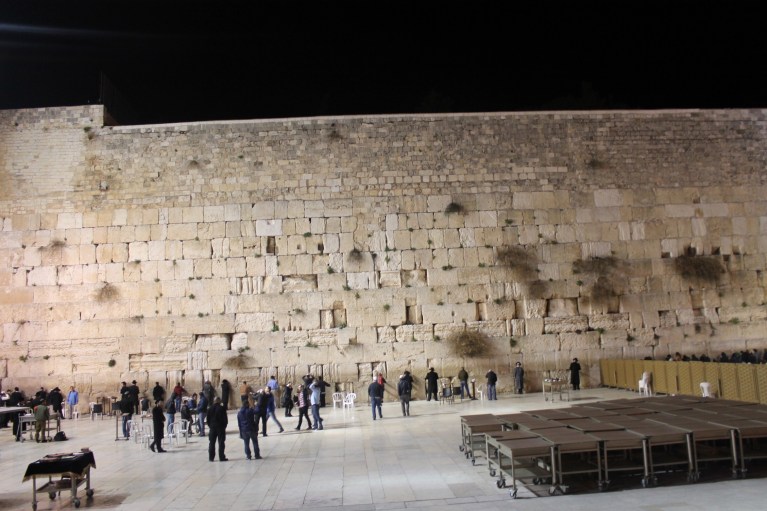
I have been to Israel twice on pilgrimage now and both times I have been utterly blown away by the power of the Western Wall. It is simply the scrap of a foundation wall that the Romans left behind because they didn’t think anyone could ever care about it, but oh how wrong the Romans were. Today, almost two thousand years after they destroyed it, it still remains one of the holiest sites in the world. Day in and day out people flock there to pray, to mourn, to celebrate, to remember, to dream. It is a place of laughter and of tears. Each time I go am amazed by the fact that this ugly ruin, just a few old stones sitting on top of each other, can be one of the most beautiful things in the world. Yes, if you want to see human sinfulness it is all over too: it is a place of division and fighting and pain and brokenness, but if you can look beyond that you will also see that it is a gateway into another world. The temple still has its power because it still directs people to God, and that was its true purpose all along.


We live in a world of uncertainties. Wars and fighting, famines and disease, these things have been more or less constant throughout history. And throughout that same history there have always been individuals going around saying: “I am he.” I am the one that can save you from all of this. Believe in me and I will protect you from all of that uncertainty. Follow me and honor me and I will give you the riches of the world. That is the world we live in and that is a world that desperately needs temples.


We need temples to remind us that nothing we can build on this earth can outshine or outlast the glory of God. We need temples to remind us that we humans are not the ultimate and final authority in this universe. We need temples to remind us that God still dwells with us. We need temples to give us hope, guidance, courage, humility, faith and perseverance. We need temples to remind us that although we live in this world and in this country and place, that we are also called to be citizens of another kingdom. We need temples because our hearts will always need to be directed to worship something other than ourselves.


What do you see when you look at this church?


Do you see pretty stones and woodwork? Do you see gilding here and there? Memorials from ages past?


Do you see an aging structure in need of ongoing repair? Do you see light bills and water bills? Do you see an office with a fussy copy machine? Do you see a social hall? A school with a chapel attached? A community services organization?


Or do you see a temple?


Because that is, in truth, what every church is. This is a temple. This is first and foremost a place where God is to be worshiped. This place stands as a symbol to the community that God still lives here among his children. It is a window into another world; an outpost or embassy of another kingdom. It is a place where we proclaim that in the midst of this tempestuous and uncertain world there is still a rock that we can stand on; that there is still shelter for the broken and the weary and the downtrodden. It is a place where we remember that God is the source of all that is holy, not Herod. It is a place of comfort, of humility, of hope and of prayer. This is a place where people come to meet God, and nothing you do, no ministry, no service is more important than that. If you have any doubt about that just look to Jerusalem. Herod is long dead and the pretty buildings are long gone, but people still flock there because they still find God in the ruins.


If this place is a temple where God is worshipped, which I believe it is, then it must also be a place where sacrifice is made. Now the supreme sacrifice of the church always has been and always will be the sacrifice of Christ on the cross. That is the sacrifice that only he can offer and it is that same sacrifice that we remember each and every time we celebrate the holy mysteries at the altar, but we are called to make sacrifices too.

This temple should be a reminder to us that this world, and all of its pleasures and pains is not the end of the story for us; it is not our ultimate destination. So if we are people of faith, then we need to look at everything we have, our lives, our finances, our time and we need to recognize that without God we wouldn’t have any of it. And without God we wouldn’t have the hope that we have for the future. We have the immense privilege to be citizen of the Kingdom of God, and heirs of salvation. Our lives should reflect the importance of God and when we gather in his temple we are called, I believe, to look at all that God has given to us, and to offer something back. Not as repayment, for we could never do that, nor as pay for play, nor as an attempt to buy our way into the kingdom, but as a sincere gesture and statement of the importance of God in our life. That is what sacrifice has always been: offering God something that is precious to us, recognizing that he has already given us so much more.


Now you may be wondering, and should be asking yourselves, how much God is calling me to give this year. That is ultimately a question that only you can answer. I can tell you that the biblical standard in the scriptures and throughout most of Christian history has been 10%. Some of you may be gripping your seat at this point. This is one of those moments when it is great to just be a guest preacher. I can say the difficult things knowing that if you don’t like it I am wearing shoes I can run in. Of course, all clergy recognize that for some people that may be a stretch, and for others it could just be a starting point, but how ever much you give, let it be significant to you. Let it represent an actual sacrifice and not just something you can spare.


I’ll be honest with you. I have wasted a lot of money in my life. Bought things I shouldn’t have. Invested in things that I shouldn’t have. I am amazed at how much can be spent on totally meaningless things. I regret those wastes, but I can tell you I don’t regret giving any of the money I have ever given to God or his church. Because I know that this is a temple, and that at the end of the day that money isn’t just about balancing budgets and paying bills, it is about building the kingdom of God.

The kingdoms of this world, they come and go. Our rulers come and go and our fancy buildings come and go. Herod is dead and everything he built lies in ruins, but Jesus is alive and his kingdom is still going strong. So let us not grow weary in doing what is right. Let us not go following after every worldly leader that promises us security in an insecure world. Rather, let us see each struggle as an opportunity to testify to our faith in the only King that truly saves us.

God doesn’t throw away tarnished silver

Standard

Sermon given on November 2nd, 2016 at the requiem mass for All Souls’ Day.

Therefore, my beloved brethren, be ye steadfast, unmoveable, always abounding in the work of the Lord, forasmuch as ye know that your labor is not in vain in the Lord.


In the name of the Father, and of the Son, and of the Holy Ghost. Amen.


Father George D. Carleton in his magnificent book about the Christian Faith called “The King’s Highway” wrote that:

“There seems to be no argument that can be brought forward against praying for the dead that would not equally be against all intercessory prayer…and indeed the Church, in encouraging prayers for the dead, has only given its sanction to what is a powerful instinct in the heart of man. The loving heart cannot but desire good for the loved ones within the veil; and every earnest desire of a Christian heart in union with Christ is prayer, even if it not be expressed in the form of prayer.”


Father Carleton was writing in 1924, at a time which was what one could call the height of the Anglo-Catholic revival within the Anglican churches. It was a time when the church sought to reclaim some of its ancient practices that had in many cases been abandoned or misunderstood by much of the church since the time of the reformation. That movement resulted in the creation of such societies as the Guild of All Souls, which was founded to witness to the church and to the rest of society that we Christians not only have the ability to pray for those who have died, it is, in fact, a part of our Christian duty.


If we believe in the power of intercessory prayer; if we believe that there is some good to be had from praying for each other as we struggle through this life, then why would we think that death somehow makes that invalid?


Saint Paul says in his letter to the Romans:

“For I am convinced that neither death, nor life, nor angels, nor rulers, nor things present, nor things to come, nor powers, nor height, nor depth, nor anything else in all creation, will be able to separate us from the love of God in Christ Jesus our Lord.”


Nothing in life or death is going to separate us from the love of God in Christ Jesus. If we, as Christians have been united to him in baptism, then we are joined to Christ in a bond that death cannot break. That is why Paul can go on and say to the Corinthians: “Death, where is thy sting? O grave, where is thy victory?” Our relationships do not end in death. Just as we remain united to Christ, we remain united to each other. Death can no longer separate us. The church is one family, not just this parish or this diocese, or even of every Christian walking the earth right now, but everyone who has ever been sanctified by the waters of baptism, and if that is so then why should our care and concern for those we love suddenly cease at the gate of death? Baptism unites us to Christ and to each other in a bond that death cannot break.


But the church has for a very long time recognized that while those waters of baptism may unite us to Christ, they don’t make us perfect. There are some individuals whose witness to the faith and lives of holiness leave us no doubt of their sanctity, those people whom we generally refer to as saints, but for the vast majority of us, when we reach the point of death we will do so as very imperfect people. The idea of purgatory, is perhaps one of the most misunderstood in the history of Christianity, both by Catholics and Protestants alike. It is not meant to be some extra punishment inflicted on believers after death, the escape from which to be made available at a price. It is not a harsh doctrine, but is in fact a witness to the grace and mercy of God. Most of us will die as individuals that haven’t figured everything out: we will not have repented of every sin, or even recognized every failure in our lives. We will, in short, not be quite ready to see God face to face. But we have faith that God has not given up on us. Imperfect as we may be, we still share in the life of his very perfect son. What the doctrine of purgatory is meant to say is quite simply that we do not believe that God throws away tarnished silver.


Through baptism are souls are transformed into a very precious metal, but sin and life has a way of tarnishing that. We try as hard as we can to keep it polished, but still we are likely to enter the next world with plenty of stains. Its ok. God’s mercy abides. If we allow him to continually wash us, and polish us, we will eventually be found gleaming around his throne.


One of the prayers in our prayerbook states:


Into thy hands, O Lord, we commend thy servant, our dear brother, as into the hands of a faithful creator and most merciful savior, beseeching thee that he may be precious in thy sight. Wash him, we pray thee, in the blood of that immaculate lamb that was slain to take away the sins of the world; that, whatsoever defilments he may have contracted in the midst of this earthly life being purged and done away, he may be presented pure and without spot before thee; through the merits of Jesus Christ thine only Son our Lord. Amen.


And another:


Remember thy servant, O Lord, according to the favor which thou barest unto thy people; and grant that, increasing in knowledge and love of thee, he may go from strength to strength in the life of perfect service in thy heavenly kingdom;


Being washed in the blood of the lamb; being purged of our defilements, and growing in strength and knowledge. That is our hope as we pass from this life into the next one. We don’t know exactly what it will be like, or how long it will take; time ceases to have the same meaning when you leave this world. What we do believe though, is that through it all we are still part of the church. We on earth are the church militant; those that are still being polished by God are the church expectant; and those that are shining around the throne are the church triumphant, but we are all one church, united in baptism, united in love and united in prayer.


There is a great lie that is often perpetuated about funerals. We are told, and we tell ourselves, that the funeral is really about the survivors, the family, and what they need. For most modern funerals that has largely become the focus: keeping the family comfortable. What this usually entails is distracting the family from the reality of death by trying to mask it. Funerals become “celebrations of life” that focus solely on happy memories. But by trying to ignore the painful, present reality of death we create something that is far more depressing: we create services that only look backwards and not forwards. We create the impression that the deceased person only has a past and not a future, and that is hardly the Christian faith at all.


We believe that in Christ we do have a future, and that our “life is changed not ended” as the preface of the mass says. So we live in the hope that our best days are always ahead of us. And we live in the hope that our loved ones have glory ahead of them too. We may not be able to do much for them right now, but we can do this. We can pray. We can hold them up before God, trusting that in his mercy and grace he will wash them of their sins, strengthen them and complete the good work that he began in them at their baptism. Our labor here is not in vain. God doesn’t throw away tarnished silver.

The Anglo-Catholic Bookshelf

Standard

Every age has its own outlook. It is specially good at seeing certain truths and specially liable to make certain mistakes. We all, therefore, need the books that will correct the characteristic mistakes of our own period. And that means old books

-C.S. Lewis “On the Reading of Old Books”

Some of the best advise I have ever been given has come in the form of two words: read this. Time and again I have had mentors, friends and spiritual directors recommend books that have had a profound influence on my life and on my faith. The list that I present below is by no means exhaustive, but represents some of the most treasured and well worn volumes on my bookshelf. Some of these books would be appropriate for anyone wishing to have a deeper understanding of the faith (e.g., “The Catholic Religion” by Vernon Staley); some are very specifically resources for priests and liturgy nerds (e.g., “Ritual Notes”); and some are just plain fun (e.g., “The Towers of Trebizond” by Rose Macaulay).

Some of these books are recommendations from colleagues of mine in the Society of Catholic Priests. As I attended our conference this year in Atlanta, I was reminded that one of the greatest things we as priests have to share with each other (and hopefully with the rest of the world as well) is wisdom. So here is a list of books that an Anglican in the Catholic tradition may wish to have on their bookshelf.

Not all of these books are about Anglo-Catholicism per se, but are about the Catholic Faith in general. Most are old, but some are new. I intend to update this list from time to time as I discover or am referred to new resources. 

General Religion/Faith/Anglo-Catholicism 

  • The Catholic Religion: A Manual of Instruction for Members of the Anglican Church by Vernon Staley
  • The King’s Highway by G.D. Carleton
  • Orthodoxy by G.K. Chesterton
  • Heresy by G.K. Chesterton
  • The Everlasting Man by G.K. Chesterton
  • Heresy by Alister McGrath
  • Paths in Spirituality by John Macquarrie
  • The Gospel and the Catholic Church by Michael Ramsey
  • Dogmatics in Outline by Karl Barth
  • Why Sacraments? by Andrew Davison
  • He who is: a study in traditional theism by E.L. Mascall
  • Existence and Analogy by E.L. Mascall
  • Priesthood and Prayer by Bede Frost
  • The Return of Christendom by Maurice Reckitt et al.
  • Reconciliation: Preparing for confession in the Episcopal Church by Martin Smith
  • Soul Friend by Kenneth Leech
  • Saving Belief by Austin Farrer
  • We Preach Christ Crucified by Kenneth Leech
  • The Christian Priest Today by Michael Ramsey
  • The Rule of Saint Benedict by Joan Chittester
  • The Divine Milieu by Pierre Teillard de Chardin
  • Thoughts in Solitude by Thomas Merton
  • Foundations by Karl Rahner
  • The Laws of Ecclesiastical Polity by Richard Hooker
  • Prices Private by Lancelot Andrews
  • Anglo-Catholic in Religion: T.S. Elliot and Christianity by Barry Spurr
  • Tokens of Trust by Rowan Williams
  • The Love of Learning and the Desire for God by Jean Leclercq
  • Corpus Christi by E.L. Mascall
  • Signs of Life (40 Catholic Customs and their Biblical Roots) by Scott Hahn

Books about Anglo-Catholic History

  • Walsingham Way by Colin Stephenson
  • Anglo-Catholicism by Sheila Kaye-Smith
  • The Vision Glorious by Geoffrey Rowell
  • The Ecclesiastical History of the English People by Bede

Books about liturgy, or prayer books

  • The Parson’s Handbook by Percy Dearmer
  • The Mass of the Roman Rite by Joseph A. Jungmann, S.J.
  • Saint Augustine’s Prayer Book by David Cobb and Derek Olsen
  • The Ritual Reason Why by Charles Walker and Thomas Ball
  • Ritual Notes by E.C.R. Lamburn
  • The Ceremonies of the Roman Rite Described by Adrian Fortescue
  • The Anglican Missal

Books mostly for fun

  • The Towers of Trebizond by Rose Macaulay
  • Merrily on High by Colin Stephenson
  • Absolute Truths by Susan Howatch
  • At Home in Mitford by Jan Karon
  • The Screwtape Letters by C.S. Lewis
  • A Glass of Blessings by Barbara Pym

Can these bones live?

Standard

Few things elicit an eye-roll and an internal groan from me more readily than hearing a clergyperson use the word “prophetic.” It is a particularly obnoxious term when used in relation to one’s own ministry. It is usually meant to imply that someone or something is forward thinking or visionary, but part of the problem with this is that the only sure-fire tool to separate the visionary from the delusional is the perspective of time. I was just at a conference with New Testament scholar Luke Timothy Johnson who quipped in his presentation: “You are a prophet after you are dead, while you are still alive you are just an asshole.” It’s a fine line in any event I’m sure.


My biggest problem with the word “prophetic” though is that by constantly using it to describe someone who can foresee the future, we set ourselves up to misread the central mission of the biblical prophets and thereby misunderstand our own prophetic mission.


Amos, Hosea, Isaiah, Jeremiah, Ezekiel…the list goes on. We think of them as eccentric visionaries; as people that make dire predictions and cry for change, but at the heart of the message of each one of the prophets is a call to faithfulness. Living in times of great distraction and distress, when people seemed hell-bent on chasing after every new “god,” the prophets called out for people to abandon their idols and their false gods and to return to the Lord, the God of their ancestors and the God of their salvation with renewed devotion. The visions of the future were a means to an end; they were a tool used by the prophets to plead with a stubborn and headstrong people, but calling people to faithfulness was their true mission. Perhaps abiding faithfulness is more at the heart of what it means to be a prophet than eccentric visions. Maybe that is the core of our prophetic mission as well.


In the Latin mass there is a traditional prayer said by the priest or deacon immediately before the proclamation of the gospel. It is known as the Munda cor meum:


Cleanse my heart and my lips, O thou almighty God, who didst purge the lips of the prophet Isaiah with a live coal, and of thy sweet mercy vouchsafe so to purify me, that I may worthily announce Thy holy Gospel. Through Christ our Lord. Amen.


This prayer has always been a very special moment in the liturgy for me. On a practical level it is the last moment to gather my thoughts before proceeding to proclaim the Gospel lesson and deliver the sermon. On a spiritual level this prayer is a reminder that the proclamation of the Gospel is a prophetic act, not in the sense that it should be filled with visions and eccentricities, but in that its core purpose is to call people to greater devotion. We are reminded as clergy, that when we set out from the altar to bring God’s word to the people, we do so in the footsteps of not just apostles and saints but of the prophets as well.


While I have appreciated the inclusion of the prophetic imagery for some time, I have not always appreciated how much the circumstances of the prophets actually mirror my own until more recently. The church at large as not yet reconciled itself to the fact that traditional Christianity (by that I mean the faith that is basically summarized by the Nicene Creed) is no longer a part of the dominant culture. When the church is still active in the public sphere it is relegated to roles that are largely ceremonious or it is used as a tool either to support nationalist sentiment (for the right wing) or socialist sentiment (for the left wing). The church is used for a means to an end, rarely as an end in itself. The dominant religion among those that are unchurched (and among many of those that are) is Moralistic Therapeutic Deism, not traditional Christianity. The faithful that the church is left ministering to are likely to find themselves living in a type of exile: holding values and priorities that are often in conflict with the society at large.


What I find most meaningful about reflecting on the role of the prophets as I go to proclaim the Gospel, is that I am reminded that I do not need to be winning over the popular culture in order to be doing the work of God. At the end of the day, I don’t have to worry about trying to change the world, doubling my Average Sunday Attendance, being in good favor with the local political establishment, or trying to come up with “new and creative ways of being.” I have no interest in clever mission statements and movements, and no desire to try to reinvent the church every few years. It’s just not me. I have the Great Commission, 2000 years of faithful Christian witness and the biblical prophets that came before. That is enough. Walking in the footsteps of the prophets is a reminder that we aren’t called to be winners, we are called to be disciples, and there is a big difference. Isaiah knew that most of his words would fall upon deaf ears; he knew that only a faithful remnant would remain, but that was enough for him. It was enough for Jeremiah, who never felt worthy of God’s calling, and it was enough for Ezekiel, who ended up preaching to dry bones in the desert. The prophetic ministry of the priest or minister is not that we are called to be creative visionaries; it is that we are called to a life of faithfulness and to witness to the power of faithfulness to others.


I just returned from spending three days at a conference with the Society of Catholic Priests. Now, whenever I mention this society to people that are unfamiliar with it, I usually have to explain that, no, this has nothing to do with the Roman Catholic Church. We are catholic priests in the Anglican Communion. We are male and female; we are gay and straight; we are married and single. We come together as priests that treasure the faith that has been handed to us by our ancestors and who wish to share that same faith with the world. We are people who highly value tradition, but who also recognize that tradition can develop and change over time. We believe in sin and redemption, and death and resurrection, not just as vague concepts, but as realities in our own lives and central truths in the life of Jesus Christ. We come together regularly to encourage one another and strengthen our witness to the faith. In short we are priests that feel called to witness to a way of faithfulness that has been handed down to us across the generations: lives filled with scripture, prayer, sacrament and mutual support. It isn’t always an easy path to walk. The right wing of the church struggles with our acceptance of women’s ordination and gay marriage; the left wing of the church struggles with our adherence to traditional ideas of sin, redemption and resurrection. If we were looking for the road to easy approval, either within the church or outside it, we have probably chosen the wrong one. With declining attendance numbers, constant corporate-like rebranding and retooling, diocesan liturgies that seem to be chasing after the spirit of the age more than the spirit of God and with the church’s often sick preoccupation with looking “cool” to the dominant culture, those of us that feel called to faithfulness and tradition can very much feel like we are in a valley of dry bones at times.


I give thanks for the times that I get to spend with my brothers and sisters in the Society of Catholic Priests. I give thanks because whenever we come together I am reminded that it is ok just to be faithful. It is ok to just worship the God of our ancestors without feeling the need to be creative or unique. It is ok to not worry about being in the majority either in the church or in society at large. We don’t have to win every battle in order to do the work of God…we just have to be faithful. We don’t need to try and think of ways to sell the next generation on our faith, we just need to live it as best we can. In the end only God knows the future. When Ezekiel was asked if the dry bones could live again he replied: “O Lord God, you know.” God knows indeed. It isn’t necessarily the prophets task to know what God is restoring life to; it is the prophets task to faithfully preach the word. The Resurrection is God’s job, not ours.


The Munda cor meum prayer is immediately followed by another prayer of the celebrant:


The Lord be in my heart and on my lips, that worthily and rightly I may proclaim his Gospel.


It is such a simple and quick moment in the liturgy, and the congregation may have no idea that it is even happening, but for me at least it is a regular reminder that as a priest I am called, like the prophets, to faithfully carry God’s word into a world filled with dry bones. My job is to faithfully proclaim; God is the one who ultimately gives life.


Mortal, can these bones live?

O Lord God, you know.

Invite them

Standard

Note: This sermon was preached on Thursday, September 29th, 2016, being the Feast of Saint Michael and All Angels, and on the occasion of the blessing and dedication of our new front entrance.

In the Name of the Father, and of the Son, and of the Holy Spirit. Amen.

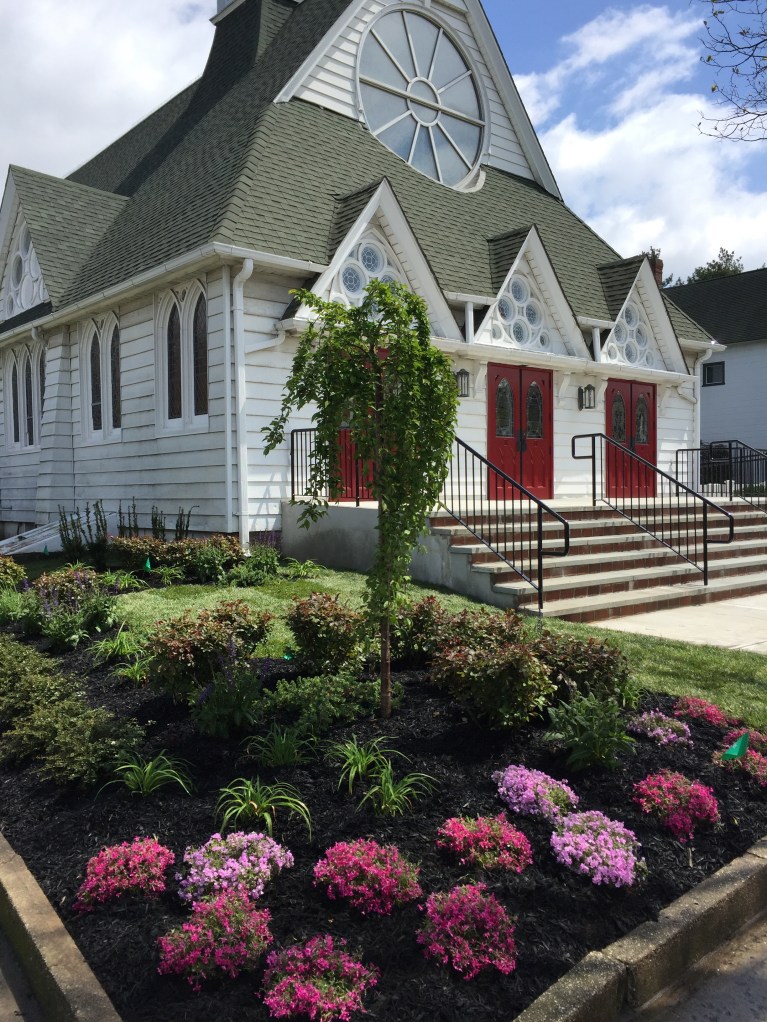
The Church of The Ascension in Rockville Centre has, I think at least, a well-deserved reputation for being a welcoming church. Plenty of individuals have made this observation to me, and it is certainly something I have experienced myself. To welcome outsiders into our community is very important, but if we are going to minister to the community in which we live and if we are going to evangelize the next generation of Christians, then being welcoming will simply not be enough. We need to be an inviting church.


You see, in the recent past going to church was taken for granted. It is just what you did. When people moved into a new community they went church shopping and very often the church they selected was the one that was the most welcoming, or the one that most suited their needs or their tastes. People were looking for church and your task was to get them to choose yours. Alas, that is not the world we live in anymore.


Most people in our society are not looking for a church anymore. Sure, you may encounter a few here and there, but they are fewer and farther between. People still have spiritual needs and they still long for answers to life’s tough questions, but they are less convinced that church is the place to have those needs met. That makes our job, as Christians that are called to spread the good news, a bit harder. We can no longer depend upon people coming to us, so we must go to them. We cannot just welcome people into this worshipping community, we must invite them.


The world we find ourselves in is less like the 1950s and 60s of our parents and grandparents, and more like the 50s and 60s AD of Paul and the Apostles: We live in a largely secular world that is mostly unfamiliar and unconcerned with the teachings of Jesus. But, that is the same world that Christ sent his disciples out into; he sent them, he didn’t tell them to wait until the world came looking for them; he sent them out and told them to go out into the world making disciples of all nations. That is the world in which we live: we are not just reminding people of the good news; for many people we are helping them encounter it for the first time.


Now you may be wondering: what on earth does this have to do with new church doors and windows? It’s this: people no longer assume that church has much to offer their lives. They aren’t going to fight to overcome obstacles to get in. We have to invite them to take a look inside. We need to show them that this isn’t just a door into a community meeting space, but a gateway into a different kingdom. Our new entrance isn’t just designed to be pretty; it is designed to be inviting. It is designed to remove barriers. It is designed to entice people to go deeper; to encourage them to look within and maybe, just maybe, respond to the God that is calling out to them.


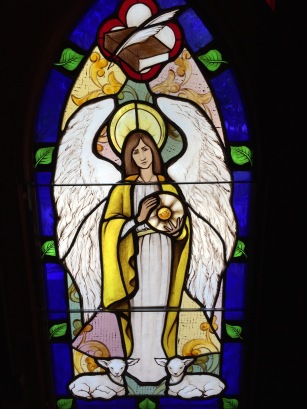
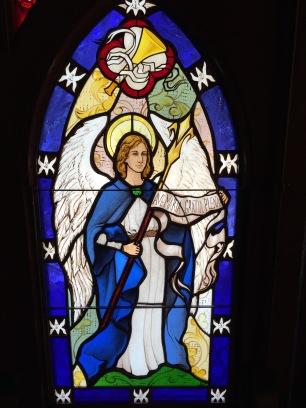
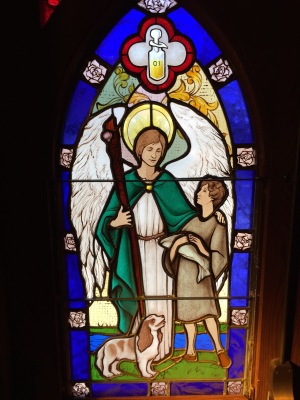
It is fitting that standing guard over this new entrance are four archangels. Tonight is the Feast of Saint Michael and All Angels; it is a day when the Church celebrates God’s angels and the work they do for his kingdom. Now I feel that I should point out here that there are many misconceptions about angels in popular culture. The biggest misconception is that angels are what we become when we die. No. That is not what the church teaches. Angels and humans are entirely different types of beings created by God. We might join the ranks of the faithful departed when we die, we might even be called saints, but we do not become angels. What we do share with angels though is a common mission: angels were created to be the special messengers of God, to work for God’s kingdom here on earth, and we as Christians are called to do very much the same. The angels that grace our doors direct our thoughts not only to the things we ought to pray for as we enter this building, they remind us of the work we need to do as we leave this building.

IMG_0175

Saint Uriel, the giver of divine light and patron of poets and artists. Saint Uriel’s task is to inspire. To make people wonder at the greatness of God and all his works. We pray to Saint Uriel to fill our thoughts with the beautiful ideas that come from God and we pray that like Saint Uriel, we too can inspire others in our own way.

img_0174

Saint Gabriel, the announcing angel who visited a young virgin to tell her that she was with child and that that child was the son of God. Saint Gabriel’s task is to proclaim. To announce to the world the coming of Jesus Christ and to proclaim the truth that this child is unlike any other. We pray to Saint Gabriel that he may continually make Christ known to us and we pray that we can be so bold as to proclaim that same child to an unknowing and unbelieving world.

IMG_0169

Saint Michael, the prince of all the angels, the angel who casts Satan down and protects us from every attack of evil. Saint Michael’s task is to defend. To use his strength to defend those that are weaker in the name of justice. Saint Michael is the patron saint of police officers, soldiers and all law enforcement and that window is given as a tribute to all those who have answered the call to serve and protect. We pray to Saint Michael that he will protect us from the evil in this world, and especially protect those who put their lives in harms way on a daily basis, and we pray that we too will have the courage to stand up to evil in the world whenever we encounter it.

img_0168

Saint Raphael, the medicine of God and the patron of pilgrims. Saint Raphael’s task is to heal. To embrace those who are suffering in body, mind or soul and give comfort and consolation. We pray to Saint Raphael that he may heal our infirmities, including our sins, and we pray that we too can be the instruments of God’s healing in the world.


Saint Uriel, Saint Gabriel, Saint Michael and Saint Raphael. As we enter this building, they remind us of the things for which we need to pray; as we exit they remind us of the work that we too are called to do in the world. We too are messengers of God, and we are called to Inspire, to Proclaim, to Defend, and to Heal. When we go out into the world doing that work, we invite people into relationship with God. The new entrance stands as a witness, not just to welcome those that are already coming in, but to invite those that are walking past. Our lives should do the same.


There are, of course, two more windows, which I haven’t referred to yet, and they are the most important. The windows at the heart of our front entrance, the two center doors, are mostly clear, and standing outside as you peer through them you first see the baptismal font, and then beyond that in the distance, the high altar and the tabernacle containing the body and blood of Christ. This is the feast that the angels are inviting us to. This is communion, becoming one with Christ and one with God. We go out into the world. Like the angels we serve as God’s messengers: we inspire, proclaim, defend and heal, but this is what we are inviting people to: to become the body of Christ in this world and ultimately to become citizens of the heavenly kingdom.

img_0717

Those aren’t just new doors and steps out there that lead into an old building. It is the gateway into a different kingdom and a different way of life. We have reason tonight to celebrate. We celebrate Alice Mary Roggenkamp who began pushing for a ramp for people with mobility problems to get into the church. We celebrate all those who contributed to the 125th campaign to help fund this project and especially the committee and those who worked long hours over the past couple of years to make this a reality. We celebrate the courageous lives of our soldiers and police officers who we will remember every time we see the light shining through Saint Michael’s face. We celebrate the lives of Mildred Savrda and Russell Dee Cooper, William and Dorothy Challice, Alfred and Ruth Frauenberger and Judith Berglund, for whom the other angel windows are given. Finally we celebrate the life of one man that wasn’t a member of this congregation; wasn’t even an Episcopalian, but nonetheless Fred Quenzer found in this church a place of spiritual refreshment and of grace. The front doors, the two center windows, the floor under your feet and even this vestment set that we are wearing were all made possible by the generous bequest from a man who only came here because someone invited him. If you have found God in this place, if you have experienced God through his angels, if you have been convinced of the truth we proclaim, if you want to fight for God’s kingdom and if you want to heal a broken world, then don’t just wait to welcome the souls that make it inside: go out and invite them.

The real reason we burn incense: It isn’t merely symbolic.

Standard

Why do we sing when we worship God?


Surely it is easier to just say the words rather than trying to move our voices to some melody, and yet singing has almost always been an important way in which God’s people have demonstrated their love for him. In scripture we find the “Song of Moses,” the “Song of Miriam,” the “Song of Hannah,” the “Song of Solomon,” and of course the Psalms themselves, all poetry that we believe was originally sung to God, just like our hymns or praise songs are sung today. Why do we sing? We sing because we believe that it gives glory and honor and praise to God in ways that surpass the spoken word. One could probably make the argument that music was invented for worship, and there aren’t many religious traditions that don’t include it in some form. But of course, music and song are not the only ancient ways in which we worship God; there is another way that is equally, if not more, ancient: incense.


Whenever I hear a priest explain the use of incense in Catholic worship I invariably hear one of the following arguments or statements:


Incense symbolizes our prayers rising to heaven

Incense is fragrant and engages our sense of smell in worship

Incense was used in the ancient times to mask bad odors


While all of these arguments have some truth to them (and I must admit I have used them myself at times), they all fall short of identifying the primary, and most important, reason that incense is used in worship: We offer incense to glorify God.


Incense is quite simply burned as an offering to God. The rising smoke of the incense fills the air with something beautiful in the same way that our voices fill the air when we sing. They are both ways in which God’s faithful people have sought to honor and worship their creator from the earliest biblical times. We don’t talk about singing as if it were symbolic of worship; it is worship. Music in church is not there to entertain the congregation; it is there to glorify God. We need to start thinking of incense in the same way.


From the Book of Exodus, wherein Aaron is instructed to build an altar of incense in front of the ark of the covenant (Exodus 30: 1-9), to the Book of Revelation, where an angel stands before the throne of God, offering God “a great quantity of incense” along with the prayers of all the saints (Revelation 8:3), incense is routinely offered in the worship of God. In Psalm 141, the psalmist writes:


I call upon you, O Lord; come quickly to me;

Give ear to my voice when I call to you.

Let my prayer be counted as incense before you,

and the lifting up of my hands as an evening sacrifice.


The psalmist is assuming that the burning incense and the evening sacrifice are acceptable to God, and he is praying that his prayers, however feeble our faulty they may be, may be as acceptable. Nowhere does the psalmist imply that the incense is merely symbolic of true worship; he actually implores God that his prayers may be as truly worshipful as offering incense.


In fact, the one time in which scripture comes down very hard on the burning of incense is when it is treated as just a symbol. The prophet Isaiah famously describes offerings as “futile” and incense as an “abomination” when he is excoriating Israel for divorcing the external forms of worship from true conversion of the heart (Isaiah 1:13). Worship is not meant to be an empty symbol or ritual, but an outpouring of the internal love we have for God, an outpouring which should also manifest itself in a desire to do good and resist evil. The problem here is not the incense or the offerings; the problem is when our rituals become disconnected from our devotion.


I know plenty of churches that value music in worship, but not incense. I cannot think of any churches that value incense, but not music. I do not think it is any accident that the churches that use incense most liberally are also the churches most inclined to sing large portions of the service. Perhaps we appreciate (even if only subconsciously) that both the smoke and the song are solemn offerings to God. They are lifted into the air, not primarily for our entertainment, but as an offering for the worship and glorification of the Almighty.


Sure, all sorts of symbols abound in our worship, and music and incense can (hopefully) be pleasing to the ear or the nose, but please, let’s stop telling people that that is why we are using them. Our primary purpose should always be the praise and adoration of God. Everything else is just gravy.

In defense of lace albs: 5 things about traditional vestments and the priests who wear them

Standard


If you were to enter almost any Catholic Church (either Roman Catholic of Anglo-Catholic) before the 1960s you would almost certainly have seen the clergy vested in a white linen garment known as an alb. Very often these albs were decorated with an extensive amount of lace. The lace in an alb served two important functions: first on a very practical level, the lace makes the garment lighter and more breathable (and saying mass in several layers of robes in churches before the invention of air-conditioning this was a welcome introduction indeed); second, and far more importantly, lace was symbolic of the amount of effort and care being put into the worship of God.


Before machines could make lace quickly and cheaply, it represented something of a luxury. Lace was expensive and very hard to make. Its intricate patterns were woven by hand and represented countless hours of toil and care. When lace first became available and fashionable, its use was not considered a sign of femininity, but of nobility, so it was quite natural that in seeking to worship the King of Kings, the church would very often employ lace in its linens and vestments to symbolize the supreme transcendence of God.


Of course, lace was not the only sign of nobility used in the worship of God. Chalices were to be ornate and made of the finest metal. Vestments and robes needed to be beautiful and splendid. Churches had altars that were intricately carved and windows that colorfully illustrated the stories of our faith. The worship of God was not something incidental: time, effort and treasure were devoted to make going to church the most awe-inspiring experience that most people ever had.


How far we have come. This past week I have twice encountered prejudice within the church against priests who still find great value in maintaining and wearing traditional vestments. It has happened plenty of times before, but enough is enough. So here are a few things I want everyone to know about traditional vestments and the priests who wear them:


  1. Femininity has nothing to do with it. Wearing traditional vestments has nothing to do with having a lace fetish and wanting to wear frilly things (not that there is anything wrong with that). Indeed, I sometimes wonder about the implied misogyny that seems to exist in so many put-downs about traditional vestments looking feminine. So what if they do? We need to recognize that our ideas about what is masculine and/or feminine have changed over time (just look at portraits of kings and queens through the ages if you don’t believe me). The church’s vestments evolved long before trousers became a thing, so maybe we should stop trying to assign them a gender. And while we are on this subject, it is worthwhile to state: not every priest that wears and values traditional vestments is opposed to the ordination of women! I, for one, love a good lace alb, and fully support women wearing them too.
  2. The vestments are not there to make me look special. The robes are not worn to glorify the priest, they are worn to glorify Christ. As a priest, I am a sinner in need of redemption just like everyone else. During the mass, I act in the person of Christ, to say his words of institution over the bread and wine and distribute his body and blood to his faithful people. It is a moment that is supremely not about me at all, but about Christ and what he has done. The time, effort and expense put into beautiful vestments is not done to make me look special, but rather to remind all of us how special Christ is and how glorious this meal is that he has invited us to.
  3. We are not trying to turn back time. I love patristic theology, early mass settings, medieval architecture, baroque vestments and altar furnishings, and even the occasional modern praise song (gasp!). My standard when evaluating church things is not “is it new?” or “is it old?” but “is it good?” What I have found, time and time again, is that things that have managed to stand the test of time have usually done so because they have lasting value from one generation to the next. I have no desire to go back to the days before civil rights, women’s rights, gay rights or air-conditioning, but I do believe that the people that lived before and through those times still probably have a lot to teach me. Just because we find timeless wisdom and value in things that are traditional does not mean that we fail to see the importance of the progress that has been made along the way as well. For the record, most priests that I know that have strong preferences for traditional worship are actually quite young, and much of the laity that are attracted to this type of worship are fairly young as well. This isn’t about catering to the blue-haired ladies in our congregations as much as it is looking to what is resonating with children and youth.
  4. This is not about some secret desire to be Roman Catholic. On many occasions people have visited my church and commented “This is just like Roman Catholic” to which I would like to reply “When is the last time you visited a Roman Catholic Church?” Traditional vestments were a hallmark of both Roman Catholic and Anglo-Catholic churches up until the 1960s, when after the reforms of Vatican II, the Roman church began moving toward more modern vestments (and by modern I mean reflecting style, material and color trends of the 1960s and 70s). Today very few Roman Catholic parishes worship in traditional vestments or follow the older Tridentine form of the mass. The fact is that Episcopal priests that wear cassock-albs, modern-styled vestments and worship at West-facing altars have far more in common with their Roman Catholic colleagues than those of us that have a preference for fiddle-back chasubles, and that is fine, it really is. I have no problem with priests and churches that can feel connected to Christ through newer rites and modern aesthetics. As long as it is faithful to the gospel and works for the community, great. Go with it. What I do have a problem with is the notion that those of us who connect with traditional worship in all its forms and finery on some level do not belong in the mainstream church and are just waiting for an excuse to leave. Nothing could be further from the truth. I am a mainstream Anglican in the Episcopal Church and that is right where I intend to stay, but if we say that our church has room for a variety of styles in worship, then we should live that out by not trying to force traditional worshipers off to the margins, or even worse, out of the picture altogether.
  5. Ultimately the lace may not matter, but style does. Style and substance go hand in hand. We need to get that. People pay more attention to what we do than what we say. If we put more effort into setting a nice table for a dinner party than we do preparing ourselves for worshiping at Christ’s altar, what does that say about our priorities? Say what you will about traditional worship, it is seldom sloppy or irreverent. It takes Christ seriously.This is not some show that we are putting on week after week, it is the worship of God, and it is that very same worship that has led many a faithful Anglo-Catholic to serve Christ in the streets and in the hearts and bodies of those in need, as well as at his high altar. Maybe a Solemn High Mass isn’t everyone’s cup of tea, I get that, but please stop suggesting that we are going through all of this effort for any other reason than to glorify God.


The next time you see a priest wearing a lace alb consider this: he or she has probably done so as a conscious choice, but it may not be for the reason you think. He might not be trying to make a statement about his stance on some political issue in the church. He might not be trying to dress like a historical figure from ages past. He might not be trying to draw attention to himself by wearing something grand our outlandish. He might, just might, have seen something very beautiful and thought “surely this is worthy of God.”