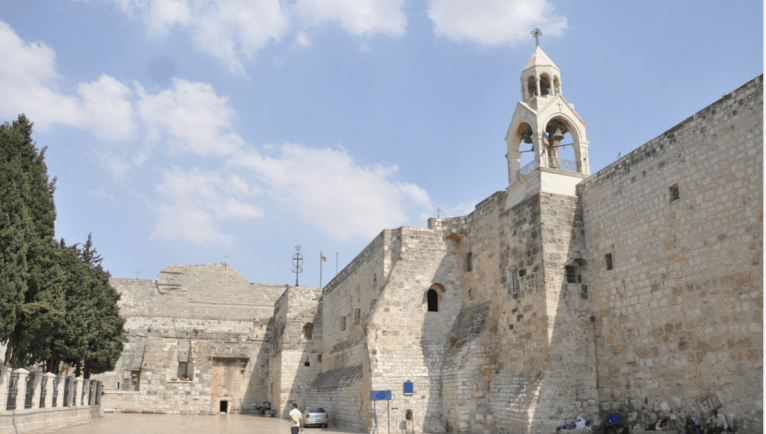
You are not the first outsider to kneel before the manger

Standard

Sermon for January 4, 2026

Readings:

The church of the nativity in Bethlehem is one of the oldest churches in the world. It was commissioned by the emperor Constantine, who basically was told to build it by his mother Helena, around the year 326. It sits on top of a cave that is the traditional birthplace of our lord Jesus Christ. People were already worshipping Jesus in that spot long before Constantine built a church there. That is why it was built there. So, it is probably the oldest site of almost continuous Christian worship that exists. Christ has been worshipped and adored on that spot from the first Christmas to this Christmas with very few interruptions. Constantine’s church would burn down at one point, but it was immediately rebuilt by another emperor, Justinian.  That building still exists to this day, but it almost didn’t. 

In the year 614 the Persian army invaded the Holy Land, destroying much in its path, but not the church of the nativity. Legend has it that the commander of the army, a man named Sharbaraz, noticed near the entrance to the church three figures in beautiful mosaic on the wall. And these figures were dressed like Zoroastrian or Persian priests. They were the Magi, or the wise men coming to pay homage to the baby Jesus. Well, the commander was moved, and a bit perplexed, and he thought that surely there must be something holy about this place. This was not just some foreign shrine to a foreign god. On the wall, there were people that looked like him worshipping the God that this church was dedicated to. The commander could see that this story, this shrine, this temple, and this God involved his own people. So, he spared the church and it more or less stands to this day. Or at least that is how the story goes. What is certainly true is that the Persians decided not to destroy that church even though they did destroy so much else.

What I love about that legend of the Persian army commander though, is that it reflects a truth that we find in the scripture story itself. People from distant lands, different races, different religions, different stations of life and different customs all manage to find in the child in the manger, a life that touches their own. This baby that has been born as King of the Jews, is noticed by people from outside the Jewish world from the very beginning. He is even noticed by the very stars in the sky.

Matthew tells us in his gospel that wise men, magi (magicians or astronomers) came from the East. They were not Jewish. They did not know the Jewish prophets. They were outsiders. They had been led there by another sign, a star, that spoke to them (as astronomers) in a way that the Jewish prophecies might not have. God sent them their own sign to lead them to Jesus. Now Jesus was still the promised Jewish messiah, so the wise men still needed some help and direction from the Jewish prophets and scriptures to actually find him and know him, but their journey to him began long before they ever hear a word of the Prophet Micah. God had been leading them to Jesus long before they ever got to Bethlehem. 

Now, the church has always held that the story of the wise men was an early sign that Jesus’s mission would be to the gentiles as well as the Jews. He came to save the whole world. His birth affects everyone. One of the things that I love about this story in Matthew’s gospel though is how few details we actually have about these mysterious characters. We are told they came from the East, but that doesn’t tell us much. We are told they were Magi (and you can translate that as magicians, astronomers, scientists). They weren’t Jewish. They travel following a star. They find Jesus and offer him gifts of gold, frankincense and myrrh. Then they slip out of town, having been warned by God not to offer Herod any assistance. We don’t really know where they came from. We don’t really know their religion or their race. We don’t even really know that there were three of them. The bible says there were three gifts, it doesn’t actually say there were three wise men. And sadly, it doesn’t say anything about camels either, but in my mind there will always be camels. The wise men are something of a blank slate or an uncolored page in a story book and I kind of have to wonder if God didn’t do that on purpose. We don’t know much about these outsiders that worshipped Jesus so we can fill in the details as we see fit. We can make them look and dress like us. Or we can make them look completely unlike us. You can make them look African or Asian or European. You can make them look tame or exotic. Yesterday, our youth went to an exhibit of Medieval illuminated psalms at the Morgan library in the city, and there in one of them was a depiction of the wise men looking an awful lot like European kings. These mysterious Magi who walk on and walk off the stage, they give us all another chance to see ourselves as a part of Jesus’s story. Their image is a sign to us today, as much as it was a sign to the Persian commander in 614, that it doesn’t matter how much of an outsider you are, you will not be the first outsider to kneel before the manger. Someone who looks just like you has worshipped this God before.

Keep Holy the Sabbath Day

Standard

Sermon for August 24, 2025

Readings:

Isaiah 58:9b-14
Psalm 103:1-8
Hebrews 12:18-29
Luke 13:10-17

Jesus was in the synagogue on the sabbath day, which should come as no surprise to anyone. Jesus was an observant Jew who took God’s laws very seriously. Jesus said he didn’t come to abolish God’s laws, he came to fulfill them. God’s commandments matter to Jesus. And in the fourth commandment we are told “remember that thou keep holy the sabbath day.” The Book of Exodus goes on to say: “six days shalt thou labor, and do all thy work; but the seventh day is the sabbath of the Lord thy God: in it thou shalt not do any work, thou, nor thy son, nor thy daughter, thy manservant, nor thy maidservant, nor thy cattle, nor thy stranger that is within thy gates: For in six days the Lord made heaven and earth, the sea and all that in them is, and rested the seventh day: wherefore the Lord blessed the sabbath day and hallowed it.”

The Book of Deuteronomy adds an extra little verse to this and says: “And remember that thou wast a servant in the land of Egypt, and that the Lord thy God brought thee out hence through a mighty hand and by a stretched out arm: therefore the Lord thy God commanded thee to keep the sabbath day.”

The sabbath day is a day of rest. The sabbath day is a day of freedom. The sabbath day is a commandment. Resting is a commandment of God. It is one of the top ten. When people talk about sin, they like to talk about the exciting things: adultery, murder, stealing, bearing false witness, but listed among those commandments is the commandment to keep the sabbath day holy and to rest. And freedom is a gift from God. God does not want us to be slaves to the powers of this world. God does not want us to be slaves to productivity. God does not want us to be slaves to the almighty dollar, or to the office, or to email, or to drudgery. God wants us to rest and God wants us to remember his promises of freedom. God wants us to remember the grace that we have been shown. So, work is prohibited on the sabbath, but worship is not; the study of his word is not. And Jesus is in the synagogue worshipping God, and reading and reflecting on his word. Jesus is obeying the commandment. 

And as Jesus is talking, he looks out on the congregation and notices a woman there. It’s amazing that Jesus saw her at all because we are told that she was bent over double. She couldn’t stand up straight. And what is more we are told that this woman has been afflicted this way for eighteen years. I want to focus on this unnamed woman for a minute this morning, because I think it is too easy to focus on the conflict between Jesus and the leader of the synagogue and not notice the incredible faith that she was demonstrating. This woman has been bent over for eighteen years. We can assume that she was probably an older woman if she has been sick that long. Now those of you out there that suffer from back pain, mobility issues, or know what it feels like to sit behind the wheel of a car for too long, or have been hunched over as desk for too long, those of you who know the pain that can come from bad posture…I think I have probably covered most of y’all at this point. Think about being doubled over in pain for eighteen years. Now let’s go back to a time before Ibuprofen, or hot baths, before there was air conditioning or sliced bread or any modern convenience that makes life easier, because that is the time that this woman is living in. Think about the pain and discomfort that she must have been in.

And she showed up in church that day anyways. She showed up to worship God. This woman had every reason to stay home in bed and nobody would have faulted her for it. She was sick. If I had been her pastor I probably would have told her to stay home; it’s fine. But she showed up. Somehow, she made it to the synagogue, got inside, managed to deal with people bumping into her because they couldn’t see her hunched over. And of course, you know most people in synagogue in those days didn’t get a seat. Those pews may be hard, but at least your sitting down. If she wanted to sit, she would have had to sit on the floor. She probably just had to stand though. But she showed up. Why? There are other stories in the gospel where people seek out Jesus for healing, but that’s not the case with this story. She doesn’t call out to him or ask him for anything. As far as we know, she doesn’t know who Jesus is and didn’t know he would be there. She asks for nothing. But her presence there on that sabbath day says something more than her words ever could. 

This is a woman of faith and she is not going to let anything keep her from worshipping her God and honoring and keeping holy the sabbath day. She is sick and in pain, but she showed up, not because she thought that she would be healed, but because she loved God and respected his commandments and intended to keep them as best she could. She didn’t come to get something; she came to give something. Jesus sees her. He sees her faith and without being asked, he sets her free from her affliction. 

And the leader of the synagogue…who would have had a nice comfy place to sit by the way…became indignant because Jesus supposedly did work by curing her on the sabbath. And Jesus calls him out and says “you wouldn’t treat your donkey that way!”

Jesus takes God’s commandment’s seriously. He isn’t dispensing with God’s laws; he is interpreting them in the light of God’s love. Our gospel today begins with Jesus worshipping God in the synagogue on the sabbath day as we would expect. He encounters many people there obeying the fourth commandment, but two stand out in this story: one is a woman who has suffered incredible pain and inconvenience to be there that morning and the only thing on her lips is praise for God; the other person is a man, an important man, the leader of the synagogue, a person with honor and position (and a chair), and all he can do is criticize an act of mercy. Which one of those two do you think did a better job of keeping the sabbath day holy? 

A matter of perspective

Standard

Sermon for August 17, 2025

Readings:

Jeremiah 23:23-29
Psalm 82
Hebrews 11:29-12:2
Luke 12:49-56

I remember one time when I was a little boy, we were traveling through the sugarcane fields of South Florida. If you go inland, away from the beaches, in the region around Lake Okeechobee, you will find miles and miles of sugarcane plantations. Or at least you could when I was little. I don’t know what it is like there now. If you have never seen sugarcane growing, it looks a lot like bamboo: thick growths of big, tall stalks that can be 10 feet high or more. When you are driving through it, it’s like there is a wall on either side of you that you can’t see through. 

Anyways, I can remember driving past these sugarcane fields, when I noticed that some of the fields were on fire. And I remember thinking, “that’s terrible! those poor farmers! All that sugarcane is lost!” And then, as we drove a little further, I was even more upset when I noticed some people walking alongside the fields with torches in their hands, actually setting fire to the sugarcane! How horrible. This wasn’t just an accident; this was intentional destruction. Well, at some point I expressed my dismay about all this, and someone in my family explained to me that they weren’t destroying the sugarcane; they were preparing it for the harvest. 

What I learned that day, was that THAT was the traditional way that sugarcane had been harvested for hundreds, maybe thousands of years. There are new harvester machines that do it differently now, but the traditional way is that once the cane is fully grown and ready to be harvested, you set fire to it. And the fire burns through the field, and burns away all the leaves, and the dead grass, and along the way it drives off all the snakes and other nasty creatures that might be living in there, and what it leaves behind is just the pure sugarcane stalk, ready to be harvested. The sugarcane itself, and the sugar within it, is unharmed. It’s all the bad stuff that gets burned away. 

I saw smoke rising from the field and thought it meant destruction; someone wiser than me knew that it meant it was harvest time. 

The image of those fields burning came to my mind this week as I was reflecting on this gospel. Jesus said that he came to bring fire to the earth. Jesus said that he came to bring division. To hear Jesus say those things, it really rubs against the popular image of Jesus the nice teacher. We are told that Jesus is the Prince of Peace, and that he is all about love and forgiveness, and living abundantly and sharing and being kind and caring, and Jesus IS all of those things, but he is also more. Our situation as humans is more complex than we sometimes want to imagine. We need more than just a nice teacher. We need more than good advice and a helping hand. We need a savior. We need rebirth and transformation. There is much good growing within all of us. God put it there. It is his image. But there is a lot of dead stuff clinging to all of us too. And there are snakes in God’s field as well. If we are ever going to have peace; if we are ever going to know true love and forgiveness; it we ever hope to live in God’s kingdom, then some of the stuff that is growing in us, around us, or on us has to go. There are things that we need to be divided from. I will say that again, there are things that we need to be divided from. There may be people that we need to be divided from. There may be attitudes that we need to be divided from. There may be substances that we need to be divided from. You might even need to be divided from your money and your material possessions. Division can be a good thing. Fire can be a good thing. And the bible often associates fire with God. There was the fiery pillar in the desert, and the burning bush on the mountain, then there was the fire of Pentecost. Fire is powerful. It can be uncontrollable. But fire is transformative. It can destroy things, but it can also make new things. Fire transforms, and God transforms, and we need to be transformed. There are things in this world, there are sins, that need to be burned away in order for God to gather us in and make us into something better than we currently are. We need God’s fire to change us and Jesus said that he came to bring fire to the earth. You can see that as bad news, or good news, it’s a matter of perspective.

If you are a snake in the grass, it is definitely bad news. If you desperately want to cling to old dead things in your life: material things, bad habits, old grudges, past hurts…it might be bad news. If you are content with this world as it is and don’t feel any need to change, or grow, or be transformed into something better…then God’s fire is probably bad news. But if you are ready to be transformed, ready to let go of some things, ready to be gathered into God’s arms in God’s kingdom, ready to let that which is sweet within you be divided from that which is bitter, then God’s fire is good news. 

You can see God’s fire and think that it means destruction, or you can see it and recognize it as a sign of God transforming a field and preparing it for the harvest. Again, it is a matter of perspective.

Mr. McBeevey

Standard

Sermon for August 10, 2025

Readings:

Genesis 15:1-6
Psalm 33:12-22 
Hebrews 11:1-3, 8-16
Luke 12:32-40

Many of you know that the Andy Griffith Show is one of my favorite shows of all time. I have preached about it several times. If you are a younger person and don’t know the show, go and watch it. You can stream it online. If you are an older person and grew up with it, it is worth watching again. The show is an intentional throwback to a different time and place, it is idealized and sanitized, but it is nonetheless a reminder of personal qualities and values that could use a revival. 

I think my favorite episode of the show is called Mr. McBeevey. Opie is out playing in the woods and he comes back to the sheriff’s office all full of stories to share with his dad, Andy, and deputy Barney Fife. He tells them that he met this man named Mr. McBeevey, who spends all day up in the trees, wears a fancy metal hat, jingles when he walks, and can make smoke come out of his ears. Andy and Barney naturally assume that Opie is telling a fantastic tale about a made-up friend as children sometimes do. And then Opie says, “and he gave me this quarter.” And as Opie holds up a real quarter, Andy’s demeanor changes. It is one thing to make up a make-believe story, but it is another thing to tell an outright lie, and Opie seems to be crossing the line. When Opie insists that he is telling the truth, Andy drives out to the woods with him to find this Mr. McBeevey, but of course there is no sign of him. Opie refuses to change his story though. Mr. McBeevey is real. Andy and Opie drive home and now Andy is getting very cross. Make-believe is one thing and that’s fine, but Opie needs to understand the difference between the truth and a lie. Andy is resolved that he is going to have to punish Opie. 

So Andy goes to Opie’s room for a father-son talk which is just one of the best scenes ever. He explains to him the difference between the truth and a lie and he tells him what the consequences will be if Opie persists with this Mr. McBeevey story. But Opie says (crying), but Mr. McBeevey is real, and if I said he wasn’t I would be telling a lie. Don’t you believe me pa? And you see this change come over Andy’s face. Before he had looked stern and disappointed, and now you could just see this sense of bewilderment and love. So Andy goes back downstairs. And Barney, who is always a little too eager to act in every situation, says to Andy: well, aren’t you going to punish him? And Andy says, no. Barney replies, you don’t mean to tell me that you actually believe in this Mr. McBeevey do you? And Andy says, no….but I do believe in Opie. No, but I do believe in Opie. 

I love that scene so much. Andy cannot comprehend the story that Opie is telling. It seems magical, nonsensical, unbelievable. Andy has serious doubts or questions about this Mr. McBeevey, what he doesn’t doubt though, is his son. Andy’s relationship with Opie and love for Opie his him the strength and the courage to say, I don’t understand this, I don’t know how this can be true, but I am going to trust you. My friends, that is faith right there. That is how faith works. Faith is not about certainty. Faith is not about seeing is believing. Faith is not about understanding. Faith is not as much an act of the mind as it is an act of the heart. Faith is a response to a relationship. It is an act of love. 

Our second reading this morning is the eleventh chapter of the Book of Hebrews. I remember once when I was in college I met a guy who had memorized the entire chapter and would perform it and I supposed if you are going to memorize a chapter of scripture this is an excellent choice, because it is all about faith. The passage talks about the faith of Abraham and Sarah, believing that God would do the impossible for them. There are a few verses missing there this morning that also talk about Abel and Enoch and Noah, and later we hear about Issac and Jacob. And we are told that “All of these died in faith, without having received the promises, but from a distance they saw and greeted them.” The great patriarchs and matriarchs of our faith, they had to trust in God and in their relationship with God, more than they trusted in themselves. Abraham and Sarah had doubts about where or not they would ever have a child, I assure you, but they trusted in God anyways. To be a person of faith means to be able to believe in things that you cannot yet see. To be a person of faith means to lean on love more than you lean on understanding or your own perceptions of things. 

You do not have to understand the meaning of everything Jesus ever said in order to love and follow him as the son of God. You don’t have to have a clear blueprint of heaven in order to believe in it. You don’t need to comprehend every single article of the creed in order to stand and say it will all of us every week. You don’t need to be able to explain why bad things happen to good people, or why good things happen to bad people. You ought to read the bible and pray, but you don’t need to be some great theologian to be a great person of faith. All you really need to be a person of faith is love. You need to love God and the more you are able to love God, the easier it will be for you to believe and trust in the promises that God makes to you. Love God, love Jesus, love whoever it was that first shared their faith with you. You don’t have to wait for a miracle or a sign to start loving God. You don’t have to see in order to believe, you have to love. When we stand every week and say the creed, we are not proclaiming things that we ourselves have seen: we weren’t there when God created the earth, we weren’t there when Jesus was born or when he suffered and died; we weren’t there when he rose from the grave; we may have encounters with the Holy Spirit, but we weren’t there when it spoke through the prophets, and so far none of us have seen Jesus come again to judge the quick and the dead, we have not experienced the resurrection of the body and the life of the world to come. Most of the things we proclaim in the creed have nothing to do with our own personal experience of God. It is the accumulated experiences and witness of countless generations of faithful people that have loved God, and experienced God’s love in return. The creed is a witness to the God we love and worship. We worship a God who creates. We worship a God who sacrifices and suffers. We worship a God who inspires and warns. We worship a God who judges, forgives and redeems. 

Living in relationship with this God means learning to use your heart as well as your mind. Sometimes love and relationship can open your heart to believe things that your mind cannot comprehend. At least, that is what happened to Andy when he decided that while he struggled to believe Opie’s story, he still believe in Opie. 

I guess I should add that at the end of that episode, Andy is wandering around in the woods trying to figure all this out, when he just utters the name “Mr. McBeevey.” Suddenly a voice from above says “Hello? Is someone calling me” Andy is completely startled and he looks up and down from the pole beside him climbs a telephone repairman with a metal helmet, and tools dangling from his belt that jingled when he walked. Andy was never happier to meet a telephone repair man in his whole life. Mr. McBeevey was real, and yes…he even had a trick to make smoke come out of his ears. 

Inviting all preachers…

Standard

Dear Fellow Preachers,

My companion website to Inwardly Digest, The Pulpiteer, will be beginning a special program next month called Preaching Companions. Preachers who wish to participate will be invited to send a video of a sermon that they have preached recently to the Pulpiteer. Sermon links or video files must be received by March 8th. The videos will then be compiled and sent out to all participants. The participants will then gather via zoom on March 19th to offer each other feed back. Please see below for further guidelines.

  • Participants will select one sermon that they have given from the previous month. After the first of the month they will send us a link to a video of this sermon. At the end of the first week of the month The Pulpiteer will compose an email that consists of links to all of the videos and send this out to the group. On the last week of the month we will have a scheduled zoom call and offer each person constructive feedback on their sermon.
  •  It is not necessary for each person to participate every month, however, out of consideration for everyone’s time if you submit a sermon for the group to watch, it is expected you will be present for the zoom call. If you can’t make the call at the end of the month, then please don’t submit a sermon that month.
  • Sermons may come from any context (Sunday morning, midweek, weddings, funerals, major feasts, etc.) but participants in the zoom call should submit a sermon of some sort and should indicate in some way what scripture readings were offered during the service. Ordinarily, everyone who is present to offer critique should also be receiving critique. This is meant to be a group for mutual support (and mutual vulnerability) and therefore everyone participating will need to be open to giving AND receiving feedback.
  • Participants should be committed to Christian orthodoxy, broadly speaking. While there is ample room for diversity and disagreement on biblical interpretations and styles of churchmanship, basic creedal Christianity is expected to be the norm. Participants are reminded that in their ordinations they affirmed their belief in the Old and New Testaments to be the Word of God and committed themselves to uphold the doctrine, discipline and worship of the Episcopal Church. Sermons should reflect these commitments even when trying to advocate for change or reform. Clergy from other Christian denominations are welcomed to participate; however the same commitment to a broad creedal orthodoxy is expected.
  • Feedback will be offered by participants both on content and style. For this reason, videos of sermons are preferred. Participants must be committed to offering critique that is constructive and to being respectful of their fellow preachers. All of us, at one time or another, have delivered a sermon that simply didn’t hit the mark. Humility and respect both in giving and receiving feedback is essential.
  • Arguments about pronouns and Divine gender are to be avoided. We respect that preachers will be preaching to different congregations in different contexts. Arguing about pronouns for God is rarely helpful and does not always take into account these local contexts. Plus, there are many ways that a preacher can broaden a congregation’s understanding of God rather than simply referring to God as “she.” Simply stated let’s not spend too much time here and respect a preacher’s choice to use what works for them in their context.

Finally, preachers are encouraged to submit “hits” as well as “misses.” In other words, don’t just submit your best sermons, but also submit sermons that just didn’t go quite the way you wanted or hoped. We are all here to grow and improve and not just to congratulate each other!

Our first zoom gathering will be on Tuesday, March 19 at 11:00am.

If you are thinking of something to do for your own spiritual and professional growth this Lent, why not consider joining us? For more information and to register, please visit thepulpiteer.org