
Sermon for January 4, 2026
Readings:
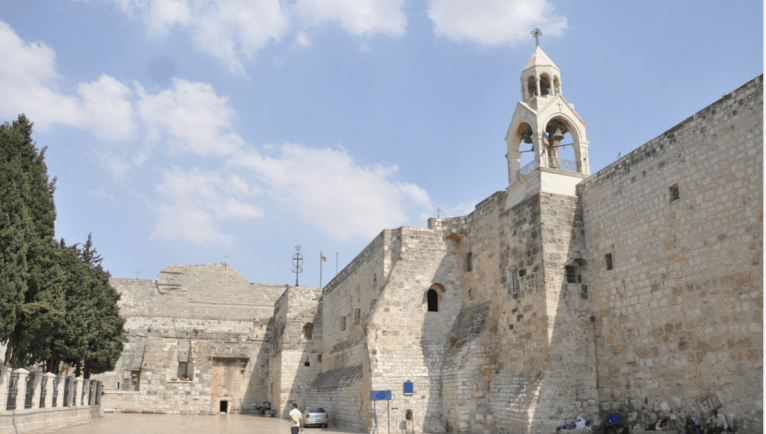
The church of the nativity in Bethlehem is one of the oldest churches in the world. It was commissioned by the emperor Constantine, who basically was told to build it by his mother Helena, around the year 326. It sits on top of a cave that is the traditional birthplace of our lord Jesus Christ. People were already worshipping Jesus in that spot long before Constantine built a church there. That is why it was built there. So, it is probably the oldest site of almost continuous Christian worship that exists. Christ has been worshipped and adored on that spot from the first Christmas to this Christmas with very few interruptions. Constantine’s church would burn down at one point, but it was immediately rebuilt by another emperor, Justinian. That building still exists to this day, but it almost didn’t.
In the year 614 the Persian army invaded the Holy Land, destroying much in its path, but not the church of the nativity. Legend has it that the commander of the army, a man named Sharbaraz, noticed near the entrance to the church three figures in beautiful mosaic on the wall. And these figures were dressed like Zoroastrian or Persian priests. They were the Magi, or the wise men coming to pay homage to the baby Jesus. Well, the commander was moved, and a bit perplexed, and he thought that surely there must be something holy about this place. This was not just some foreign shrine to a foreign god. On the wall, there were people that looked like him worshipping the God that this church was dedicated to. The commander could see that this story, this shrine, this temple, and this God involved his own people. So, he spared the church and it more or less stands to this day. Or at least that is how the story goes. What is certainly true is that the Persians decided not to destroy that church even though they did destroy so much else.
What I love about that legend of the Persian army commander though, is that it reflects a truth that we find in the scripture story itself. People from distant lands, different races, different religions, different stations of life and different customs all manage to find in the child in the manger, a life that touches their own. This baby that has been born as King of the Jews, is noticed by people from outside the Jewish world from the very beginning. He is even noticed by the very stars in the sky.
Matthew tells us in his gospel that wise men, magi (magicians or astronomers) came from the East. They were not Jewish. They did not know the Jewish prophets. They were outsiders. They had been led there by another sign, a star, that spoke to them (as astronomers) in a way that the Jewish prophecies might not have. God sent them their own sign to lead them to Jesus. Now Jesus was still the promised Jewish messiah, so the wise men still needed some help and direction from the Jewish prophets and scriptures to actually find him and know him, but their journey to him began long before they ever hear a word of the Prophet Micah. God had been leading them to Jesus long before they ever got to Bethlehem.
Now, the church has always held that the story of the wise men was an early sign that Jesus’s mission would be to the gentiles as well as the Jews. He came to save the whole world. His birth affects everyone. One of the things that I love about this story in Matthew’s gospel though is how few details we actually have about these mysterious characters. We are told they came from the East, but that doesn’t tell us much. We are told they were Magi (and you can translate that as magicians, astronomers, scientists). They weren’t Jewish. They travel following a star. They find Jesus and offer him gifts of gold, frankincense and myrrh. Then they slip out of town, having been warned by God not to offer Herod any assistance. We don’t really know where they came from. We don’t really know their religion or their race. We don’t even really know that there were three of them. The bible says there were three gifts, it doesn’t actually say there were three wise men. And sadly, it doesn’t say anything about camels either, but in my mind there will always be camels. The wise men are something of a blank slate or an uncolored page in a story book and I kind of have to wonder if God didn’t do that on purpose. We don’t know much about these outsiders that worshipped Jesus so we can fill in the details as we see fit. We can make them look and dress like us. Or we can make them look completely unlike us. You can make them look African or Asian or European. You can make them look tame or exotic. Yesterday, our youth went to an exhibit of Medieval illuminated psalms at the Morgan library in the city, and there in one of them was a depiction of the wise men looking an awful lot like European kings. These mysterious Magi who walk on and walk off the stage, they give us all another chance to see ourselves as a part of Jesus’s story. Their image is a sign to us today, as much as it was a sign to the Persian commander in 614, that it doesn’t matter how much of an outsider you are, you will not be the first outsider to kneel before the manger. Someone who looks just like you has worshipped this God before.
 Inwardly Digest