
Sermon for August 31, 2025
Readings:
Sirach 10:12-18
Psalm 112
Hebrews 13:1-8, 15-16
Luke 14:1, 7-14
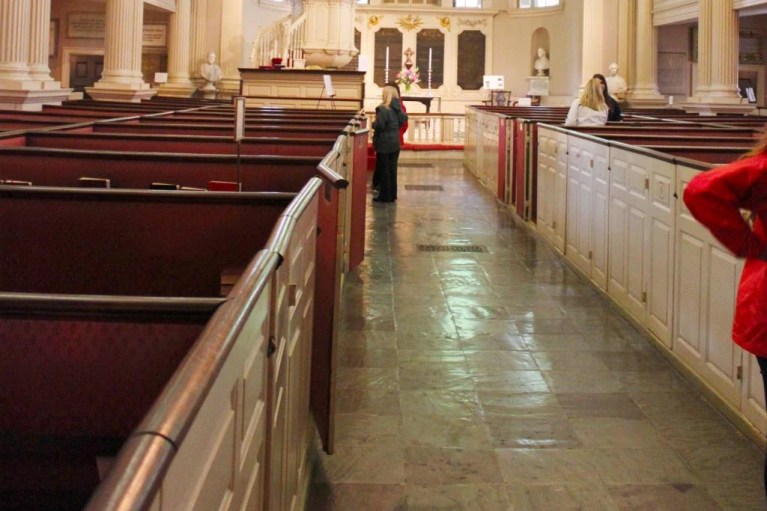
In 1885, when this church was founded, it was founded to be a free church. What that means, is that it was the intention of our founding families that this church would not charge pew rents, but instead would rely on the voluntary donations and pledges of the congregation. Many of you are aware that there was a period of time, especially during the 1700s and early 1800s, when churches had box pews with little doors that were rented. It’s how churches paid the bills. A lot of you have “your pew” that you always sit in now, but back then your pew really was your pew. You paid for it and nobody else could sit there. And of course, just like going to a Broadway show, the best seats cost you more. So if you wanted to sit down front where you could see and be seen, you would pay a premium for it. There were usually some free seats, but they were in the balcony or in the back. If you visit many historic colonial churches, you will find just this setup.
It really was a disgraceful practice, especially in the light of the plain reading of the gospel, but for so many years it was so common that it really was unquestioned. You just assumed that the fancy, rich folks in church got to sit up front, and the poor folks would sit in back. One of the later reforms that came out of the Oxford Movement, which was a church reform movement in the early 19th century that was started by my hero, John Keble, was the movement away from this pew rental system. Our founders were influenced by that. I think that we may justifiably be proud of our parish, and our founders, for wanting to abandon this pew rent practice. It is a good thing to be proud of. The bible has lots of warnings about pride, but we need to remember that there is good pride and there is bad pride. There is a pride that is born out of love and gratitude, and there is a pride that is born out of self-righteousness and disdain. We can embrace one, hut we need to be very careful of the other.
It is good to be proud of our parish and our founders for wanting to abolish pew rents, but in being proud we need to remember that we weren’t the first parish to try that, not by a long shot. We weren’t the first; we weren’t the only ones; and there were times when we seriously considered implementing pew rents because finances were so tight. So, we can be proud of what our founders did accomplish while at the same time recognizing that they weren’t perfect. We can love our parish without having to feel that it is necessarily superior to every other parish that ever existed. That is healthy pride, good pride. That is pride that is born out of love. And I think that all humans need that sort of pride. It is a pride that makes you raise your head and look up. You raise your head and look up to people who might be a little better at this thing called life than you are. You raise your head and look up to elders, and heroes. You raise your head to recognize superior skill, superior values, and superior wisdom. You raise your head to recognize something superior to yourself. Healthy pride involves looking up, not looking down, and to look up you need to be able to recognize that there must always be someone or something above you. And if you can’t do that, then you can’t know God. That is when the other kind of pride gets in the way.
Negative pride, pride that is born out of self-righteousness and disdain, looks down. Negative pride is about feeling superior to others. This unhealthy type of pride is presumptuous, it takes the high seat at the table. It assumes that it must be the best, the greatest, the wisest, and therefore does not strive to be better than it is. That is why this type of pride is so deadly. It alienates you from God above and from everyone else below. You have no need for anything above you and you are too good for anything beneath you. Negative, unhealthy pride is isolating and it leads to destruction. That is the type of pride that the scriptures are talking about in the first reading this morning:
The beginning of human pride is to forsake the Lord;
the heart has withdrawn from its Maker.
For the beginning of pride is sin,
and the one who clings to it pours out abominations.
Therefore the Lord brings upon them unheard-of calamities,
and destroys them completely.
The Lord overthrows the thrones of rulers,
and enthrones the lowly in their place.
Be very careful if you think the throne is yours or if you think the best seat in the house belongs to you. You may just find yourself turned out of your pew when the true owner of the house arrives. Take the lower seat our Lord advises. Assume that there are others that are better than you. Look up and show respect. Remember that you still have things to learn. We may think that charging rent for pews is a totally abhorrent idea that is contrary to the gospel, but 100 years from now there may be some practices that we simply ignore or take for granted that future generations may be scandalized by. We can be proud of our ancestors, we can look up to them, but we needn’t be self-righteous in doing so. We can look up, without looking down, if you know what I mean.
The funny think about learning to always look up to those above you, is that in doing so you learn to hold your own head a little higher. Learning to respect others goes hand in hand with learning to respect yourself. So healthy pride, pride that is born out of love, pride that is born out of admiration for that which is good walks hand in hand with humility. We can be proud of ourselves and our accomplishments, we can be proud of our children and our families, we can be proud of our church, our country, our heroes, and we can be proud of our cultures. We can be proud of all these things and we can love them without thinking that they are superior to all others or completely faultless. Humility isn’t about looking down in shame; it is about looking up in admiration. When we learn to look up to others, our own status rises as well. Those who exalt themselves will be humbled, but those who humble themselves will be exalted.
 Inwardly Digest