
Sermon for March 3, 2024
The Third Sunday in Lent
Readings:
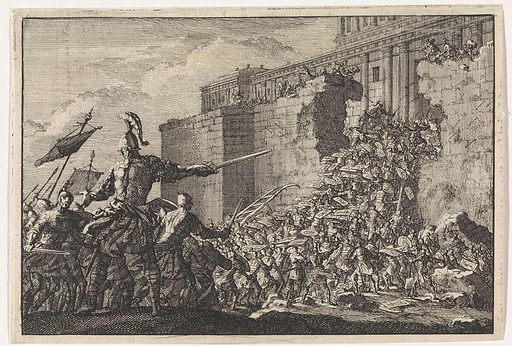
In the year 63 BC (so more or less 60 years before Jesus was born), the Roman general Pompey laid siege to the city of Jerusalem. Sadly, this was a scenario that Jerusalem had already experienced many times in its history and would experience many times more, even unto our present day. Well the city put up a good fight, but eventually Pompey and his troops figured out that if they tried to fight the Israelites on the sabbath day, they would indeed fight back, but if they didn’t directly fight them, but instead spent time building bridges and ramps to get over Jerusalem’s fortifications (in other words, doing the work to support the invasion), then they would be left alone because the Israelites would only break the sabbath if their lives were immediately at risk. So, Pompey used this to his advantage and eventually broke into the city.
And when he came in, of course the first place he went was the temple mount. He wanted to understand what power this temple and this God had over these people. He wanted to know what it was that they were sacrificing to and that they were willing to lose their lives to protect. No doubt he also assumed that there would be untold riches inside as well. So, he strolls into the temple, walks right past all the priests who are begging him and pleading with him not to go any further. He pushes them aside and marches right into the temple building itself. And when he goes into the temple, the first thing he sees in the outer room is the golden lampstand, and an altar of incense, and a table with bread on it, a few nice things, but he assumes that the real wealth of the temple must be in the inner room, the Holy of Holies that is just beyond the veil. Only the high priest was ever allowed in there and then only once a year.
So, Pompey pushes the curtain aside, walks in…and discovers an empty room. The holiest place in the world for these Jewish people, the thing that they were dying to protect, was an empty room. Now Indiana Jones fans, I am sure you are thinking “But what about the Ark?” The Ark of the Covenant, which contained the stones that the ten commandments were written on, that was in the sanctuary of the First Temple, the temple that King Solomon built. But that temple was long ago destroyed by the Babylonians and the Ark had ever since been missing. So, in the Second Temple, the Temple that Pompey walked into, and the Temple that Jesus would know some decades later, there was no Ark. The Holy of Holies was just an empty room.
Pompey was completely perplexed at this. These Jews, he thought, were a strange people. Not only were they unwilling to do any work one day a week unless their lives were immediately at stake, but also the holiest place at the center of their faith was not a great golden statue of a God carved with human hands, but an empty space. An empty space that these Jews claimed, belonged to God. Pompey didn’t understand it. He certainly understood sacrifice. Pagans sacrificed THINGS all the time, but these Jews were sacrificing time and space. They were sacrificing their own creative powers. It was odd. Pompey didn’t understand it, but he saw something in it that he respected. He could have torn the temple down, but he didn’t. He could have looted the temple of its wealth, but he didn’t. Jerusalem would lose its freedom and become a Roman province, that was true. But Pompey let the worship in the temple go on. He didn’t understand this Hebrew God, but he understood the power of respect. He saw the respect that the Jews had for this empty room, and something about that was compelling. So, he let the priests go back to work. Respect for God can be contagious. But then again, so can disrespect for God. Both can creep up on you, you know.
When Jesus entered the temple some decades later what he witnessed was a creeping disrespect for God. The Holy of Holies was still there and set aside as sacred, as God’s space, but the areas around it, in the temple precinct outside, were becoming more and more profane. God had become big business for many of the temple authorities. And you may know that business and busyness in our language come from the same root word. People were busy. There was a lot of human activity going on. People were busy making things: making transactions, making a buck. For many people, God was their business, and I say that fully recognizing that I am a priest, who is also paid to do this work. God is my business too, so I can say with good authority that priests often get distracted by the business of worship and the business of church administration and are prone to forgetting that at the heart of our faith is time and space that belongs to God and no one else. There were a lot of people there in that temple in Jesus’s day that were more focused on monetizing God than on worshipping him. They weren’t worried about what belong to God; they were worried about what belonged to them. It had happened before in the time of the Prophet Jeremiah; it happens now in our own day. Disrespect for what belongs to God can creep in. Inch by inch, the money changers get closer and closer to the Holy of Holies.
I assure you that God knows that we are like this. God created us in his own image, and a part of that image is the power to be creative. We can imagine things, and create things, and that is a God-given gift, but you see in order to remember that this gift is God-given, we must remember that we were created by God. A man can create many things, but he cannot create himself. All of us were created by something, or someone, else. None of us called ourselves into being. We get so caught up in our own creative powers that we forget that. We forget that we are creatures. So, God reminds us.
Think about some of the commandments that we recited and heard this morning. Think about the commandment to keep the sabbath day holy. How does God command us to keep it holy? By filling it with activity? No. Just the opposite. By keeping it empty. Empty. Rabbi Jonathan Sacks says that we keep the sabbath day holy “by renouncing our own status as creators. On Shabbat, all melakha, which is defined as “creative work,” is forbidden. On Shabbat, we are passive rather than active. We become creations, not creators. We renounce making in order to experience ourselves as made. Shabbat is the room we make for God within time.”
And likewise, the Tabernacle that the Israelites make in the wilderness, the holy tent, which in time becomes the Temple and the Holy of Holies. It could have been filled with the wonders of human creation, with golden statues carved by human hands, but no. It was God’s space, not ours. The more we filled it with human stuff, the less room there would be for God. “The Tabernacle is the room we make for God within space,” Rabbi Sacks says. He goes on to say that “Holiness is the space that we make for the otherness of God – by listening, not speaking; by being, not doing; by allowing ourselves to be acted on rather than acting. It means disengaging from the flow of activity whereby we impose our human purposes on the world, thereby allowing space for the Divine purpose to emerge. All holiness is a form of renunciation.”
Renunciation. To say that this isn’t mine, it belongs to something or someone else. That is what holiness is all about. Holiness is recognizing that something belongs to God and not to you. Giving God more space and not less. Doing the opposite of what the money changers in the temple were doing: not filling God’s space with our things. Leaving space in our lives and in our world for God. Obviously, this is something that God knows we need to be commanded to do, and continually reminded to do, because from day one humans have been prone to taking things that don’t belong to us. We don’t just steal from our neighbors; we steal from God too.
We steal from God when we fill every moment of our waking lives with productive activity. Brothers and sisters, I confess to you that I love to make daily to-do lists, and I love crossing things off of those lists. I get a little high when I feel like I am being productive, like somehow I am worth more to God now that I cleaned that closet out, or wrote that letter, or got that thing crossed off of my list. I like to be productive and I like to be creative, but sometimes I need to remember that I was created. I need to remember that I was precious to someone before I could do anything for myself. I need to remember that this world was created and existed long before I was in it. I need to leave space in my life for God. In need an empty room that God can fill. We all do.
That means learning to do less sometimes, and NOT more. It means putting busy-ness, aside. It means emptying ourselves of all the stuff that just creeps in so that God has some space in our lives that belongs to him. The pagan world has never understood sabbath, and in case you were wondering, it is still a pagan world out there. But even those of us who know the commandments and have asked God to write them on our hearts, even we need to be reminded that God still makes claims to time and space in this world that he has created. We still need sabbath. And keeping sabbath is just as much a commandment of God as not stealing, not committing murder, and not coveting your neighbors property.
Some things still belong to God. There is time that belongs to God. There is space that belongs to God. And there are people that belong to God. That is what makes them holy. Later in John’s gospel Jesus tells his disciples that the “will of him who sent me, is that I should lose nothing of all that he has given me, but raise it up at the last day.” Jesus’s body was God’s body. It was holy. We tried to take it from God, but God took it back. He raised it up again. It was a temple like no other. And it belonged to God. But there are other temples in this world still. There is still time, there are still places, and there are still people that are called to be holy. And not only is God watching how we respect that which belongs to him, so are the people who don’t know our God. So how we treat holy things matters. Disrespect for God may be contagious, it may creep up on us, but respect can do that too. Respect for God can be contagious.
 Inwardly Digest