
Candlemas Sermon 2013

Standard

Candlemas Sermon 2-13


Childbirth is a dangerous thing. We forget that now, we think of it as rather routine, but as last week’s episode of Downton Abbey reminded us: for most of history it was a threatening ordeal for both mother and child. There was always a very real danger that one or the other, or both, would not survive. For most of the history of the Book of Common Prayer, up until the last revision, there has been a service called the Thanksgiving of Women After Childbirth, also known as the Churching of Women. There was good reason to thank God for a safe child delivery, because it was by no means a certainty. But this service was really a Christian adaptation of an ancient Jewish practice, and it is the ancient Jewish practice that we are talking about today in the Gospel.


The purification of the Blessed Virgin Mary is one title for today’s festival. In Jewish law a woman who had just given birth to a child had to wait several weeks before she could enter the temple again.


What I find interesting is not that pregnant or infirm people are commanded to make a sacrifice to God after their deliverance, but that they are commanded to wait until after the crisis had passed before they do so. It is easy to want to worship God right when we think we need him, when we are in the midst of our suffering. What is far more telling about us though, is how we behave once things have returned to normal and the crisis has passed. Do we only respond to God when we need him, or do we respond whenever he asks?


The Church has traditionally held that Mary didn’t need to be purified after the birth of our Lord (being preserved from any stain of impurity), but that she chose to do so out of obedience to the law. Mary was keenly aware that this child was like no other, conceived like no other, and with a destiny like no other, but Mary did not consider being favored by God as an exemption from religious duty. Just because we may have been spared some calamity or in some way have been blessed by God, does not exempt us from the worship of God, but calls us all the more to it. So Mary was purified, but the purification was just one part of the law, for the law also called for the redemption of her first born.


This feast is also known as the Presentation of our Lord Jesus Christ in the Temple. Jesus, as a first-born son had to be presented to God. Jewish law required it, as a reminder that the Jewish first-born had been spared by God during the Exodus from Egypt, therefore they still belonged to him. He is a first-born son and therefore Mary and Joseph had to acknowledge that he belonged first and foremost to God, not to them. Joseph offered to the priest Simeon the prescribed sacrificial animals to be offered to God in exchange for the life of this baby boy. This was the law of Moses and we are told that Joseph and Mary did everything in accordance with the law.


According to tradition Simeon was an old priest. He had been doing this very same service of claiming first-born sons as belonging to God for years, perhaps hundreds of times. Simeon had been told by the Holy Spirit that this work he was doing would not be in vain, but that it eventually would lead him to see the messiah, the child that would actually be God’s very own. The first-born, not just of one man and woman, but of all creation. And here at last he was in his arms: the beacon of light that he had waited his entire life to see and the one child that would give all of that waiting and working meaning. When Simeon utters that Nunc Dimmittis, the “Lord, now lettest thou thy servant depart in peace,” he does it for all of us who spend our lives working and waiting for God’s glory to be realized and seen. It is fitting that we often say the Nunc Dimmittis at evensong at the end of the day, because it is often only those brief glimpses of God’s kingdom that give us the strength and courage and peace that we need to go forward into another day.


Mary and Joseph were astounded at what Simeon and Anna said, not because they didn’t believe it, but because it confirmed what they already knew and could see. What a joy it is to have your faith confirmed by others; to have an experience that you thought only you had, be shared by someone else. How important it is to have that confirmation that other people see the light of God where you see the light of God. That is the beauty of Christian fellowship: to be able to stand together with others and say hat we have seen God here. That brings me to the third name for this feast: Candlemas. From ancient times, the Church has celebrated the light of God on this day, and the greatest symbol we have for the light of God is the candles we use during worship. You have probably learned by now that I really love candles, although I have to admit that I am glad I am not using them to light the rectory anymore. Since my arrival we have added the votive stand, which we dedicated on All Souls’ Day and the Memorial Torches, which we are dedicating this morning. Candles are something that we use here everyday in our worship of God. In the old Ritual Notes manual for celebrating mass it is made clear that mass cannot be said without at least one real flame burning on the altar. Artificial light is never a substitute for the real light, and as much as our worship may be a bit dramatic at times, this is not a stage and this is not a show. The God that we worship here is real, just as the candles we use are real. Part of the reason we go to church, I hope, is that it is a place where we believe we can encounter God, a real God. Now Candlemas can be a hard sell to get people to come to church sometimes. It doesn’t have any of the penitential lament of Ash Wednesday or Good Friday; it doesn’t have any of the joy or frivolity of Christmas Day or Epiphany. Its popular customs are largely forgotten and have mostly to do with this being the end of the Christmas and Epiphany season. It doesn’t stir us up and excite us, and maybe for that very reason it might have the most to say to us about our daily lives as Christians. The Purification of the Blessed Virgin and the Presentation of our Lord were done not out of desperation or delight, but out of devotion. They were done because God asked for them to be done and the people that did them had the will and the patience and the faith to keep listening to God, to keep observing his commands, and to keep working for his kingdom until by God’s light and grace they were allowed to see it. My report to you on this morning of our annual meeting 2013 is actually quite short and quite simple: Over the past year we have seen God’s light in this place; we have seen his salvation and we have tried to carry it into the world. We will try to do the same in the coming year. That is what God asks of us: to work for his kingdom, to look for his light and to share that light with the world. We will do our duty to God, just as Joseph and Mary and Jesus did their duty, just as Simeon and Ana did their duty, and we will do it out of devotion. We will honor the tradition that we have been given, so that we like them, may be so lucky to serve God, to see his salvation, and to depart in peace.
 

Memorial for Zunie Ridley

Standard

Sermon delivered at the memorial for Zunie S Ridley

November 24th, 2013

zunie


Long before I was ever a priest or a minister, before I ever went to seminary and before I preached my first sermon, I was her grandson. I struggled so with what I wanted to say today, because I kept trying to say it through the voice of Father Kevin, the priest who has presided over more funerals than he can keep count of, but I can’t do that today. I can’t be that right now. Right now I am just another member of the family. Right now I am here to represent everyone who ever loved this woman and I am here to tell you what we are all feeling.


Our hearts are broken, but they aren’t troubled.


Our hearts are broken for everything that she meant to us: she raised us…she raised all the neighborhood children. She loved us, she cooked for us, she taught us how to pray, she spanked us occasionally (some more than others). She was our rock, she was always there. She was the one we played pranks on, went shopping with; she scratched our backs, squirted us with water pistols, she made us laugh, she sang with us, she took us to church, she argued with us, she watched baseball with us and went to the movies with us. Our hearts are broken, because she was a part of this world for 92 years and not one of us here knows a world without her in it.


Our hearts are broken, but they aren’t troubled.


They aren’t troubled because of what she is leaving us. She is leaving us with traditions that keep us connected with her: traditions like using blue lights outside our house every Christmas after someone dies, traditions like icebox fruitcake and corn casserole, and cornbread dressing. She is leaving us with so many wonderful stories from her life: setting her pants on fire while she was welding in the shipyards in Brunswick Georgia during the war, stories about going to the drive in with granddaddy and her mother and having to lay down in the back seat because she was pregnant with my mother. Stories about the Lashley place, the Arline place, the Joyner place…all those places where she grew up that I could never really keep straight. She left us with her love for life and her love for her family, but for me today, the most important thing that she left me with and the number one reason that my heart isn’t troubled, is that I know that she worshipped a loving God. From the day that she was baptized in the creek outside the Pine Park Baptist church, she worshipped a God whose principle commandment was to love and she tried to live that commandment. She wasn’t an every Sunday churcher, she wasn’t a bible expert either, but she knew how important faith was, genuine faith, faith that comes from truly loving God and truly loving other people.


When Jesus was talking to his disciples and telling them that he had to leave they were devastated. They couldn’t bear the thought of him leaving them, but he reassured them by saying don’t let your hearts be troubled. I am going ahead of you to prepare a place for you. We will be together again. I believe that Jesus keeps his promises. He promised that he would rise again from the dead, and he did, he promised that he has a place prepared for us, and that in that place we will all be together again. It is that faith that is getting me through this right now. Saint Paul said that he reckoned that the pain we experience in this world and in these bodies is nothing compared with the glory that we will experience when we reach the other shore. Grandma knew a thing or two about pain and suffering. All my life I remember her suffering from some ailment or another, but that never really stopped her. She never lost her joy and love for life.


As I stand here today, I am looking at lots of faces that are suffering. We are sick, we are tired, we have pain. But I am reminded of a saying that I saw while I was on pilgrimage this summer: Pain is something temporary, glory lasts forever. Our bodies are broken sometimes, but its ok, we can get past it. Our hearts are broken, but they aren’t troubled, because we know this heartbreak is only temporary.


This service today is really for us, not for her. We are the ones who are suffering now, she is in glory. Her pain is no more.


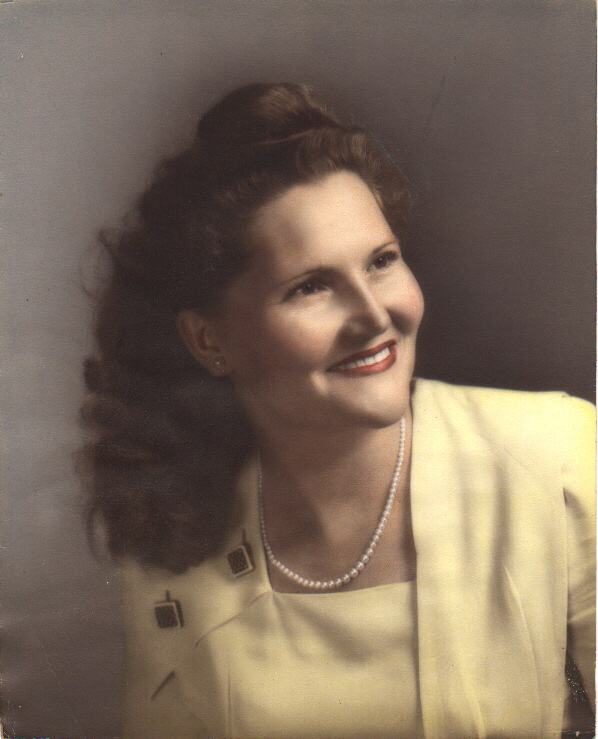
After granddaddy’s funeral so many years ago, I had a dream and in that dream he walked up to me and looked me in the face and just gave me a hug. But the face that I saw wasn’t the face that I had ever known in my life, it was the face of him as a young man who was happy and healthy again. Ever since I had that dream I have had this belief that that is what we become when we reach the other side: our happiest, handsomest, prettiest, healthiest self. Today would have been his 93rd birthday. When we were thinking of which picture to use today I wanted to use the one on the cover of your program, because although it isn’t how she looked three days ago, I do believe it is how she looks today, and I believe that that is the face that will be greeting us when we get there ourselves.


We still have work to do in this world: as a family and as Christians we have work to do: It’s not our time yet: there are still children to be raised and spankings to be given, dinners to be cooked and love to be shared. Our hearts are broken today and they will be for a while. We will get upset when we are reminded of her and all that she meant to us, but that’s ok we aren’t troubled because we know this pain is temporary. The loving god that she worshiped has washed away her pain and he will do the same for us as well.

Spiritmatters Monthly December 2011

Standard

The hopes and fears of all the years…

If you think that Christmas is just about hope and love and light and happiness then you are setting yourself up for a huge disappointment come December the 25th. Despite all the carols played constantly over the radio, this time of year isn’t always the “Hap, Happiest season of all.” Let’s face it, December is probably the most stressful month of the year for most of us: the crowds, the shopping, the traffic, the parties, the Christmas lists, and that’s just if you are lucky. For some, the holiday stressors take on an entirely different dimension: fear, depression, loneliness, anxiety. The darkness of December isn’t always outside our doors; sometimes it’s within us as well.
We all have this cookie-cutter image of what a happy holiday is supposed to look like, but most of us know deep down that our celebrations are rarely, if ever, perfect. Despite so much commentary and complaint about the commercialization of Christmas in recent decades, the reality is that holiday stress is hardly a new thing. If you spend much time watching old Christmas movies over the next few weeks you may notice a theme throughout many of them: anxiety, fear and desperation. Consider the following list of holiday classics:
A Christmas Carol

It’s a Wonderful Life

Miracle on 34th Street

The Bishop’s Wife

Christmas in Connecticut

White Christmas

A Christmas Story
And yes even, National Lampoon’s Christmas Vacation.
Each of these classic stories about Christmas includes at least one or more characters that are driven to their absolute limit by the demands that life places upon them this time of year. Even Charlie Brown was overwhelmed by Christmas stress and that was over 50 years ago! Anxiety and fear are not a product of this generation, they are a product of every generation. Things like the media and the economy might make our problems worse, but they certainly don’t create them. We are human; and humans, for whatever reason, get stressed out and depressed this time of year. Maybe it is the weather, maybe it is the darkness, maybe it is something more profound and mysterious, but whatever it is, it is real and we need to be willing to address it and deal with it. Trying to act as if Christmas is merely a happy time, and nothing more, is destructive and dishonest. If we take the time to look closely at our holiday traditions, we just might find that they actually do try to address the great range of emotions we feel this time of year. The next time you are sitting in a church and suffering through a boring sermon (it happens), grab the hymnal in front of you and actually read the text of some of your favorite Christmas carols. You might be surprised to find out that these hymns, which many of us think we know by heart, actually have a lot to say about the darkness and brokenness in our lives. See if you can identify which popular carols these verses come from:
“Yet with the woes of sin and strife the world has suffered long;

beneath the heavenly hymn have rolled two thousand years of wrong;

and waring humankind hears not the tidings which they bring;

O hush the noise and cease the strife and hear the angels sing!”
“For he is our life-long pattern; daily when on earth he grew,

He was tempted, scorned, rejected,

Tears and smiles like us he knew.

Thus he feels for all our sadness, and he shares in all our gladness.”
“Why lies he in such mean estate where ox and ass are feeding?

Good Christian, fear: for sinners here the silent Word is pleading”
“O Flower, whose fragrance tender with sweetness fills the air,

Dispel in glorious splendor the darkness everywhere:

True man, yet very God, from sin and death now save us, and share our every load.”
“Where children pure and happy pray to the blessed Child,

Where misery cries out to thee, Son of the mother mild;

Where charity stands watching and faith holds wide the door,

The dark night wakes, the glory breaks, and Christmas comes once more.”
These songs were not written to be sung by children; they were written to be sung by adults who know very well just how painful and dark the world can be. I get very frustrated when I hear people say that Christmas is a holiday about children or for children. It is not. Granted, there is great joy and fun in having little ones around that still have faith in the magic of Santa Claus, but that is just the point: they still have faith, they still believe. It is the adults in the world that need to be reminded of the power of God. We are the ones who need to hear the message of hope; we are the ones who need to be reminded that God’s love can heal our brokenness. Christmas is stressful, and we only need to review the story of the Nativity (cue Linus with his blanket) to be reminded that it always has been. Our holiday celebrations may not compare to those we remember as children, but then again, we aren’t children anymore; we know full well how tough the world can be. We need Christmas in a much different way than our children do: we no longer have visions of sugarplums dancing in our heads.
Of course the holidays can add stress to our lives, but they can also give us the added hope and inspiration that we need to get through that stress and keep going. If we listen to every verse of our Christmas carols, we just might realize that they are about hope AND fear. If we revisit some classic Christmas stories, we just might realize that much of the stress that we feel this time of year isn’t unique to us or to our generation, but is a part of the bigger picture which is Christmas. Of course, we could just do away with the holiday: we could take down the trees and the lights. We could blow out the candles, turn off the carols and cancel the Charlie Brown Christmas Special. We could get rid of everything that is Christmas, but it wouldn’t get rid of the stress in our lives. Christmas can help us to find what light there is in a world that can at times seem very dark. Know that every emotion you feel this time of year (joy or sadness, fear or relief, hope or despair) is a part of the Christmas story. Perhaps Phillips Brooks, an Episcopal Priest in Philadelphia, said it best when he wrote this carol in 1868:
O little town of Bethlehem, how still we see thee lie!

Above thy deep and dreamless sleep the silent stars go by;

Yet in thy dark streets shineth the everlasting light;

The hopes and fears of all the years are met in thee tonight.

Spiritmatters Monthly October 2011

Standard

“No self-respecting Southerner uses instant grits.”
Growing up in the South, I have eaten my fair share of grits. They have always been a staple of my diet and even today I find myself reaching for the bag of grits on the shelf when I am looking for a hot comfort food that goes with just about anything. Many Northerners know about the South’s love affair with grits because it was a crucial part of the plot in the popular film “My Cousin Vinny.” Grits are a tradition in the South that European settlers learned from the Native Americans and in ages past many poorer Southerners survived on grits and not much else.
In the early 1900s, a horrible disease known as Pellagra (which is a niacin deficiency) became epidemic in the South, particularly in the poorer regions. Originally it was thought that Pellagra was caused by some germ or toxin in corn, but that explanation didn’t make much sense given that corn had always been a staple in the Southern diet. Why was this strange disease becoming a problem all of a sudden? Because the traditional method of making grits involved soaking corn kernels in lime water (the mineral lime, not the citrus fruit) before grinding them. This simple step makes niacin nutritionally available in corn, and therefore Native Americans and early settlers could survive on a diet of corn without many ill side effects. In the early 20th century, with the advent of so many new farming and milling methods in the South, the traditional method of preparing corn, including the preparation of grits, was replaced by what was thought to be a more sensible and faster method of just grinding the corn without soaking it. The results were disastrous: by 1916 approximately 100,000 Southerners had developed Pellagra and many died for the simple reason that they dispensed with an old tradition that they didn’t understand. The Native Americans didn’t know anything about niacin or specifically why soaking the corn in lime was important, they had just learned (undoubtedly through trial and error) that this was a step that needed to be taken.
I am always suspicious whenever any individual or group dismisses tradition lightly. It is a particularly nasty side-effect of so much wonderful innovation: we fall into the habit of thinking that the new way of doing things is always the better way, and it simply isn’t. Believe it or not, people have been having good ideas for a very long time. In our desire for creativity and innovation, we often forget the importance of wisdom. Wisdom is knowledge that comes largely from time and experience. If creativity is a spark, then wisdom is a slow-burning ember. We need wisdom because it keeps us from having to learn every one of life’s lessons the hard way. Tradition is one way in which the wisdom of our ancestors is handed down, but we have fallen into the belief that we must understand a tradition in order for it to be of value to us. We did not understand the purpose of washing corn kernels in lime water before milling them, but that doesn’t mean that tradition had no value. By dispensing with the tradition we were forced to learn the hard way just how important it was.
If the Pellagra outbreak in the South can teach us anything, it should be the danger of modern arrogance. Modern arrogance is the idea that we have only really figured the world out in the last 60 years or so and that every idea, every tradition and every practice of previous generations should be regarded with suspicion or condescension. Modern arrogance teaches us that people in the past were superstitious, ignorant and backward and that we, in contrast, are more enlightened and more clever. It just isn’t so. Next time you look at a medieval cathedral remind yourself that this building was built without power tools and calculators. How many of our modern buildings do you think will still be around in 500 or 1000 years? I am all for progress and innovation, but it should be done with humility and respect paid to tradition. We forget that traditions have had to stand the test of time, which is usually a far more severe judge than we could ever be. Give traditional ideas and methods a chance and don’t easily dismiss them. We may not understand everything our ancestors did, but that is probably more a sign of our ignorance than theirs.